Showing posts with label paranoia. Show all posts

Friday, February 21, 2014

The London Monster: A Sanguinary Tale - Jan Bondeson

Bondeson's tale is a stranger-than-fiction account of the "Monster," a savage serial stabber in 1790s London, who preyed upon unaccompanied young women by with a "tremulous eagerness," accompanying his attacks with shockingly foul and indecent language. Although the Monster (or perhaps, Monsters) employed a variety of sinister stratagems of assault, including stabbing unsuspecting maidens in the face using a knife hidden inside a bouquet of artificial nosegays, and tearing at women's exposed arms with some sort of metal claw, his preferred method of attack was to slash at his victims' thighs and buttocks, inspiring fearful aristocratic women to wear copper petticoats, and lower class women to hide frying pans under their skirts.

All told, the Monster attacked somewhere between 15-30 women, causing mass hysteria and vigilante mob action, before a local pervert and malcontent, artificial flower-maker Rhynwick Williams, was brought to trial and ultimately convicted (although both then and now, doubts remain about his guilt), essentially ending the slew of attacks and putting an end to the witch-hunt.

The book is largely an exploration of the panic caused by these stabbings, as well as the popularity of the subject in the media (the book contains ribald poetry, bawdy newspaper cartoons, and descriptions of various Monster plays from the period), as well as the bizarre circumstances of the two trials.

Pretty odd, but interesting!

Sunday, July 7, 2013

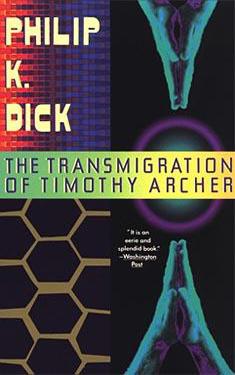
The Transmigration of Timothy Archer - Philip K. Dick


Just finished reading Philip K. Dick's The Transmigration of Timothy Archer (1982), published posthumously. (For those who may not know, transmigration is "the religious or philosophical concept that the soul or spirit, after biological death, begins a new life in a new body that may be human, animal or spiritual depending on the moral quality of the previous life's actions.")

The novel is set in the 1960s and 1970s, and follows the descent into drug addiction, radical religion, and madness of a deeply entwined but unhappy circle of five friends - intelligent but lonely Angel Archer, "professional student" at Cal Berkeley and poetic grass fiend, her disaffected husband, Jeff, whose maniacally intensive study of Wallenstein and Hitler becomes a pointless bid for his father's attention, Jeff's father, the dreamy but brilliant Bishop Timothy Archer, who unwittingly destroys himself and his friends, the Bishop's secret lover, the spiteful barbiturate addict Kirsten, and Kirsten's angelic son, the schizophrenic Bill.

The action begins on the day of John Lennon's death, with Angel's attempts to make sense of the "retributive fate" which has enveloped her life and destroyed those closest to her. For all this darkness, the book is a fairly light read, with some good humorous bits. For Philip K. Dick enthusiasts, it is also an interesting window into his thoughts in later years, and perhaps his most mature piece of writing. Although the repetitive nature of some of the lines was at times tedious for me, I believe it was a deliberate stylistic choice to evoke the obsessive nature of Angel's thoughts, and was effective for that purpose.

Bishop Archer's darkly comic misadventures are in fact based on the doings of the unfortunate Bishop James Pike - definitely worth reading a bit about that man, although save it for after you've read the novel - spoiler alert!