Showing posts with label video games. Show all posts
Showing posts with label video games. Show all posts
Wednesday, July 8, 2015
The Peripheral - William Gibson
The Peripheral is Gibson's most recent novel, and it did not disappoint. The tale opens in a a world that appears to be our near future, the logical extension of our society's tendency to favor technological advancement amidst crumbling physical infrastructure. The increasingly unstable economy is marked by intensified monopolization, and the average person can only get wealthy by "funny" means - "building" (producing and selling drugs), or "fabbing" (3D printing) prohibited items. Our morally-conscious protagonists - a wounded special ops veteran named Burton and his spunky sister, Flynne - choose instead to eke out a living by playing security forces in a video game for a mysterious employer. It is during one of these gaming sessions that Flynne becomes sole witness to a gruesome murder, an event that ignites a series of radical changes in their lives and world. The novel is ultimately set in two futures, whose inhabitants are able to influence each other by means of shared "peripheral" technology. Fascinating stuff, as always!

Friday, August 2, 2013
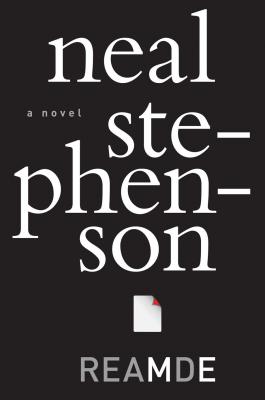
REAMDE by Neal Stephenson
 Just finished reading Stephenson's 1000-something page novel, REAMDE, which was amazing. (Excellent overview by Colin here: http://blogenburyisreading.blogspot.com/2011/12/neal-stephenson-reamde.html?m=1).
Stephenson has the impressive ability to weave together a host of characters and circumstances which, in the hands of a lesser author, would feel they had been chosen by a random word generator: jihadists, MMORPG, computer virus, British spy, Russian mafia, ski resort, Wikipedia. Well, maybe they do have a theme: it sounds like a James Bond movie, but without the glamour, and set against the new realities of postmodernity: the digital age and the international War on Terror.
Stephenson is truly a great author: each section of the book is told from the perspective of one of a handful of key characters, and each has a distinctive and authentic tone. Although the book plays like an action movie and largely examines the meaning of life as experienced in the scopes of a rifle, the detailed attention to psychology and the richness of the world feel (almost) Tolstoyan. (Making the Acknowledgments page quite interesting, since he lists areas of expertise, such as guns, which are seamlessly integrated into the plot, yet evidently draw heavily upon the knowledge of others.)
Although set in the present (near future?) and so less earthshatteringly visionary than The Diamond Age, I preferred this to Snow Crash and definitely recommend.
Stephenson's Novels
- The Big U (1984)
- Zodiac (1988)
- Snow Crash (1992)
- Interface (1994)
- The Diamond Age: or A Young Lady's Illustrated Primer (1995)
- The Cobweb (1996)
- Cryptonomicon (1999)
- The Baroque Cycle
- Quicksilver (2003), volume I
- The Confusion (2004), volume II
- The System of the World (2004), volume III
- Anathem (2008)
- The Mongoliad (2010–2012)
- Reamde + Colin's review (2011)
Friday, July 12, 2013
Ernest Cline's Ready Player One

WOW! My bookclub's most recent pick was Ready Player One, and I read this thrilling 372-page sci-fi novel cover to cover over the last several hours. Talk about a page-turner! I won't give away the main quest driving the plot, but suffice to say, it is action-packed and awesome.
The experience of reading this book was very self-indulgent for a cyberpunk nerd like myself -- it is a book about otaku, for otaku, and it has the works: a post-apocalyptic wasteland where everyone with enough money for a visor and "haptic gloves" escapes the filth and squalor of our used-up Earth via a full-dive VR universe called OASIS; brilliant teen hackers; a soulless corporate entity in full villain mode; and, in an unusual twist on your typical sci-fi novel, endless real-world references to obscure sci-fi, video games, and everything 1980s.
The British newspaper The Observer says that the otaku is "the passionate obsessive, the information age's embodiment of the connoisseur, more concerned with the accumulation of data than of objects." In Ready Player One, and in many nerd subcultures IRL, a player's ability to amass vast knowledge of game-related trivia is a sought-after mark of authenticity, and a status symbol within the group.
In one early scene, our ridiculously erudite, but chronically poor and therefore low-level hero, Perzival, spars with the braggart I-r0k in a VR chat room, about what it takes to be a "gunter" (egg hunter, or elite gamer):
"Poseur."
"Poseur? Penis-ville is calling me a poseur? ...This chump is so broke that he has to bum rides to Greyhawk, just so he can kill kobolds for copper pieces! And he's calling me a poseur!"
..."That's right, I called you a poseur, poseur." I stood up and got in his grille. "You're an ignorant know-nothing twink. Just because you're fourteenth-level, it doesn't make you a gunter. You actually have to possess some knowledge."
As Perzival's friend Aech would say, "Word."
This novel is recommended for everyone, but especially if you like:
- Stephenson's Snow Crash
- Sword Art Online (anime TV series)
- Gibson's Idoru
Wednesday, December 28, 2011
Neal Stephenson - Reamde
In Stephenson's oeuvre, Reamde, despite its 1056 pages, is light reading. This is not necessarily a bad thing. The man is a master of plot construction, not in terms of technical complexity but rather in terms of sheer engagement: he gets those pages turned. The novel's most striking feature is its action sequences, in which Stephenson shows off his impressive gunfight-choreography chops.
 The novel's cyberpunk elements center around the computer game T'Rain (the fictional successor to the online hegemony of World of Warcraft), whose most salient characteristic its elaborate economy, based on a virtual-gold standard whose integrity is ensured by an elaborate geological simulation which determines the location of deposits of ore within the game world. The game is designed to exploit, rather than be exploited by, the existence of "gold-farmers," or kids in China who perform repetitive in-game actions (or grinding) in order to harvest virtual items and currency that they can then sell to rich Westerners - a real phenomenon in games like WoW. Stephenson's picture of how this all works is really quite ingenious, and somehow constitutes both a more sophisticated version and elaborate parody of early cyberpunk depictions of the function of virtual spaces in the global economy, like Stephenson's own depiction of the "Metaverse" in Snow Crash.
A series of elaborate coincidences embroil the creator of this game, the draft-dodging black sheep of a gun-toting Idaho clan, and his adopted Eritrean refugee niece in a globe-trotting hostage plot involving Islamic terrorists and Russian organized crime; all of which is much too complicated to even begin to explain here. Suffice to say that the entire thing is incredibly entertaining, and the characters are extremely well-written: I thought that the terrorist Abdullah Jones, a suave Black American convert, was a particularly intriguing figure.
In Reamde, Stephenson dials down the whole "novel of ideas" business and writes a fairly straightforward thriller that delivers exactly what it promises and in fine style. The Stephensonian themes are all here, but muted and lighthearted in a way that I think is actually a very good artistic move, especially following the somewhat more ponderous (but very good) Anathem. If nothing else, the book makes me wistful for a world in which the rest of the bestseller list was even a fraction of Reamde's quality.
I would recommend the book, but read the essential Stephenson first: Snow Crash, The Diamond Age, Cryptonomicon.
Stephenson's Novels
- The Big U (1984)
- Zodiac (1988)
- Snow Crash (1992)
- Interface (1994)
- The Diamond Age: or A Young Lady's Illustrated Primer (1995)
- The Cobweb (1996)
- Cryptonomicon (1999)
- The Baroque Cycle
- Quicksilver (2003), volume I
- The Confusion (2004), volume II
- The System of the World (2004), volume III
- Anathem (2008)
- The Mongoliad (2010–2012)
- Reamde + Colin's review (2011)
Subscribe to:
Posts (Atom)