Showing posts with label France. Show all posts

Thursday, June 9, 2016

All the Light We Cannot See

This book by Anthony Doerr is written simply, but with the emotional power and magical intensity of a fable or fairy tale. The book is set in World War II and centers on two main characters, a blind French girl and a talented young German soldier, who are eventually drawn together and meet in the walled city of St. Malo. The structure is a little unusual, with short chapters that switch from one character to another and back in forth in time, getting closer and closer to the moment of meeting.  

There's a very interesting interview with Doerr that was published in the Powell's Book Blog.   At one point, the interviewer, in asking him about the short chapters, says perhaps they "can allow for more lyricisms and/or experimentation with language in some ways than longer chapters because you get that cessation. Doerr agrees that his writing in this novel is very lyrical and says "I know that's demanding, so this was a gesture of friendliness, maybe. It's like I'm saying to the reader, "I know this is going to be more lyrical than maybe 70 percent of American readers want to see, but here's a bunch of white space for you to recover from that lyricism." [Laughter].


The story and characters are so captivating that All the Light We Cannot See is hard to put down.  When I had finished and was thinking over the book, it seemed to me that it differed from many books in that it had no strong themes.  One line spoken by a character in the book has been repeatedly quoted by readers and reviewers:  “Open your eyes and see what you can with them before they close forever.”  The title and this statement clearly relate to the blind girl, but I finally came to feel that they also describe a central "theme"of the book: that life is magnificent; joyous and heartbreaking, meaningful and random, kind and cruel. Although Doerr is not Tolstoy, and All the Light We Cannot See is not War and Peace, the power of the writing nevertheless grips us and invites to embrace the variety of life.


Sunday, January 18, 2015

The Werewolf of Paris - Guy Endore

I am delighted to have discovered Endore's 1933 The Werewolf of Paris via Mark, who found an old copy in a thrift store and thought it sounded like something I would enjoy. Did I ever! It is written in an extremely charming and engaging style. and vividly describes life in Paris in the 1870s.

The novel begins with a frame story in which a young, penniless scholar discovers a manuscript documenting the trial of the young army officer, Bertrand Caillet, who has been charged with violently attacking a fellow officer. The manuscript is the work of Bertrand's uncle, Aymar, who tries desperately to convince the Court that Bertrand, a werewolf, ought to be burned at the stake for the greater good. This assertion, of course, is anathema in the age of reason.

Aymar is a compelling character: a former revolutionary skeptic whose experiences with the boy have convinced him that there is more to the world than modern science would lead us to believe. In making his case for the existence of the supernatural, Aymar argues: "Let us beware of judging hastily. The Catholic Church is said to have burned 300,000 witches, until the world exclaimed in horror: 'What gross superstition! There are no witches.' And truly there were none. At any rate there were no more."

I am amazed that this work has never been made into a movie, it would be a wonderful one.

Saturday, August 23, 2014

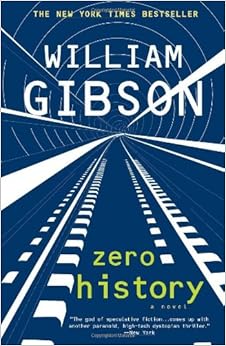
Zero History - William Gibson

Finally finished the last book in Gibson's Blue Ant/Bigend trilogy. Liked this much better than Spook Country, even though the protagonist was again Hollis Henry, whom I do not particularly care for (she is flavorless and lovelorn, snooze).

In this work, a mysterious line of wondrously simple denim clothing called "Gabriel Hounds" catches Bigend's eye for their innovative use of secrecy in marketing, and he hires Hollis to identify the brand's creator. When Hollis objects she is hardly the best person for this job, suggesting instead someone who might understand the fashion world better, Bigend replies, "But that's exactly it. Because they 'understand all that' they won't find the edge. They won't find the new. And worse, they'll trample on it, inadvertently crush it, beneath a certain mediocrity inherent in professional competence." Bigend is an immensely compelling figure, who prides himself on his ability to always select the exact right person for a given job... makes me wish I could work for someone like him!

Hollis' partner in the search for the Hounds' creator is Bigend's rescued drug addict, hyper-alert and sensitive Russian translator Milgrim, who has been put to work researching military uniform contracts. Of course, working for Bigend means being swept up in his machinations, and this tale follows the ensuing drama.

Always a pleasure to read Gibson, and now I've read his entire works!

The Sprawl Trilogy:
The Bridge Trilogy:
The Bigend Books:

Sunday, June 15, 2014

Of Human Bondage - Maugham

After reading Dad's review, I decided to check out Maugham's Of Human Bondage. It was a very interesting tale of a neurotic young man afflicted with a clubfoot, and his coming of age in England and France during the late 18 and early 1900s. Although it starts off fairly slowly (the tale begins in Philip's youth), it builds powerfully and is a very captivating read.

I don't have much to add to Dad's review, except to say that it is filled with interesting bits of Philip's evolving philosophy, such as when he thinks:
Society had three arms in its contest with the individual: laws, public opinion, and conscience; the first two could be met by guile, guile is the only weapon of the weak against the strong... but conscience was the traitor within the gates; it fought in each heart the battle of society, and caused the individual to throw himself, a wanton sacrifice, to the prosperity of his enemy.

Sunday, October 25, 2009

A Year in Provence

Light, wry, humorous and filled with an appreciation of humanity. A sweet read. Highly recommended

Friday, August 21, 2009

When You Are Engulfed In Flames

Finished reading David Sedaris' "When You Are Engulfed In Flames." If you are a Sedaris fan, as I am, then this is a good book for you. The last book of his that I read was "Me Talk Pretty One Day," which I recall as being side-splittingly funny. This one didn't have me rolling on the floor, but it was pleasurable and funny with his characteristic sense of offbeat, awkward humor.

Sedaris describes his life in France and in Tokyo and his language misadventures. He humorously chronicles his struggles to come out as gay and to quit smoking. The NYT Book Review on the jacket fairly calls it "A delightful compilation of essays circling the theme of death and dying, with nods to the French countryside, art collecting, and feces."

I would reccommend.