Sunday, February 28, 2021
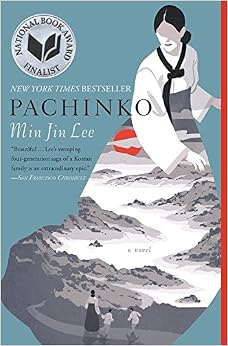
Pachinko - Min Jin Lee
Saturday, November 14, 2020
Slaughterhouse Five
Kurt Vonnegut’s voice is exceptional. The main themes of Slaughterhouse Five are deadly serious, yet the story is rich in humor, both simple and mordant, and has a unique viewpoint that features time travel and intelligent aliens. It’s a perplexing yet commanding combination. The narrator of the frame story is Vonnegut himself, who was a prisoner of war and one of the very few survivors when Dresden was firebombed in World War II. But the protagonist is Billy Pilgrim, who travels in space and time with a view of his entire life. Billy witnesses innumerable deaths, each commemorated by “So it goes”, from his unique whole-life perspective. Fascinating, thought provoking, outrageously funny and heart-rendingly sad by turns.
Monday, October 19, 2020
Love and War in the Apennines
Newby's story, then, describes his experiences of being harbored by the Italian farmers and mountain people who, at great risk to themselves, assisted him, out of their admirable humanity and because they hated the Fascists. Newby is humbled by their courage and generosity and views his experiences with sympathy and humor.
Here are a couple examples of the humor:
Drink and supplementary food were bought on the black market, which was even more extensive and better organized than it was in Britain, and a special float of Red Cross cigarettes was kept for this purpose, and for the general corruption of the Italian camp staff, by responsible members of the British administration, ex-bank managers mostly, to whom this sort of thing was second nature.
She used to tell me the latest news about my friends………how one officer whose identity I never discovered had been hidden in the castello of a local principessa who had been so impressed by his girlish face that she had the brilliant idea of dressing him as a young woman of fashion and putting him on a train to Switzerland. This she had done but, unfortunately, he looked so desirable on the train that some soldiers had “interfered” with him, as the News of the World used to put it, and discovered the truth, although one of them got punched hard on the nose in the process of doing so.
And, in an example of the humanity and generosity of the Italian country people, one evening, a few days after the Germans had made a surprise raid to search for hidden enemy soldiers or Italian deserters, Newby was invited to a dinner with some important people in the town. This was dangerous and he had to take special care to arrive unseen.
I was motioned to take a seat and a glass of wine was poured for me. There was no small talk. The Chairman of the Board, for that was obviously what he was, said carefully and very slowly so that I could understand, "We have been talking about you among ourselves for some days. Many of the people in this village and in the farms round about have sons and relatives who are being hunted by the Germans. Three of them were taken the other day. Some of them have sons in Russia of whom, so far, there is no news and who may never return. They feel that you are in a similar condition to that of their sons who, they hope, are being given help wherever they are , and they think it is their duty to help you through the coming winter, which otherwise you will not survive. I speak for them because my father was born here, and they have asked me to do so. And as it has now become too dangerous to shelter you in their houses, they have decided to build you a house which no one except the people assembled in this room, our families and one other person, and he is a kinsman, will ever hear about. The work will begin at dawn tomorrow".
The descriptions of where the home was to be located and how it was built are extraordinary. A truly wonderful book.
Saturday, March 7, 2020
But the ships are sailing....sailing..... by Chiyono Sugimoto Kiyooka
Sunday, January 26, 2020
Logicomix
Thus, Russell's earliest passions were to discover hidden truths, with certainty, which drove his interest in logic. He spent roughly a decade collaborating with Alfred North Whitehead in developing a logical basis for arithmetic, with the goal of placing mathematics on a secure foundation. Although the methods they developed in their Principia Mathematica were highly influential, they never succeeded in their goal and Russell felt that this effort had been a failure. Eventually, as recounted in this book, Kurt Gödel relied heavily on the methods of Russell and Whitehead, to prove conclusively that the effort to axiomatize arithmetic is inherently flawed. John von Neumann was in the audience when Gödel presented this work, and famously said "It's all over".
Russell was also a passionate pacifist, and the human cost of the wars and revolutions of the 1900's is a second major theme of the story, serving to underscore the tension between rational versus emotional or ideological approaches to human interaction. The authors appear in the book as themselves, discussing the ideas and themes and, especially, how the book should end. So as not to spoil the ending, I will simply say that the authors and illustrators attend a performance of the Oresteia, and draw conclusions from the ending of the play, which is visually exciting and emotionally powerful. A very interesting and thoughtful book....and I am now reading the Oresteia!
Sunday, June 5, 2011
A Fierce Radiance
Sunday, September 6, 2009
The Zookeeper's Wife
Thursday, November 13, 2008
The Boys' Crusade

Our local library has several savvy librarians - and one happy consequence is that I frequently see books that interest me on one of the "Staff Selections" racks. In this way, I was attracted to The Boys' Crusade by Paul Fussell, an account of the very young men (as the title suggests, really boys) who fought in northwestern Europe during the late stages of World War Two. Having just finished the Orwell book, it also seemed interesting to hear another perspective on life on the front lines.
Well, Orwell's book was clear-eyed, but he saw little actual combat. Fussell's short book, though very well-written, and light on rare occasions, is largely grim:
Now, almost sixty years after the horror, there has been a return, especially in popular culture, to military romanticism, which, if not implying that war is really good for you, does suggest that it contains desirable elements - pride, companionship, and the consciousness of virtue enforced by deadly weapons. In this book I have occasionally tried to confront this view with realistic details. Some readers may think my accounts of close warfare unjustifiably pessimistic in implication, but attention to the universal ironic gap between battle plans and battle actualities will suggest the ubiquity of much of my joyless material. There is nothing in infantry warfare to raise the spirits at all, and anyone who imagines a military "victory" gratifying is mistaken.As this quote indicates, Fussell is a masterful writer - among his other books are Theory of Prosody in Eighteenth-Century England, Poetic Meter and Poetic Form, and Samuel Johnson and the Life of Writing. All his talent is evident here, forcefully illustrating the horror of war. Not so much the carnage, though there are some vivid descriptions of that, but especially the utterly terrifying and hopeless situations into which so many of these boy recruits were thrust. Not a light read, but powerful and great.
At any rate, there was a distinct difference between American and German reactions to the desertion impulse, which any soldier must have felt occasionally. In the American army, the idea of soldiers running away was considered as not unlikely: thus the institution in infantry platoons of the guide sergeant in the rear, whose duty (never discussed) was to catch and dissuade youngsters reacting to a powerful impulse to run to the rear. In the German Army, such soldiers would be shot on sight. The difference is surely one of the things the war was about.


