This book was fun. The same energy (humorous outerspace swashbuckling) as The Martian, but with a cyborg murderbot as the protagonist. A very quick and enjoyable read.
Showing posts with label sci-fi. Show all posts
Showing posts with label sci-fi. Show all posts
Wednesday, August 10, 2022

Sunday, July 31, 2022
A Memory Called Empire - Arkady Martine
A Memory Called Empire was phenomenal. My favorite genre of sci-fi is cyberpunk, and although this was not that, and was more a traditional Star Trek- or Ursula K. LeGuin-style exploration of cultures intersecting in outer space, this did have my favorite cyberpunk trope, of stacks and sleeves (or wetware and hardware, or whatever you want to call it -- importing one's consciousness into a new vessel). This novel uses a form of this trope I particularly enjoy, a la Jadzia Dax, where the individual's consciousness merges with that of their predecessor, forming a new hybrid individual. In Memory, this technology is called an 'imago line,' which citizens on Lsel Station use to covertly preserve the knowledge, personality, and memories of generations.
In this work, Mahit is the new Lsel Ambassador to the Empire, appointed after her predecessor, Yskandr, dies under suspicious circumstances. Mahit is fitted with Yskandr's imago, which should give her the benefit of his expertise, but it's missing 15 years of his experiences, and then mysteriously stops functioning at all, leaving her entirely alone and unsupported on an alien planet. Mahit must rely upon her own instincts (and some unlikely allies) to navigate the politics of the imperial court, investigate Yskandr's demise, and preserve the independence of Lsel Station -- all against a backdrop of increasing civil unrest in the imperial City.
A brilliant, exciting, authorial debut, written by an author with a passion for poetry and linguistics, which deepen and enrich this political space opera. Highly recommend!!
Sunday, July 17, 2022
Gideon the Ninth
Gideon the Ninth was... interesting. In this gory sci-fi/fantasy, necromancers from nine Houses compete to become Lyctors: powerful sorcerers in the service of the necromantic God. With the aid of their loyal sword-wielding partners (cavaliers, or "cavs"), the necromancers must complete a series of brutal challenges. The hero of the story is Gideon Nav, a red-haired, foul-mouthed, ass-kicking lesbian, and reluctant cav to Harrowhark, a sadistic and tight-lipped female necromancer of the Ninth House. Each House has its own flavor; the Ninth has a gothic vibe and is known for its secrecy and bone magic (perhaps the most creative device in the book).
The concept of this story intrigued me, and the action was very exciting. However, I found it impossible to keep track of the 16+ characters (I missed the character summaries at the end of the book, which would have been really helpful). I was also disconcerted by the author's penchant for inserting modern slang into the mouths of her otherworldly characters. Finally, I was not satisfied with the answer to a central mystery, which struck me as very abrupt and contrived.
In the final assessment, I enjoyed the read, but would likely not continue with the next books in the series.
Thursday, January 6, 2022
Senlin Ascends Tetrology - Josiah Bancroft

At Terra's suggestion, I recently finished the BRILLIANT 4-book Babel series by Josiah Bancroft. These were easily the most creative, exciting, and compelling books I've read in a long while. The books are set in a familiar yet distinctly different world from our own, one where the major cultural epicenter and tourist attraction in the land of Ur is the famed Tower of Babel! Pedantic and rule-loving headmaster Senlin brings his quirky and beautiful young wife to visit the Tower on their honeymoon, but swiftly discovers it is far, far different from the orderly citadel of culture he had imagined! Our unlikely hero rises to meet the occasion via the most satisfying character development I've maybe ever read.
This book defies genre classification -- perhaps it's best seen as a swashbuckler, but this epic straddles fantasy, adventure, sci-fi, steampunk, comedy, and romance. A thrilling read for over a thousand pages! Moreover, Bancroft is so creative, and so rich in interesting observations on life, love, and friendship, that he crams within one book more insights than most authors can hope to share in their entire opus. Destined to become a classic, and should be read by all.
Wednesday, January 13, 2021
To Be Taught if Fortunate - Becky Chambers

Besides Ursula K. LeGuin, Octavia Butler, and Madeline L'engle, I don't know that I've read many female science fiction authors, which is too bad, since it's one of my favorite genres. I don't know that I would say the author's gender was really relevant to this book, though I did find it interesting that in one passage the main character (who is also a woman) muses that
"We astronauts are taught to compartmentalize the realities of flight. [And the fact that everyone you know will be dead when you return.] ...You wonder if you're a bad daughter, a bad friend, a selfish asshole placing her own intellectual wankery above the living, breathing people who poured everything they could ever give into her, and were rewarded with the sight of her walking away forever."
I don't think I've heard this sentiment much in the male-centered space exploration stuff I've read, and it struck me the extra pressures women explorers face, since we are usually expected to be caregivers for elder family, etc. -- more guilt and conflict there. So I found that interesting.
Anyway, all in all, a good book for the new year.
Thursday, August 22, 2019
The Sparrow - Mary Doria Russell
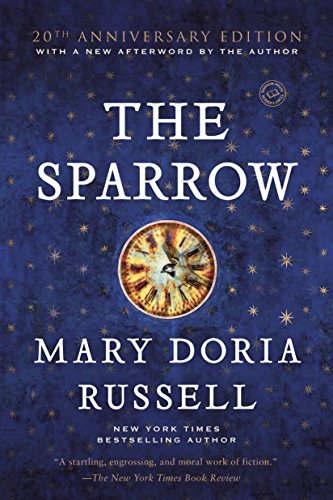
The story is told from both ends - an idealistic Jesuit monk bonding with his close-knit group of friends, and this same monk, broken almost beyond recognition, after his return from a first-contact mission gone horribly awry.
I don't want to say too much lest I spoil anything, but this is definitely a first-rate book, which I highly recommend! It is rough but very powerful and poignant.
Jesse's review here
Dad's review here
Thursday, August 16, 2018
Station Eleven - Emily St. John Mandel
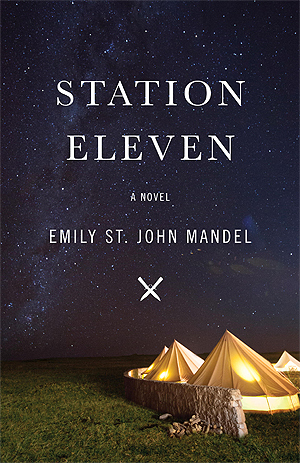
Station Eleven is a highly sensitive portrayal of human character, in all its beauty, ugliness, vanity, and complexities, and a compelling envisioning of what our post-apocalyptic society might look like.
I especially enjoyed the scenes with Miranda, whose magnum opus is the eponymous comic book series, Station Eleven. Her art is described in vivid terms, and its themes of isolation, longing, and exploration prefigure and contextualize the novel's broader themes.
Definitely recommend!
Friday, June 16, 2017
Childhood's End - Arthur C. Clarke
In Childhood's End, futuristic alien spaceships suddenly appear over major cities all over the world. Although the alien "Overlords" do not exit the ships, they issue a few dictates to humanity (such as the prohibition on harming animals), and allow a single human representative, UN Secretary Stormgren, to board the ship every few weeks and talk to their Alien "Supervisor," Karellen, through a voice apparatus. Mostly through gentle guidance, the aliens reshape earth's civilization entirely - there is no more crime or violence, everyone's basic needs are met, and the populace is free to live a life of idle pleasures. However, this has deleterious effects on human culture - the arts stagnate, and intellectual pursuits are cramped. Some members of human society want to rebel against the overlords, and especially, to at least SEE one of them.
This book is written in a charmingly writerly style evoking the time in which it was written (1953), but the ideas are entirely original, and some of the technology and concepts still feel futuristic today.
Would recommend!
This book is written in a charmingly writerly style evoking the time in which it was written (1953), but the ideas are entirely original, and some of the technology and concepts still feel futuristic today.
Would recommend!
Wednesday, April 26, 2017
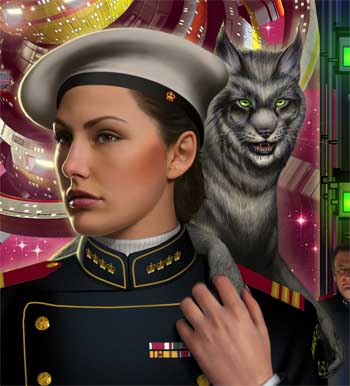
On Basilisk Station - David Weber
Monday, February 20, 2017
Kindred - Octavia Butler
Kindred is unlike anything I have read before. Set in the 1970s, it is the tale of a modern Black woman living in California who suddenly begins to experience involuntary time travel episodes to antebellum Maryland. Each time Dana is transported to the past, she arrives at a moment of extreme peril for a young plantation owner's son named Rufus Weylin. Repeatedly saving Rufus' life leads them to develop an unlikely bond, but as Rufus gets older and takes over running the plantation (and its many slaves), and as Dana gets sucked into the past for longer and longer stays, she learns first-hand the ugly realities of slavery and the complexity of the relationships it breeds. A truly remarkable and original tale, offering a very compelling first-person account of a cruel and strange time in American history. Powerful and a must-read, in my opinion.
Sunday, February 19, 2017
The Dispossessed - Ursula K. LeGuin
For Bookclub this month, we are reading two sci-fi novels by female authors: The Dispossessed (1974), by Ursula K. LeGuin, and Kindred (1979), by Octavia Butler. Both are tremendous!
The Dispossessed is the story of Shevek, a brilliant physicist and revolutionary from Anarres, a moon isolated from its homeworld, Urras, since its settlement by anarchist colonists 179 years ago. Although Anarresti society still largely lives by the teachings of its founder, Odo, Shevek and his friends progressively observe how their freedom has become cramped by bureaucracy and social constraints. Shevek ultimately determines that the only way to achieve his physics masterwork and heal his society is to make an unprecedented journey to Urras, to share his science and reunite the two worlds.
I really enjoyed Shevek's character, and his zeal for the Odonian way of thinking. Many of Odo's quotes have great attraction for me, as well. For example:
"A child free from the guilt of ownership and the burden of economic competition will grow up with the will to do what needs doing and the capacity for joy in doing it. It is useless work that darkens the heart. The delight of the nursing mother, of the scholar, of the successful hunter, of the good cook, of the skilful maker, of anyone doing needed work and doing it well, - this durable joy is perhaps the deepest source of human affection and of sociality as a whole."
All in all, a fascinating, surprising, and gripping tale.
Wednesday, August 24, 2016
Aurora - Kim Stanley Robinson
Aurora is KSR's latest novel, published in summer 2015, and the only other book of his that I have read, other than the genius Mars trilogy. Aurora is just as delightful, and satisfyingly familiar in tone, with its hyper-detailed yet highly readable descriptions of technology, and the incisive and compelling character depictions, which elevate the book from tech porn to high literature.
Aurora is the story of a generation of families born on a spaceship in the middle of a 159+ year colonizing trip to Tau Ceti, led at this point in their journey by brilliant yet troubled scientist Devi, who keeps their aging vessel in working order through hundreds of daily repairs. Unlike Mars, with its numerous protagonists, this novel focuses primarily on Devi and her daughter, Freya. In a unique and engaging narrative twist, the tale's chronicler is the ship itself, an AI called simply "ship."
The action begins in Freya's youth and young adulthood, in the final years of the journey to Tau Ceti. A deeply interesting and moving tale, which I highly recommend to all sci-fi enthusiasts!
Aurora is the story of a generation of families born on a spaceship in the middle of a 159+ year colonizing trip to Tau Ceti, led at this point in their journey by brilliant yet troubled scientist Devi, who keeps their aging vessel in working order through hundreds of daily repairs. Unlike Mars, with its numerous protagonists, this novel focuses primarily on Devi and her daughter, Freya. In a unique and engaging narrative twist, the tale's chronicler is the ship itself, an AI called simply "ship."
The action begins in Freya's youth and young adulthood, in the final years of the journey to Tau Ceti. A deeply interesting and moving tale, which I highly recommend to all sci-fi enthusiasts!
Monday, April 18, 2016
Red Rising - Pierce Brown

 |
| "I's looking behind us now, into history back." |
Personally, I thought the movie Hunger Games was insipid, but I would recommend this book to HG fans, and any other survival enthusiasts.
Old Man's War - John Scalzi

Altered Carbon - Richard K. Morgan

I read Rudy Rucker's Software not long ago, so Morgan's elaboration of the consciousness-divorced-from-physicality concept was a nice "sequel." I was especially intrigued by his portrayal of the ugly consequences of wealth inequality, in a world where the technology of immortality is largely limited to the economic elite. (Kim Stanley Robinson's Mars trilogy also fruitfully explores this issue.)
I will definitely be checking out the other Takeshi Kovacs novels!
Wednesday, November 18, 2015
Freeware

Monique was a moldie: an artificial life form made of a soft plastic that was mottled and veined with gene-tweaked molds and algae.Freeware starts with a diagram of the family trees of the main characters in the four books, including Staun "Sta-Hi" Mooney, who, after his outlandish adventures in Software, is mentioned in Freeware as the author, while serving as Senator of California, of the Moldie Citizenship Act. Other entries in the family trees and in the story include additional moldies and aliens with exceptional body forms and life experiences.
Unfortunately, I didn't find Freeware to be nearly as intriguing as Software. There was less humor, less interesting consideration of life forms and consciousness, and a lot more really outlandish stuff that I couldn't connect with. Oh well.
Wednesday, July 8, 2015
Seveneves - Neal Stephenson
Stephenson's fascinating new sci-fi novel, Seveneves, reads much like Kim Stanley Robinson's Mars trilogy in its realistic and highly-detailed portrayal of space exploration technology. The novel opens when an unknown force - the Agent - causes our Moon to explode. After a period of global bafflement, American scientist and media personality Doc Dubois realizes that the moon's fragmentation will continue exponentially, ultimately causing a Hard Rain of meteorites to obliterate the earth's service in a terrible holocaust lasting thousands of years. Scientists all over earth come to the same conclusion within a matter of weeks, and the entire world's resources are dedicated to preparing to save as many humans as possible by getting them onto a space station, along with earth's genetic data. If this feels like a spoiler, it's not, this merely sets the stage for all the action that unfolds from there! About the latter third of the book is dedicated to even more radical extrapolation from these initial conditions... Very unique and thought-provoking.
Stephenson is a brilliant social critic, and his book is rich with insights and neologisms like "amistics" -
Stephenson is a brilliant social critic, and his book is rich with insights and neologisms like "amistics" -
"choices that different cultures made as to which technologies they would, and would not, make part of their lives. The word went all the way back to the Amish... who had chosen to use certain modern technologies, such as roller skates, but not others, such as internal combustion engines. All cultures did this, frequently without being consciously aware that they had made collective choices."Highly recommend!
Thursday, May 14, 2015
Dawn - Octavia Butler

This was also the first book I'd read by Octavia Butler, a talented African American female sci-fi author (her Wikipedia page here).
Software - Rudy Rucker
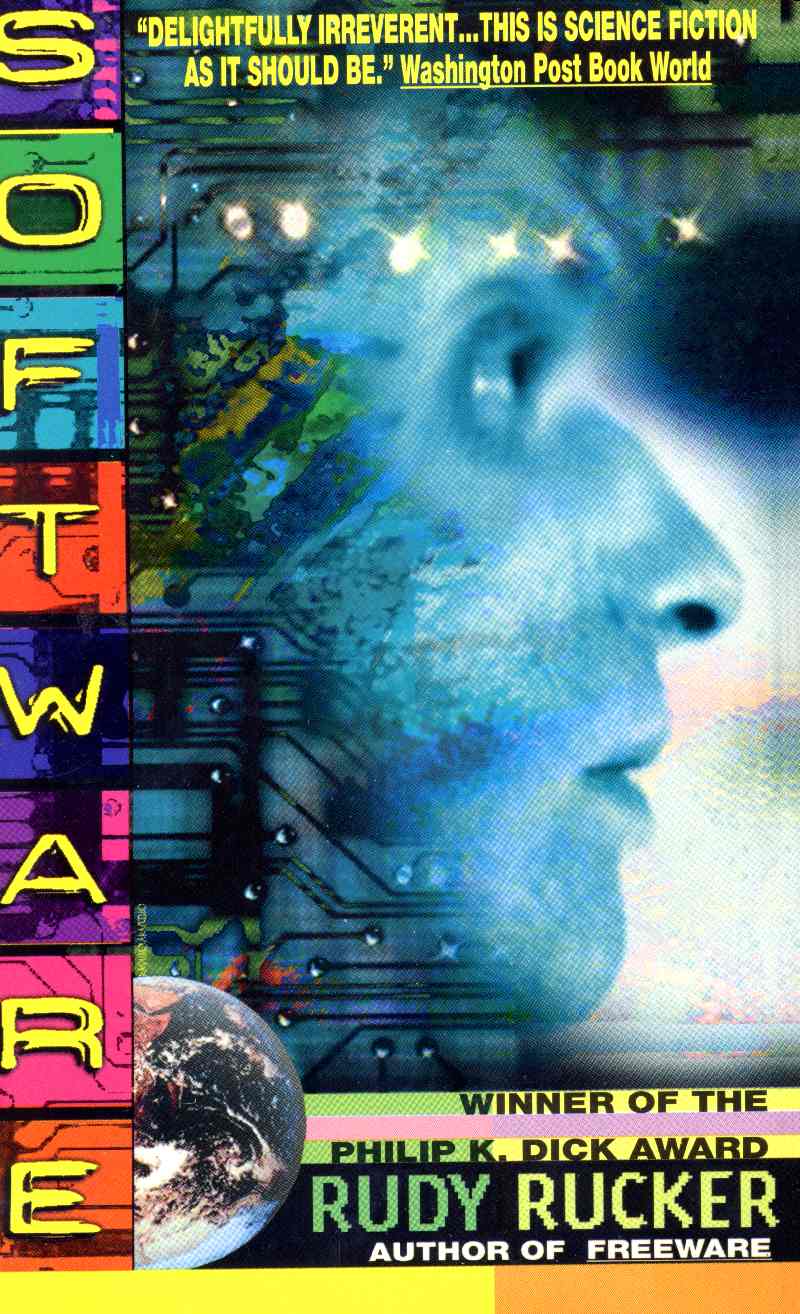
This exciting and compelling novel explores the meaning of humanity and the potentially transformative power of technology through the colorful exploits of Cobb and his junkie side-kick, the flamboyant and foul-mouthed "Sta-Hi."
It deals with similar questions as do Bicentennial Man and Ghost in the Shell - what really makes someone a human? What is it that we experience as the self? In my bookclub, we call this latter question the "phone booth" problem (one description of this thought experiment here).
"You wanted to know who I am. I gave you one answer. A robot-remote. A servo-unit operated by a program stored in a bopper spaceship. But... I'm still Misty-girl, too. The soul is the software, you know. The soft ware is what counts, the habits and the memories. The brain and the body are just meat, seeds for the organ-tanks."I will definitely look forward to reading the second and third parts of this trilogy, and thanks to my IT friend Josh for the recommendation! (By the way, there are versions of these books on Rucker's website, but some of the more graphic language/brutal phrasing seems to have been edited out in those versions.)
Saturday, January 17, 2015
Red Planet - Robert Heinlein

Written in 1949, the novel is reminiscent of a Hardy Boys style adventure, but the ideas are refreshingly modern (with the exception of the frequent sexism, which tends to mar the quaint tone). Still, a charming book with an interesting conception of alien life.
Also, Willis was so cute!
 |
| Some artist's conception of Willis |
Subscribe to:
Posts (Atom)