Showing posts with label detective. Show all posts

Tuesday, May 28, 2019

The Blessing Way and Dance Hall of the Dead - Tony Hillerman

Over Memorial Day weekend, my friends and I went camping, and I finally had some time to relax and read. Inspired by dad, I decided to give Tony Hillerman a try, and I'm glad I did! I read the first two of his Navajo country murder mysteries, The Blessing Way (1970) and Dance Hall of the Dead (1973).

I really enjoyed these novels, particularly the worldview conveyed by the protagonist, Navajo sheriff Joe Leaphorn:

"Leaphorn never counted on luck. Instead he expected order—the natural sequence of behavior, the cause producing the natural effect, the human behaving in the way it was natural for him to behave. He counted on that and upon his own ability to sort out the chaos of observed facts and find in them this natural order. Leaphorn knew from experience that he was unusually adept at this. As a policeman, he found it to be a talent which saved him a great deal of labor. It was a talent which, when it worked unusually well, caused him a faint subconscious uneasiness, grating on his ingrained Navajo conviction that any emergence from the human norm was unnatural and—therefore—unhealthy. And it was a talent which caused him, when the facts refused to fall into the pattern demanded by nature and the Navajo Way, acute mental discomfort."

When I read this passage, I was strongly reminded of a quote by Hercules Poirot in the film version of the Murder on the Orient Express -

"I can only see the world as it should be. And when it is not, the imperfection stands out like the nose in the middle of a face. It makes most of life unbearable. But it is useful in the detection of crime."

I'm not sure if this characterization reflects a shared reality among talented detectives, or whether it is a purely literary conceit, but I thought this parallel was interesting.

The books also treat fairly extensively on Navajo culture and religion, its beliefs, and its rituals. My experience with Native American culture, and Navajo culture in particular, is fairly limited, so I was very interested in the insights from these works. (Although Hillerman is White, it seems he was was considered a true friend of the Navajo people and an excellent student of their culture, and his books, although works of fiction, are evidently praised for their accuracy in this regard.)

Finally, I really enjoyed the depictions of nature, and especially the scenes where Leaphorn applies his skilled tracking abilities to locate missing persons. The books are very successful in conveying a sense of the rich beauty and detail of nature, which I appreciated.

I will definitely be reading more Hillerman!

Wednesday, October 7, 2015

The Daughter of Time - Josephine Tey


The Daughter of Time was the first required reading for my medieval history course (HSTAM 235: Medieval Mysteries), and I found it completely delightful. The protagonist of this work is an English police officer who was injured on the job and is laid up resting at a small hospital. A highly perceptive detective with a wry wit, Scotland Yard Inspector Alan Grant is unused to boredom and inactivity, and struggles immensely with the tedium of convalescence. That is, until his vivacious actress friend brings him a folio of paintings of faces. Grant's intuitive ability to read criminals' faces snags on one mysterious portrait - a suffering, noble face Grant is dismayed to learn is that of the barbaric Richard III. His curiosity deeply piqued, Grant teams up with a charmingly oafish young history buff to unravel the mystery of the murder of the princes in the tower. Fascinating analysis with a surprising conclusion. (And a bonus reference to our illustrious ancestor, Sir Robert Brackenbury.) Delicious language enhances this very enjoyable thriller.

Monday, September 14, 2015

Madman's Bend

Madman's Bend is another enjoyable Bony mystery by Arthur Upfield.  The very best of these include three strong elements:  an interesting mystery that Bony solves through incisive reasoning and patient, methodical investigation - often employing exceptional observational and tracking skills he both inherited and learned from the aboriginal side of his family; a very sympathetic heroine or a very eccentric male character; and vivid and engaging descriptions of intriguing features of the Australian Outback. This story has all these elements, but not as effectively as in some of the other stories. At the outset of the story, the major suspect in the murder of her stepfather and the love interest of the story is Jill, an admirable and sympathetic young woman:
"Then what will you do?  What shall I do?" 
"I shall go on meanderingly looking for facts.  You will stay here at Mira, be patient, be grateful for the kindness extended by Mrs. Cosgrove, and the love given you by her son.  And now we may admit to beliefs.  You may believe that every cloud has a silver lining, and I may believe that the disappearance of William Lush will one day be cleared up.  Smile, Jill, just a little." 
Jill looked at him with misty eyes, and, instead of smiling, burst into sobbing.
Jill is featured early on,  but appears less frequently as the story develops, removing a strong emotional force that could have provided balance to the rough life and men, and the unyielding terrain. 

The mystery itself is solved logically, but there are no startling clues or very unexpected developments, so Madman's Bend lacks the spark of some other Bony stories.  The natural phenomenon that elevates this story, however, is the serious flooding resulting from the funneling of distant, heavy rainfall into a restricted area that is the setting for the mystery.   The imminent threat that this flooding will cover the ground and destroy the evidence provides much of the tension in the story, but the descriptions of the river when calm and, later, as a powerful torrent of debris provide some lovely poetry:
"....and the river I had heard rapturously described was barely running in a ditch, and I loathed it so much I wouldn't look at it for a year." 
"Then the river made itself heard." 
"Yes, how did you know?" 
"It has a voice, a little voice to whisper to you, a mighty voice to shout at you." 
Mrs. Cosgrove halted and turned to regard Bony with quizzing eyes.  She said, "You spoke of poets, remember.  You could be one yourself.  Yes, I heard the river shouting at me and I hated it.  The wild westerlies would blow when the world was filled with the shouting of the trees.  My husband then had a fast motor-boat, and one evening he induced me to go with him up the river.  The day had been hot, and the evening was cool, and when he turned the boat round to come home he stopped the engine, and we just drifted with the current.  It was then I first heard the whispering:  the bird calls, the fish plopping, the other tiny sounds you'd never hear in the broad day.  That evening my husband and I were truly joined in spirit."


Saturday, August 23, 2014

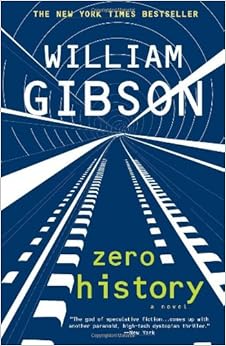
Zero History - William Gibson

Finally finished the last book in Gibson's Blue Ant/Bigend trilogy. Liked this much better than Spook Country, even though the protagonist was again Hollis Henry, whom I do not particularly care for (she is flavorless and lovelorn, snooze).

In this work, a mysterious line of wondrously simple denim clothing called "Gabriel Hounds" catches Bigend's eye for their innovative use of secrecy in marketing, and he hires Hollis to identify the brand's creator. When Hollis objects she is hardly the best person for this job, suggesting instead someone who might understand the fashion world better, Bigend replies, "But that's exactly it. Because they 'understand all that' they won't find the edge. They won't find the new. And worse, they'll trample on it, inadvertently crush it, beneath a certain mediocrity inherent in professional competence." Bigend is an immensely compelling figure, who prides himself on his ability to always select the exact right person for a given job... makes me wish I could work for someone like him!

Hollis' partner in the search for the Hounds' creator is Bigend's rescued drug addict, hyper-alert and sensitive Russian translator Milgrim, who has been put to work researching military uniform contracts. Of course, working for Bigend means being swept up in his machinations, and this tale follows the ensuing drama.

Always a pleasure to read Gibson, and now I've read his entire works!

The Sprawl Trilogy:
The Bridge Trilogy:
The Bigend Books:

Sunday, June 15, 2014

1Q84 - Murakami

At my suggestion, our bookclub's most recent selection is Murakami's 1Q84. An interesting factoid from Wikipedia: "The title is a play on the Japanese pronunciation of the year 1984 and a reference to George Orwell's Nineteen Eighty-Four. The letter Q and the Japanese number 9 (typically romanized as "kyū", but as "kew" on the book's Japanese cover) are homophones, which are often used in Japanese wordplay."

It has been a while since I've read Murakami (previously: Kafka on the Shore; The Windup Bird Chronicle), and as always, I was struck by the believability of his characters, whose inner monologues are powerfully, resonantly realistic, and the vividness of his imagery despite his relatively sparse prose (at least in the translation!). This one was a little surreal and overly sentimental for my taste at times, but I still really enjoyed it for the reasons previously mentioned. I also LOVED the Town of Cats story told within the novel:

In the story, a young man is travelling alone with no particular destination in mind. He rides the train and gets off at any stop that arouses his interest. He takes a room, sees the sights, and stays for as long as he likes. When he has had enough, he boards another train. He spends every vacation this way. 
One day, he sees a lovely river from the train window. Gentle green hills line the meandering stream, and below them lies a pretty little town with an old stone bridge. The train stops at the town’s station, and the young man steps down with his bag. No one else gets off, and, as soon as he alights, the train departs. 
No workers man the station, which must see very little activity. The young man crosses the bridge and walks into the town. All the shops are shuttered, the town hall deserted. No one occupies the desk at the town’s only hotel. The place seems totally uninhabited. Perhaps all the people are off napping somewhere. But it is only ten-thirty in the morning, far too early for that. Perhaps something has caused all the people to abandon the town. In any case, the next train will not come until the following morning, so he has no choice but to spend the night here. He wanders around the town to kill time. 
In fact, this is a town of cats. When the sun starts to go down, many cats come trooping across the bridge—cats of all different kinds and colors. They are much larger than ordinary cats, but they are still cats. The young man is shocked by this sight. He rushes into the bell tower in the center of town and climbs to the top to hide. The cats go about their business, raising the shop shutters or seating themselves at their desks to start their day’s work. Soon, more cats come, crossing the bridge into town like the others. They enter the shops to buy things or go to the town hall to handle administrative matters or eat a meal at the hotel restaurant or drink beer at the tavern and sing lively cat songs. Because cats can see in the dark, they need almost no lights, but that particular night the glow of the full moon floods the town, enabling the young man to see every detail from his perch in the bell tower. When dawn approaches, the cats finish their work, close up the shops, and swarm back across the bridge. 
By the time the sun comes up, the cats are gone, and the town is deserted again. The young man climbs down, picks one of the hotel beds for himself, and goes to sleep. When he gets hungry, he eats some bread and fish that have been left in the hotel kitchen. When darkness approaches, he hides in the bell tower again and observes the cats’ activities until dawn. Trains stop at the station before noon and in the late afternoon. No passengers alight, and no one boards, either. Still, the trains stop at the station for exactly one minute, then pull out again. He could take one of these trains and leave the creepy cat town behind. But he doesn’t. Being young, he has a lively curiosity and is ready for adventure. He wants to see more of this strange spectacle. If possible, he wants to find out when and how this place became a town of cats. 
On his third night, a hubbub breaks out in the square below the bell tower. “Hey, do you smell something human?” one of the cats says. “Now that you mention it, I thought there was a funny smell the past few days,” another chimes in, twitching his nose. “Me, too,” yet another cat says. “That’s weird. There shouldn’t be any humans here,” someone adds. “No, of course not. There’s no way a human could get into this town of cats.” “But that smell is definitely here.” 
The cats form groups and begin to search the town like bands of vigilantes. It takes them very little time to discover that the bell tower is the source of the smell. The young man hears their soft paws padding up the stairs. That’s it, they’ve got me! he thinks. His smell seems to have roused the cats to anger. Humans are not supposed to set foot in this town. The cats have big, sharp claws and white fangs. He has no idea what terrible fate awaits him if he is discovered, but he is sure that they will not let him leave the town alive. 
Three cats climb to the top of the bell tower and sniff the air. “Strange,” one cat says, twitching his whiskers, “I smell a human, but there’s no one here.” 
“It is strange,” a second cat says. “But there really isn’t anyone here. Let’s go and look somewhere else.” 
The cats cock their heads, puzzled, then retreat down the stairs. The young man hears their footsteps fading into the dark of night. He breathes a sigh of relief, but he doesn’t understand what just happened. There was no way they could have missed him. But for some reason they didn’t see him. In any case, he decides that when morning comes he will go to the station and take the train out of this town. His luck can’t last forever. 
The next morning, however, the train does not stop at the station. He watches it pass by without slowing down. The afternoon train does the same. He can see the engineer seated at the controls. But the train shows no sign of stopping. It is as though no one can see the young man waiting for a train—or even see the station itself. Once the afternoon train disappears down the track, the place grows quieter than ever. The sun begins to sink. It is time for the cats to come. The young man knows that he is irretrievably lost. This is no town of cats, he finally realizes. It is the place where he is meant to be lost. It is another world, which has been prepared especially for him. And never again, for all eternity, will the train stop at this station to take him back to the world he came from.

It sort of reminds me of what happens to the girl's parents in Spirited Away, except that there is no possibility for redemption in this world.

Friday, October 18, 2013

Women & murder


Over the summer I read five great page-turners. Although I picked each out for different reasons, they all coincidentally fit a grisly theme:

NOS4A2 - Our teen heroine, who rides her bike across a bridge/portal to "find things," goes looking for trouble. She finds a mass-murder who kidnaps children away to "Christmasland." She escapes but doesn't really get away.  Recommended in a NYT article by Janet Maslin.

The Shining Girls - Our young heroine escapes a mass-murder who finds his victims across time using a house/portal. She has to track him down and thwart him. For my office book club.

The 5th Wave - Our teen heroine has survived the first four waves of an alien invasion that murders 99% of humanity. She has to stay alive and rescue a kidnapped kid. Recommended in a NYT article by Janet Maslin.

The Rook - Our heroine wakes up with no memory, surrounding by the bodies of people who were trying to kill her. She has to figure out who was trying to kill her while running an intelligence agency that combats supernatural foes. Recommended by a friend.

The Cuckoo's Calling - A famous model is murdered. Our hero, a down-on-his-luck PI, tries to crack the case. The new book by JK Rowling.

I'd highly recommend all of them - they're fun and fast.

Wednesday, August 22, 2012

Cake in the Hatbox

All of the Upfield Napoleon Bonaparte mysteries are a pleasure to read, and Cake in the Hatbox is one of the best.  Bony happens to be in northwestern Australia when a local policemen is found murdered and so he is naturally called upon to lead the investigation.  Officer Stenhouse, a hard, brutal man, appears to have been shot with his own rifle, by his aborigine tracker, who has disappeared, but Bony rapidly determines that the murder scene has been staged.  Discovering the real scene of the murder, the motive, and the culprits requires all of Bony's keen intelligence and considerable skills as a tracker.  Early on he realizes, even before locating the body, that the aborigine tracker also has been killed, putting Bony immediately into conflict with the tracker's tribe, who are relentless in attempting to identify the murderer and avenge the tracker's death.  Key to the mystery are the Breens,  a rough and fiercely independent family - three giant and immensely strong brothers and their beautiful, iron-willed sister, the baker responsible for the literal "Cake in the Box" and the figurative "Cake in the Box" - mini-mysteries that are delightfully revealed as Bony solves the murders, with an exceptional ability to strike a balance between what is legally required and what is just.  

Wednesday, December 28, 2011

China Mieville - The City & The City

Mieville has always had a thing for patchwork cities. I first encountered the author years ago with the strange and wonderful Perdido Street Station, which I highly recommend. That novel was a masterpiece of imagination, set in a politically fractured steampunk metropolis. Its two sequels were entertaining but lackluster, and Mievelle fell off of my radar.

The City & The City, which shared the 2010 Hugo with Bacigalupi's vastly inferior The Windup Girl, is a detective novel set in the absurd divided city of Beszel and Ul Qoma, located somewhere in a post-Soviet Eastern Europe. I don't want to say too much about the nature of the relationship between the two cities, as the gradual unfolding of this relationship in the early part of the novel produces a somewhat maddening sense of disorientation that I found to be fairly masterful on the part of Mieville. For this same reason, I would recommend that one avoid reading too much about the book before diving into it.

The setting itself is something of a literary-theoretical thought experiment taken to an absurd extreme; this is self-conscious, as Foucault and Baudrillard are referenced by a character in the text (although I think the conceit is more due to Deleuze). Which is to say: this book is ambitious, in a way that (especially with the noir trappings) reminds me of nothing more than Paul Auster's New York Trilogy, to which this book is clearly indebted. And Mieville, somehow, pulls it off, producing a novel that's both a technical masterpiece and lot of fun.

edit: As a sidenote, you can understand the thematic structure of this novel in terms of Greimas' semiotic square, which is a bit like a two-dimensional dialectic and a really powerful analytic tool in general.

Wednesday, October 12, 2011

Raymond Chandler

Just finished The Library of America's Chandler Stories and Early Novels, which included 13 "Pulp Stories" and 3 novels, including The Big Sleep, Farewell My Lovely, and The High Window. The stories, particularly, were wonderful - sure, there is lots of vivid tough-guy talk, but also great plotting, amusing dialog and tangled mysteries unwound by Philip Marlowe (or, in some stories, Mallory or Malvern), who has a code of honor but is still tough and wise enough to see through the lies and cheap ambitions.
One discovery - there's lots of humor in these stories! Fascinating and immensely readable. I grew up in LA - was it really like this?
(Art from Steve Weissman)