Showing posts with label Neal Stephenson. Show all posts

Wednesday, July 8, 2015

Seveneves - Neal Stephenson

Stephenson's fascinating new sci-fi novel, Seveneves, reads much like Kim Stanley Robinson's Mars trilogy in its realistic and highly-detailed portrayal of space exploration technology. The novel opens when an unknown force - the Agent - causes our Moon to explode. After a period of global bafflement, American scientist and media personality Doc Dubois realizes that the moon's fragmentation will continue exponentially, ultimately causing a Hard Rain of meteorites to obliterate the earth's service in a terrible holocaust lasting thousands of years. Scientists all over earth come to the same conclusion within a matter of weeks, and the entire world's resources are dedicated to preparing to save as many humans as possible by getting them onto a space station, along with earth's genetic data. If this feels like a spoiler, it's not, this merely sets the stage for all the action that unfolds from there! About the latter third of the book is dedicated to even more radical extrapolation from these initial conditions... Very unique and thought-provoking.

Stephenson is a brilliant social critic, and his book is rich with insights and neologisms like "amistics" -
"choices that different cultures made as to which technologies they would, and would not, make part of their lives. The word went all the way back to the Amish... who had chosen to use certain modern technologies, such as roller skates, but not others, such as internal combustion engines. All cultures did this, frequently without being consciously aware that they had made collective choices."
Highly recommend!

Saturday, August 2, 2014

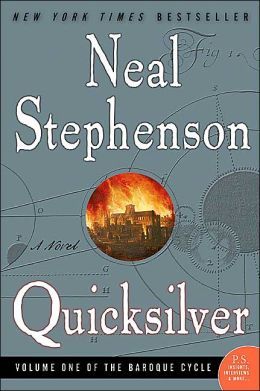
Quicksilver (The Baroque Cycle, #1) - Neal Stephenson

The first novel in the Baroque cycle is an engaging picture of life in 1600s and 1700s England and America, where former Puritan Daniel Waterhouse is mixing it up with the greatest minds of his day, including Isaac Newton and the young Benjamin Franklin, among others. I don't have much to say about the plot (such as it is), but it is full of interesting philosophical discussions, such as this:
“And yet viewing several depictions of even an imaginary city, is enlightening in a way," Leibniz said. "Each painter can view the city from only one standpoint at a time, so he will move about the place, and paint it from a hilltop on one side, then a tower on the other, then from a grand intersection in the middle--all in the same canvas. When we look at the canvas, then, we glimpse in a small way how God understands the universe--for he sees it from every point of view at once. By populating the world with so many different minds, each with its own point of view, God gives us a suggestion of what it means to be omniscient.”
An interesting book. I've set down The Confusion, which has a different cast of characters and didn't grab me as much, but I may return to it.

Stephenson's Novels

Tuesday, May 27, 2014

Zodiac - Neal Stephenson

Finished reading Stephenson's (1988) Zodiac this weekend. It was weird, to say the least, and definitely seemed less mature than other works of his that I've read (not surprising, it's his 2nd book, written before Snow Crash). It's the tale of S.T., a nonviolent ecoterrorist who brings polluting companies to justice by zipping around on his Zodiac (high-powered motored raft) plugging up waste pipes in the Boston Harbor and exposing the offenders to media ridicule. A quick and easy read, not one I'd necessarily recommend.

Book Challenge 2014 stats: 15/65 (23%), 11 books behind schedule. (Although I've now read 2 more books thus far in 2014 than I did in all of 2013!)

Stephenson's Novels

Sunday, February 9, 2014

Anathem - Neal Stephenson

Today I finished my 6th book of 2014, Stephenson's Anathem. WOW!

The book is set on the planet Arbre, quite similar to our own, but divided in the present time (and for the past several thousand years) into the Saecular and Mathic worlds. Inside the "maths", or cloisters, live the Avout, non-religious men (fraas) and women (suurs) who have devoted their lives to intense scholarship and medieval asceticism, almost wholly without advanced praxis (technology). They live secluded from the outside world, except for a 10-day holiday called Apert during which the gates are opened, when the "extras" are free to come into the math, and the Avout are free to leave and explore extramuros. Depending on whether an Avout is a Unitarian, Tenner, Hundreder, or Thousander, his or her order will have the chance to celebrate Apert only once a year, decade, century, or millenium. In the mean time, all knowledge of the Saecular world is strictly avoided.

The book opens as Fraa Erasmas, a Tenner, is about to celebrate his first Apert since joining his math, the Concent of Saunt Edhar, as a young boy. Over the course of this holiday, however, he and his fraas and suurs discover that something very serious and shocking has been happening extramuros. Dun dun dun!

Of course I won't give away more, but suffice to say, this book is pure Stephenson genius. A beautifully rich world filled with highly likable characters (especially Fraa Jad!) engaged in a gripping and meaningful quest.

Recommended if you enjoyed: The Name of the Rose, Reamde

Stephenson's Novels

Friday, August 2, 2013

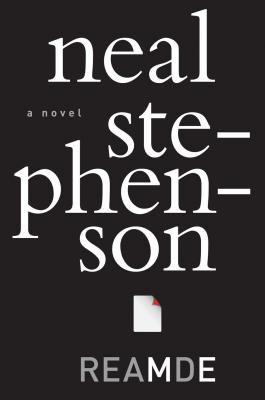
REAMDE by Neal Stephenson


Just finished reading Stephenson's 1000-something page novel, REAMDE, which was amazing. (Excellent overview by Colin here: http://blogenburyisreading.blogspot.com/2011/12/neal-stephenson-reamde.html?m=1).

Stephenson has the impressive ability to weave together a host of characters and circumstances which, in the hands of a lesser author, would feel they had been chosen by a random word generator: jihadists, MMORPG, computer virus, British spy, Russian mafia, ski resort, Wikipedia. Well, maybe they do have a theme: it sounds like a James Bond movie, but without the glamour, and set against the new realities of postmodernity: the digital age and the international War on Terror.

Stephenson is truly a great author: each section of the book is told from the perspective of one of a handful of key characters, and each has a distinctive and authentic tone. Although the book plays like an action movie and largely examines the meaning of life as experienced in the scopes of a rifle, the detailed attention to psychology and the richness of the world feel (almost) Tolstoyan. (Making the Acknowledgments page quite interesting, since he lists areas of expertise, such as guns, which are seamlessly integrated into the plot, yet evidently draw heavily upon the knowledge of others.)

Although set in the present (near future?) and so less earthshatteringly visionary than The Diamond Age, I preferred this to Snow Crash and definitely recommend.

Stephenson's Novels

Monday, February 27, 2012

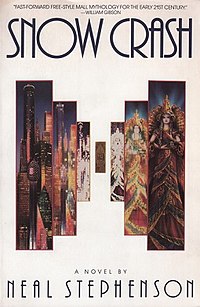
Neal Stephenson's Snow Crash


Stephenson has rapidly become one of my very favorite, if not all time favorite, authors. Snow Crash is so incredible - Stephenson's vision of the future is a rarity in its clarity, depth, and originality. The overpopulated earth has become a trashy wasteland, and the technological/economic elite have essentially moved to a digital existence, most often "goggled in" to the virtual reality of the Metaverse, where your avatar can move around and conduct business in the same way as on earth. Hackers, especially the samurai-sword wielding protagonist (named Hiro Protagonist), have the upper hand in a landscape they can control. However, the intersection between man and machine, embodied particularly in the hackers' binary-acccomodating neural pathways, has led to the dangerous potential for computer viruses to infect the user's mind. This unique vision has even more resonance given Google's recent announcement that they are developing glasses which will project a virtual reality and other information over the real world. This novel's astounding scope encompasses the exploration of memes, Glossolalia, drugs, viruses, and religion, which are depicted as being basically synonymous. A wonderful page-turner!

Wednesday, December 28, 2011

Neal Stephenson - Reamde

In Stephenson's oeuvre, Reamde, despite its 1056 pages, is light reading. This is not necessarily a bad thing. The man is a master of plot construction, not in terms of technical complexity but rather in terms of sheer engagement: he gets those pages turned. The novel's most striking feature is its action sequences, in which Stephenson shows off his impressive gunfight-choreography chops.

The novel's cyberpunk elements center around the computer game T'Rain (the fictional successor to the online hegemony of World of Warcraft), whose most salient characteristic its elaborate economy, based on a virtual-gold standard whose integrity is ensured by an elaborate geological simulation which determines the location of deposits of ore within the game world. The game is designed to exploit, rather than be exploited by, the existence of "gold-farmers," or kids in China who perform repetitive in-game actions (or grinding) in order to harvest virtual items and currency that they can then sell to rich Westerners - a real phenomenon in games like WoW. Stephenson's picture of how this all works is really quite ingenious, and somehow constitutes both a more sophisticated version and elaborate parody of early cyberpunk depictions of the function of virtual spaces in the global economy, like Stephenson's own depiction of the "Metaverse" in Snow Crash.


A series of elaborate coincidences embroil the creator of this game, the draft-dodging black sheep of a gun-toting Idaho clan, and his adopted Eritrean refugee niece in a globe-trotting hostage plot involving Islamic terrorists and Russian organized crime; all of which is much too complicated to even begin to explain here. Suffice to say that the entire thing is incredibly entertaining, and the characters are extremely well-written: I thought that the terrorist Abdullah Jones, a suave Black American convert, was a particularly intriguing figure.

In Reamde, Stephenson dials down the whole "novel of ideas" business and writes a fairly straightforward thriller that delivers exactly what it promises and in fine style. The Stephensonian themes are all here, but muted and lighthearted in a way that I think is actually a very good artistic move, especially following the somewhat more ponderous (but very good) Anathem. If nothing else, the book makes me wistful for a world in which the rest of the bestseller list was even a fraction of Reamde's quality.

I would recommend the book, but read the essential Stephenson first: Snow Crash, The Diamond Age, Cryptonomicon.

Stephenson's Novels

Friday, December 31, 2010

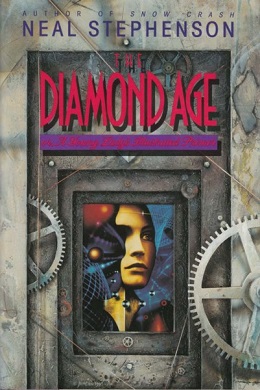
The Diamond Age or, a Young Lady's Illustrated Primer

Recently read Neal Stephenson's The Diamond Age, a novel set in a futuristic society (maybe ~100 years from now) in China. Whether this book presents a dystopian or utopian vision is unclear, maybe it shows both, although the dystopian aspects (callous brutality, pervasive misogyny) are more salient.

Background (no spoilers):

In this society, nanotechnology has become the dominant means of production. (Many buildings are built out of man-made diamond because it is hard and durable, hence the title). Stephenson's novel is Marxist in that he posits a world in which the social structure arises from the means of production. Matter Compilers, or MCs, create food, clothes, etc. using molecular blueprints downloaded from a central government server. This top-down means of production makes poor people dependent on the government for their existence.

Most people are divided into phyles (aka claves) which are essentially tribes which live together in different parts of the city. One prominent phyle is that of the "Vickys" - neo-Victorians who have consciously adopted Victorian dress, mannerisms and social codes, believing that this is preferable to the amoral degeneracy of prior centuries (i.e. our time). The poor are the exception to this structure; they have no phyles, and lead lives that are nasty, brutish and short.

Nanotechnology has also become a means of ugly warfare and supports a bizarre justice system which combines Confucian principles with nanotech-based methods of execution. Rogue nanotech experts develop their own micromachines in defiance of the government's prohibition, and use them to spy, track, and kill.

My take on it:

I really, really enjoyed the first half of this book. Stephenson's vision is brilliant: complex, detailed, strikingly creative and novel, and powerful. It is also very pleasurable to read. However, I found the second half of the book chaotic and the ending unrealistic and anticlimactic. I was also troubled by the book's at times graphic misogyny, which does not seem to serve any purpose beyond reinforcing the brutality of the world. However, I highly recommend it because it is truly novel and gripping and introduces many fascinating ideas.

Stephenson's Novels