Showing posts with label bubonic plague. Show all posts

Saturday, August 2, 2014

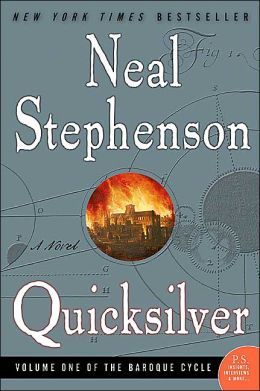
Quicksilver (The Baroque Cycle, #1) - Neal Stephenson

The first novel in the Baroque cycle is an engaging picture of life in 1600s and 1700s England and America, where former Puritan Daniel Waterhouse is mixing it up with the greatest minds of his day, including Isaac Newton and the young Benjamin Franklin, among others. I don't have much to say about the plot (such as it is), but it is full of interesting philosophical discussions, such as this:
“And yet viewing several depictions of even an imaginary city, is enlightening in a way," Leibniz said. "Each painter can view the city from only one standpoint at a time, so he will move about the place, and paint it from a hilltop on one side, then a tower on the other, then from a grand intersection in the middle--all in the same canvas. When we look at the canvas, then, we glimpse in a small way how God understands the universe--for he sees it from every point of view at once. By populating the world with so many different minds, each with its own point of view, God gives us a suggestion of what it means to be omniscient.”
An interesting book. I've set down The Confusion, which has a different cast of characters and didn't grab me as much, but I may return to it.

Stephenson's Novels

Thursday, January 9, 2014

Bloody Mary: The Life of Mary Tudor

I am a member of goodreads.com (check out my profile here) and was dismayed to realize I only read 13 books in 2013. I have set myself a slightly more ambitious goal of 65 books for 2014, and am happy to say that it's a week into the new year and I just finished my second!

Carolly Erickson's Bloody Mary is a history that reads like an action adventure. This book was thoroughly engaging and immensely interesting.

Adored and publicly admired by her father as a young child, Mary's peaceful home life was destroyed when her father, always flirtatious, suddenly decided to pursue his love affair with Anne Boleyn beyond the bedroom, and with cold indifference and evident scorn cast aside his former wife, daughter, and religion. Mary was stripped of the title "Princess" and of all her fine clothes and possessions, tormented by Anne and her courtiers, denied medical treatment when sick, and kept for years as a veritable prisoner in a run-down and drafty old house.

Although Mary rose above seemingly insurmountable obstacles to become Queen, and was an impressive scholar who spoke excellent Latin and ruled with wisdom and moderation, and even compassion and clemency (by the standards of the day), she was never accorded the respect she deserved while she was alive, due to the "imbecility of her sex," and was later condemned in the public memory as a bloody tyrant.

This book illustrates the flavor of life during the period very colorfully, and portrays Queen Mary with perhaps greater subtlety and nuance than has been accorded her in the past.

Highly recommend!

Sunday, January 5, 2014

Plagues and Peoples - William McNeil

This book by William McNeil offers an interesting interpretation of the way that epidemic disease has shaped the course of world history from ancient times to the present day, a topic that the author asserts has been neglected in traditional historical accounts. The book is written in a charmingly old-fashioned style which is pleasant to read, although it is at times a bit tediously wordy and the citations are sparser than I would like.

Nevertheless, here is one passage from the Introduction that I think provides a good example of the interesting theories underpinning this book:
Disease and parasitism play a pervasive role in all life. A successful search for food on the part of one organism becomes for its host a nasty infection or disease. All animals depend on other living things for food, and human beings are no exception. Problems of finding food and the changing ways human communities have done so are familiar enough in economic histories. The problems of avoiding becoming food for some other organism are less familiar, largely because from very early times human beings have ceased to have much to fear from large-bodied animal predators like lions or wolves. Nevertheless, one can properly think of most human lives as caught in a precarious equilibrium between the microparasitism of disease organisms and the macroparasitism of large-bodied predators, chief among which have been other human beings.
Originally published in 1977, parts are noticeably antiquated, but it remains an interesting and thought-provoking work which has sparked my interest in learning much more about the bubonic plague and the medieval period.