Showing posts with label heresy. Show all posts

Saturday, May 17, 2014

The Medieval Underworld - Andrew McCall

This book was interesting, but very painful to read because McCall tortures all of his sentences. In McCall's hands, for example, the previous sentence might read: "The sentences of this book, being tortured by McCall, were very painful to read, yet interesting did I find the book."Or some such nonsense.

Anyway, the content was engaging - the book opens with the context of the Middle Ages, the theory behind Church, State, and sin, then the nature of medieval punishment (cruel and unusual), following by a closer treatment of several strains of deviants in the Middle Ages:
    • bandits, freebooters and outlaws
    • richman, poorman, beggarman, thieves
    • prostitutes
    • homosexuals
    • heretics
    • sorcerers and witches
    • Jews
The book ends with an analysis of the medieval conception of hell.

Again, interesting, but perhaps not worth the effort.

Sunday, January 19, 2014

The Witch-Hunt in Early Modern Europe - Brian P. Levack

Levack's work is a overview of the legal, political, economic, religious, and epidemic circumstances which he argues enabled the great witch-hunts of early modern Europe. Although witches have been a lifelong interest for me, and I was eagerly anticipating reading this book, I found it kind of disappointing, to be honest.

The scope feels too broad - Levack seldom dives deeply into the particulars of any given hunt, preferring to treat the issue in very general terms. The book is surprisingly dry and even boring, which seems nearly impossible, treating as it does the lurid topics of torture, naked dancing, and burning at the stake, which in this book are described in the most clinical, repetitious passages. Levack also almost never includes direct quotes from contemporaries, which would have spiced it up considerably.

I did learn a few things, but the book could have been a third as long and 10 times more exciting. Especially on the heals of Erickson's riveting historical drama about Mary Tudor, this was pretty dull. Would not recommend.

Thursday, January 9, 2014

Bloody Mary: The Life of Mary Tudor

I am a member of goodreads.com (check out my profile here) and was dismayed to realize I only read 13 books in 2013. I have set myself a slightly more ambitious goal of 65 books for 2014, and am happy to say that it's a week into the new year and I just finished my second!

Carolly Erickson's Bloody Mary is a history that reads like an action adventure. This book was thoroughly engaging and immensely interesting.

Adored and publicly admired by her father as a young child, Mary's peaceful home life was destroyed when her father, always flirtatious, suddenly decided to pursue his love affair with Anne Boleyn beyond the bedroom, and with cold indifference and evident scorn cast aside his former wife, daughter, and religion. Mary was stripped of the title "Princess" and of all her fine clothes and possessions, tormented by Anne and her courtiers, denied medical treatment when sick, and kept for years as a veritable prisoner in a run-down and drafty old house.

Although Mary rose above seemingly insurmountable obstacles to become Queen, and was an impressive scholar who spoke excellent Latin and ruled with wisdom and moderation, and even compassion and clemency (by the standards of the day), she was never accorded the respect she deserved while she was alive, due to the "imbecility of her sex," and was later condemned in the public memory as a bloody tyrant.

This book illustrates the flavor of life during the period very colorfully, and portrays Queen Mary with perhaps greater subtlety and nuance than has been accorded her in the past.

Highly recommend!

Sunday, July 7, 2013

Umberto Eco’s The Name of the Rose


The first book I read with my Reedie bookclub was Umberto Ecos’s The Name of the Rose, a beautifully written murder mystery set in medieval Italy. In this thrilling tale, the young monk Adso follows his brilliantly perceptive but unorthodox master, William, to a Benedictine monastery in Northern Italy, to investigate a murder which has taken place in a small but ostentatiously wealthy monastery whose heart is a labyrinth library. More horrors and mysteries are unveiled the deeper William and Adso dig, and the more the two suspect that certain persons are working against them to keep the monastery’s secrets from ever being revealed.

This novel is a true page-turner, but also deals in depth with many interesting themes revolving around the nature of Truth – its complexity, mutability, and debatable impenetrability, the meaning of heresy, and whether knowledge should be shared freely with all, and if not, under what circumstances secret knowledge should be guarded, by whom, and through what means.

A truly fascinating book that I would recommend to all, and would definitely enjoy discussing at greater length!

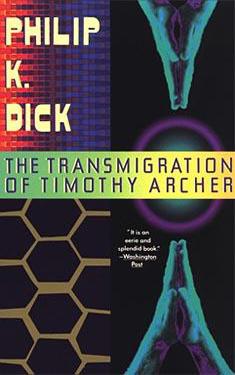
The Transmigration of Timothy Archer - Philip K. Dick


Just finished reading Philip K. Dick's The Transmigration of Timothy Archer (1982), published posthumously. (For those who may not know, transmigration is "the religious or philosophical concept that the soul or spirit, after biological death, begins a new life in a new body that may be human, animal or spiritual depending on the moral quality of the previous life's actions.")

The novel is set in the 1960s and 1970s, and follows the descent into drug addiction, radical religion, and madness of a deeply entwined but unhappy circle of five friends - intelligent but lonely Angel Archer, "professional student" at Cal Berkeley and poetic grass fiend, her disaffected husband, Jeff, whose maniacally intensive study of Wallenstein and Hitler becomes a pointless bid for his father's attention, Jeff's father, the dreamy but brilliant Bishop Timothy Archer, who unwittingly destroys himself and his friends, the Bishop's secret lover, the spiteful barbiturate addict Kirsten, and Kirsten's angelic son, the schizophrenic Bill.

The action begins on the day of John Lennon's death, with Angel's attempts to make sense of the "retributive fate" which has enveloped her life and destroyed those closest to her. For all this darkness, the book is a fairly light read, with some good humorous bits. For Philip K. Dick enthusiasts, it is also an interesting window into his thoughts in later years, and perhaps his most mature piece of writing. Although the repetitive nature of some of the lines was at times tedious for me, I believe it was a deliberate stylistic choice to evoke the obsessive nature of Angel's thoughts, and was effective for that purpose.

Bishop Archer's darkly comic misadventures are in fact based on the doings of the unfortunate Bishop James Pike - definitely worth reading a bit about that man, although save it for after you've read the novel - spoiler alert!

Wednesday, June 5, 2013

Galileo's Dream

Quite an unusual story, from Kim Stanley Robinson, author of the Mars Trilogy.  Well, two stories: one is the life of Galileo in Italy and the second is set in about the year 3000 on the planets of Jupiter.  Humans who have settled the planets have a way to time travel and, and for reasons never made completely convincing, they retrieve Galileo from time to time, to help settle some ongoing disputes.  The second of these narratives is a little loopy, but interesting.  Without serious spoilers, it's fair to reveal that the crux of some of the major dispute is whether Galileo is spared or martyred  for his heretical views.  A brief but terrifying part of the book allows Galileo and the reader) to visualize/experience being burned at the stake.  The main narrative describes  Galileo's life, vigorously portraying his vitality, his passion for experimentation, his astonishing breadth of interests and achievements, and his loving but tragic relationships with his daughters.  Not a perfect book, but a wonderful, absorbing read.

Saturday, September 26, 2009

The Life of Archpriest Avvakum by Himself


Autobiography of Avvakum (1621-1682), "a Russian protopope of Kazan Cathedral on Red Square who led the opposition to Patriarch Nikon's reforms of the Russian Orthodox Church. His autobiography and letters to the tsar, Boyarynya Morozova and other Old Believers are considered masterpieces of 17th-century Russian literature." (excerpted from the Wikipedia article).

(The painting is The Burning of Avvakum (1897), by Grigoriy Myasoyedov.)

This autobiography is short and truly delightful to read. It is unique among old Russian literature for the "vigorous, clear, and laconic style." Avvakum's opposition to the reforms of Nikon is incredibly strong, and at one point he refers to Nikon as the "anti-Christ." This probably doesn't sound that appealing to most people, but I really highly recommend it to all!!