Showing posts with label science. Show all posts

Wednesday, January 13, 2021

To Be Taught if Fortunate - Becky Chambers


With the pandemic, I have barely been reading, so it's been a long time since I've contributed to our book blog! But I'm hoping to get back on track in 2021. My first read of 2021 is this novel by Becky Chambers, for my bookclub. I love space exploration sci-fi, and this was fresh and evocative light reading. Spunky like The Martian, thoughtful like (but not nearly as dark as) The Sparrow (also by a woman, Mary Doria Russell).

Besides Ursula K. LeGuin, Octavia Butler, and Madeline L'engle, I don't know that I've read many female science fiction authors, which is too bad, since it's one of my favorite genres. I don't know that I would say the author's gender was really relevant to this book, though I did find it interesting that in one passage the main character (who is also a woman) muses that 
"We astronauts are taught to compartmentalize the realities of flight. [And the fact that everyone you know will be dead when you return.] ...You wonder if you're a bad daughter, a bad friend, a selfish asshole placing her own intellectual wankery above the living, breathing people who poured everything they could ever give into her, and were rewarded with the sight of her walking away forever." 
I don't think I've heard this sentiment much in the male-centered space exploration stuff I've read, and it struck me the extra pressures women explorers face, since we are usually expected to be caregivers for elder family, etc. -- more guilt and conflict there. So I found that interesting.

Anyway, all in all, a good book for the new year.

Tuesday, July 3, 2018

The Three-Body Problem

The Three-Body Problem, the first volume of a science fiction trilogy by Liu Cixin, is both a strong sci-fi story and a provocative consideration of the nature of man. The books, published in 2006, were very popular in China, were translated into English in 2014 and, in 2015, the first volume won the very prestigious Hugo Award for best science fiction novel of the year.  (Thanks to Dan Lidral-Porter, via Lauren, for the recommendation!)


The book has a traditional sci-fi theme, communication and contact with an alien civilization,  but has several features that made it particularly fresh and interesting to me.   The story is set within the world of Chinese academics, especially physicists and materials scientists, starting during the Cultural Revolution and continuing into the years afterwards.  There’s a heavy dose of speculative physics, which I enjoyed, and some strong, memorable characters, including a savvy, outspoken and very funny cop.  The protagonist is Ye Wenjie, a very talented astrophysicist who sees her illustrious father beaten to death by Red Guards, and many years later happens to intercept a message from intelligent aliens, triggering much of the book’s action.  (Stephen Hawking:  “We only have to look at ourselves to see how intelligent life might develop into something we wouldn’t want to meet”).  For me, this was an intriguing, thought-provoking and lively read. 
-->
-->

UPDATE (Lauren's Additional Review):

I found The Three-Body Problem fascinating. It was recommended to me as being the most important sci-fi to come out in recent years, which seems a bit of a stretch perhaps, but it was certainly very original and thought-provoking. The theme that was most compelling to me was that of the people on Earth who had given up on their society and longed for an alien race to come take over and rule the planet instead. Some interesting connections to Childhood's End, in that respect. Like dad, I also really enjoyed the cop character, Shi Qiang (史强), nicknamed "Da Shi" (大史), ("Big Shi").

Wednesday, August 24, 2016

Aurora - Kim Stanley Robinson

Aurora is KSR's latest novel, published in summer 2015, and the only other book of his that I have read, other than the genius Mars trilogy. Aurora is just as delightful, and satisfyingly familiar in tone, with its hyper-detailed yet highly readable descriptions of technology, and the incisive and compelling character depictions, which elevate the book from tech porn to high literature.

Aurora is the story of a generation of families born on a spaceship in the middle of a 159+ year colonizing trip to Tau Ceti, led at this point in their journey by brilliant yet troubled scientist Devi, who keeps their aging vessel in working order through hundreds of daily repairs. Unlike Mars, with its numerous protagonists, this novel focuses primarily on Devi and her daughter, Freya. In a unique and engaging narrative twist, the tale's chronicler is the ship itself, an AI called simply "ship."

The action begins in Freya's youth and young adulthood, in the final years of the journey to Tau Ceti. A deeply interesting and moving tale, which I highly recommend to all sci-fi enthusiasts!

Tuesday, January 13, 2015

The Best Science and Nature Writing 2013

December Bookclub was The Best Science and Nature Writing 2013, a collection of articles hand-picked by Siddhartha Mukherjee, author of Emperor of all Maladies (reviewed by Dad here and Lauren here). 

The complete list of Mukherjee's selections is here.

Here are my thoughts on the articles I read:

MICHELLE NIJHUIS. Which Species Will Live? [log-in required]
From Scientific American
This was a bleak but interesting analysis of the techniques conservationists use to triage efforts to save different species from extinction.

BRETT FORREST. Shattered Genius
From Playboy
I was surprised this made it on the list, actually, since the topic was ostensibly the current activities of reclusive math genius Grigori Perelman, yet the interviewer only managed to exchange a few sentences with the man. More than others have achieved, but not much to go on. The discussion of the Poincaré conjecture's history was interesting, however. (Now you can say you "read Playboy for the articles"!)

DAVID OWEN. The Artificial Leaf
From The New Yorker
One man's quest to create artificial photosynthesis as a source of clean energy for the developing world. Moderately interesting.

GARETH COOK. Autism Inc.
From The New York Times
I loved this article. After Thorkil Sonne's child Lars was born with autism, Thorkil was saddened to learn that most research suggested Lars would lead a deficient life. In fact, however, Lars demonstrated impressive and unexpected talents (e.g., following a family trip at 7 years old, Lars was able to draw a perfect reproduction, from memory, of the entire highway network from Scotland to Germany). Thorkil was inspired by his son's talents to create a consulting agency specializing in matching autistic individuals with jobs for which they are uniquely suited. The agency has been a terrific success. An inspiring and very interesting story!

NATHANIEL RICH. Forever and Ever
From The New York Times Magazine
This was perhaps my favorite of the articles in this collection: the story of Shin Kubota, a marine biologist specializing in an immortal (seriously) species of jellyfish known as Turritopsis dohrnii. Dr. Kubota is unique worldwide in his ability to successfully breed and maintain the finicky Turritopsis in captivity, and has devoted his life to unlocking its secrets. He is also a minor celebrity in Japan (akin to Bill Nye in America), due to his second passion: writing and singing jellyfish-themed karaoke songs in the guise of his alter ego, Mr. Immortal Jellyfish Man (photo below). One of Kubota's charming songs is “I Am Shin Kubota":

My name is Shin Kubota
Associate professor of Kyoto University
At Shirahama, Wakayama Prefecture
I live next to an aquarium
Enjoying marine-biology research
Every day, I walk on the beach
Scooping up with a plankton net
Searching for wondrous creatures
Searching for unknown jellyfish.
Dedicate my life to small creatures
Patrolling the beaches every day
Hot spring sandals are always on
Necessary item to get in the sea
Scarlet medusa rejuvenates
Scarlet medusa is immortal

STEPHEN MARCHE. Is Facebook Making Us Lonely?
From The Atlantic 
An interesting (if depressing) analysis of loneliness in the modern world, in which we are always"connected" yet feel increasingly isolated.

KEVIN DUTTON. The Wisdom of Psychopaths
From Scientific American
I did not read this entire article (it was long and sort of pop-sciencey) but it was interesting enough. The thesis is that psychopaths can teach us valuable lessons (e.g., about self-confidence and navigating conflict) if we embrace their attitudes in moderation.

Saturday, August 2, 2014

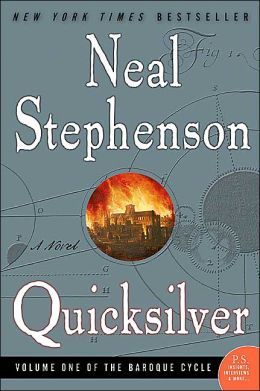
Quicksilver (The Baroque Cycle, #1) - Neal Stephenson

The first novel in the Baroque cycle is an engaging picture of life in 1600s and 1700s England and America, where former Puritan Daniel Waterhouse is mixing it up with the greatest minds of his day, including Isaac Newton and the young Benjamin Franklin, among others. I don't have much to say about the plot (such as it is), but it is full of interesting philosophical discussions, such as this:
“And yet viewing several depictions of even an imaginary city, is enlightening in a way," Leibniz said. "Each painter can view the city from only one standpoint at a time, so he will move about the place, and paint it from a hilltop on one side, then a tower on the other, then from a grand intersection in the middle--all in the same canvas. When we look at the canvas, then, we glimpse in a small way how God understands the universe--for he sees it from every point of view at once. By populating the world with so many different minds, each with its own point of view, God gives us a suggestion of what it means to be omniscient.”
An interesting book. I've set down The Confusion, which has a different cast of characters and didn't grab me as much, but I may return to it.

Stephenson's Novels

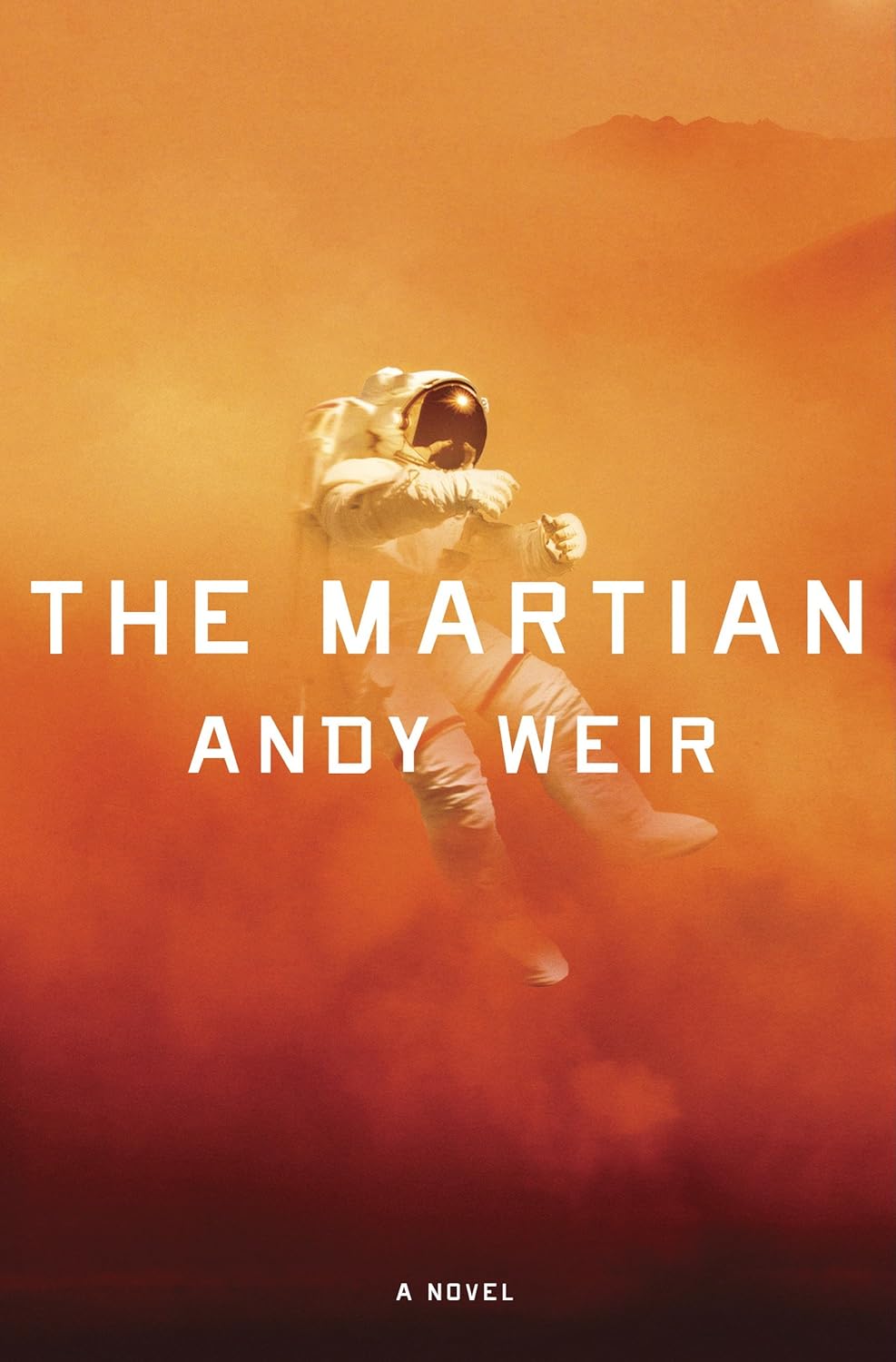
The Martian - Andy Weir

"Robinson Crusoe in space" is how our bookclub organizer described The Martian, and this is a pretty apt description. Our intrepid astronaut hero Mark Watney is left stranded on Mars when his crew takes him for dead following a terrible accident. Using his botany and mechanical engineering skills, Mark must survive and find a way to let Earth know that he's still alive!

This fast-paced action thriller is written in a highly loose and conversational style, with entries styled as Mark's log. Recommended for fans of Kim Stanley Robinson, though this is much less literary and more of a beach read. Still fun and thought-provoking!

Also, here's a (kind of) relevant clip from Total Recall:

Sunday, February 9, 2014

Anathem - Neal Stephenson

Today I finished my 6th book of 2014, Stephenson's Anathem. WOW!

The book is set on the planet Arbre, quite similar to our own, but divided in the present time (and for the past several thousand years) into the Saecular and Mathic worlds. Inside the "maths", or cloisters, live the Avout, non-religious men (fraas) and women (suurs) who have devoted their lives to intense scholarship and medieval asceticism, almost wholly without advanced praxis (technology). They live secluded from the outside world, except for a 10-day holiday called Apert during which the gates are opened, when the "extras" are free to come into the math, and the Avout are free to leave and explore extramuros. Depending on whether an Avout is a Unitarian, Tenner, Hundreder, or Thousander, his or her order will have the chance to celebrate Apert only once a year, decade, century, or millenium. In the mean time, all knowledge of the Saecular world is strictly avoided.

The book opens as Fraa Erasmas, a Tenner, is about to celebrate his first Apert since joining his math, the Concent of Saunt Edhar, as a young boy. Over the course of this holiday, however, he and his fraas and suurs discover that something very serious and shocking has been happening extramuros. Dun dun dun!

Of course I won't give away more, but suffice to say, this book is pure Stephenson genius. A beautifully rich world filled with highly likable characters (especially Fraa Jad!) engaged in a gripping and meaningful quest.

Recommended if you enjoyed: The Name of the Rose, Reamde

Stephenson's Novels

Thursday, December 26, 2013

Surely you're joking, Mr. Feynman!

A present from Will, I greatly enjoyed this book of Feynman's reminiscences!  I was familiar with some of the tales, which I enjoyed re-reading, and I was delighted to read many new accounts of Feynman's insatiable curiosity and lively sense of fun.  As a child during the Depression, he bought many broken radios and repaired or recombined them - and then was hired by relatives and, eventually, stores, to repair their radios and other appliances.

Sometimes his ingenious inventions created gigantic and very humorous consequences, as when he devised a rapid-fire string bean slicer and, enthusiastically demonstrating it for the head chef, cut his finger, releasing blood into an entire bowl of beans, dooming his invention! His adventures in drumming, safecracking, deciphering Mayan codices, art, and frequenting topless bars are all absorbing and very entertaining.

The book ends with a transcription of his commencement speech to graduating Caltech students, titled Cargo Cult Science.  I have read this before and again found it interesting; he describes the difference between real science and "phony" science - but his concluding advice was dishearteningly relevant to much of today's academic research:
So I have just one wish for you - the good luck to be somewhere where you are free to maintain the kind of integrity I have described, and where you do not feel forced by a need to maintain your position in the organization, or financial support, or so on, to lose your integrity.  May you have that freedom.
This is really a very enjoyable read!

Thursday, October 24, 2013

The Emperor of All Maladies

My bookclub's most recent book (recommended to me by dad) is The Emperor of All Maladies, an unusual piece of nonfiction which reads like a novel, and which the author calls a "biography of cancer." This tale spans the entire known "life" of the disease(s) we call cancer, from the earliest ancient references (Herodotus recorded the strange tale of the Persian Queen Atossa's breast cancer) to the latest advances in medicine and technology. Mukherjee is a masterful storyteller (and a wise person), and weaves a riveting and at times heartbreaking tale of the hundreds of years of scientific inquiry (and ignorant butchery) which form the largest part of cancer's story. It is a frightening tale but ultimately a hopeful one, and I highly recommend this surprising page turner to all.

Dad's review here.

Wednesday, June 5, 2013

Galileo's Dream

Quite an unusual story, from Kim Stanley Robinson, author of the Mars Trilogy.  Well, two stories: one is the life of Galileo in Italy and the second is set in about the year 3000 on the planets of Jupiter.  Humans who have settled the planets have a way to time travel and, and for reasons never made completely convincing, they retrieve Galileo from time to time, to help settle some ongoing disputes.  The second of these narratives is a little loopy, but interesting.  Without serious spoilers, it's fair to reveal that the crux of some of the major dispute is whether Galileo is spared or martyred  for his heretical views.  A brief but terrifying part of the book allows Galileo and the reader) to visualize/experience being burned at the stake.  The main narrative describes  Galileo's life, vigorously portraying his vitality, his passion for experimentation, his astonishing breadth of interests and achievements, and his loving but tragic relationships with his daughters.  Not a perfect book, but a wonderful, absorbing read.

Monday, February 27, 2012

Ryu Mitsuse - 10 Billion Days & 100 Billion Nights


This book is utterly insane, and operates under the principle that sufficiently advanced technology is indistinguishable from magic, mystical experience, or a really incredible psychedelic voyage.

At one point, Jesus of Nazareth and Siddhartha Guatama the Buddha, who are cyborgs, fight a laser battle amidst the fortieth-century ruins of Tokyo.  I feel like that should be recommendation enough.  If dream narratives aren't your thing, though, you might find the book frustrating.

The story is a sort of metaphysical space-opera with Dickian gnostic overtones, featuring Plato, Jesus, Buddha, and the goddess Asura.  The translation is excellent and highly poetic; the original Japanese must be pretty amazing.  

Sunday, January 9, 2011

Animals in Translation


I almost always finish books I start. The first book I never finished was Penrod by Booth Tarkington. And I have bookmarks still stuck in the early parts of Moby Dick and Don Quixote. I have concluded that, in general, the likelihood that I will complete a book is proportional to the rate at which I read it. Further evidence, at the other end of the spectrum, would be The Girl Who Played with Fire.

But now I have to reconsider this theory, based on a most unusual experience with Temple Grandin's Animals in Translation. I heard about the very interesting Temple Grandin on a flight to Portland, from a woman who ran a ranch for abandoned or abused horses. Temple Grandin is both extremely intelligent and autistic, and uses these traits to make amazing observations about how animals (and humans) think. She is particularly famous for having devised both mechanisms and evaluation schemes designed to make slaughterhouses more humane. She's so remarkable that she was the subject of a semi-biographical HBO movie.

Well, I thought Animals in Translation was fascinating, but I could not read more than 10 pages or so at a time, so it took me forever to get through. It's still not clear to me exactly why I could only read so little at a time - the writing is simple and clear. Partly I think it's because the book seemed a little disorganized to me.

But Temple Grandin discusses a lot of contemporary neuroscience research that is extremely interesting, and she has unusual ideas and insights. Just as one example, she cites evidence that wolves (and their descendants, dogs) co-evolved with humans, in very meaningful ways. "Basically, two different species with complementary skills teamed up together". She strongly believes, and cites some supporting evidence, that humans also picked up many "human" traits from wolves, including hunting in groups, complex social structures, loyal same-sex and nonkin friendships, and more. I'm only hinting at the thoughtful and sometimes provocative views she expresses here and in other parts of the book. Very highly recommended!

Friday, December 31, 2010

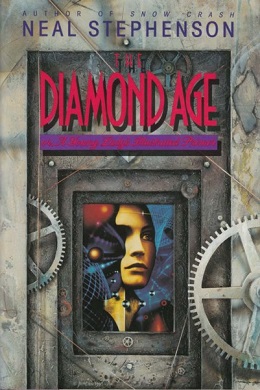
The Diamond Age or, a Young Lady's Illustrated Primer

Recently read Neal Stephenson's The Diamond Age, a novel set in a futuristic society (maybe ~100 years from now) in China. Whether this book presents a dystopian or utopian vision is unclear, maybe it shows both, although the dystopian aspects (callous brutality, pervasive misogyny) are more salient.

Background (no spoilers):

In this society, nanotechnology has become the dominant means of production. (Many buildings are built out of man-made diamond because it is hard and durable, hence the title). Stephenson's novel is Marxist in that he posits a world in which the social structure arises from the means of production. Matter Compilers, or MCs, create food, clothes, etc. using molecular blueprints downloaded from a central government server. This top-down means of production makes poor people dependent on the government for their existence.

Most people are divided into phyles (aka claves) which are essentially tribes which live together in different parts of the city. One prominent phyle is that of the "Vickys" - neo-Victorians who have consciously adopted Victorian dress, mannerisms and social codes, believing that this is preferable to the amoral degeneracy of prior centuries (i.e. our time). The poor are the exception to this structure; they have no phyles, and lead lives that are nasty, brutish and short.

Nanotechnology has also become a means of ugly warfare and supports a bizarre justice system which combines Confucian principles with nanotech-based methods of execution. Rogue nanotech experts develop their own micromachines in defiance of the government's prohibition, and use them to spy, track, and kill.

My take on it:

I really, really enjoyed the first half of this book. Stephenson's vision is brilliant: complex, detailed, strikingly creative and novel, and powerful. It is also very pleasurable to read. However, I found the second half of the book chaotic and the ending unrealistic and anticlimactic. I was also troubled by the book's at times graphic misogyny, which does not seem to serve any purpose beyond reinforcing the brutality of the world. However, I highly recommend it because it is truly novel and gripping and introduces many fascinating ideas.

Stephenson's Novels

Monday, November 1, 2010

Kim Stanley Robinson's Mars Trilogy


Wow! Many thanks to Colin for recommending this fascinating, compelling science fiction novel (the first of a trilogy) describing the colonization of Mars.
Many significant Earth-bound themes are thrown into sharp relief, accentuated by the open possibilities for establishing a new (?) world order on Mars. Some of these issues are represented by key members of the First Hundred to settle on the planet: Idealism (John Boone) versus political manipulation (Frank Chalmers), eco-preservation (Ann Clayborne) versus aggressive terraforming (Sax Russell), and revolutionary democratic forms of government (Arkady Bogdanov) vs. control by transnational corporations (Phylis Boyle). The characters are interesting individuals and Mars is depicted in astonishing and deeply-researched detail as hostile, extraordinarily strange, and awe-inspiringly beautiful.

Friday, June 4, 2010

How To Build Your Own Spaceship


Guess I've been on the same wavelength as Colin, reading about space, fiction or non! This short book by Piers Bizony is very interesting. He discusses the basic science behind propulsion and orbits, some history of space travel, and a great deal about past and future commercial opportunities. Bizony has a dry sense of humor and overall the book is informative and entertaining. (Famous dancer Buzz Aldrin recommends it).

Saturday, May 22, 2010

Where is Everybody?

This book presents a set of 50 possible solutions to the Fermi Paradox ("where is everybody," i.e. if the universe is so big why haven't we met any other technological civilizations?). The solutions come in three main categories: they're already here, they exist but haven't communicated, and they don't exist. The book is not at all rigorous but serves as a broad-ranging introduction that includes more speculative material than the textbook below. My only quibble with this book concerns his chapters on evolutionary biology, where I don't feel he's fully acquainted with the complexity of the issue, but in fairness there isn't space to even begin to address those questions here. Overall this was a entertaining and good broad overview to a wide selection of factors to consider on the subject, from the physics of interstellar travel to von-Neumann probes and Dyson spheres, although a lot of the science is glossed over and I found a couple of his mathematical models a bit suspicious (or at least poorly defended).

An Introduction to Astrobiology

I am doing some readings about aliens this summer and this was one of the books on my list. It is basically an undergraduate level textbook with some fairly nontechnical chapters on the genesis of life, cell biology, the essential chemical reactions of life, extremophile terrestrial species, planetary geology, exoplanet astronomy, and SETI. It does a very good job of explaining what we know and how we know it. The book is about five years out of date (most relevant for the astronomy section, as exoplanet discoveries are starting to pour in) but gave me a good basis for further reading on the subject.