Showing posts with label Marx. Show all posts

Sunday, February 15, 2015

The Coast of Utopia I, II, and III


These three plays by Tom Stoppard bring to life some of the Russian revolutionaries during the period from 1833 to 1866.  Michael Bakunin and Alexander Herzen are particularly featured - Bakunin as a somewhat juvenile, but infectiously enthusiastic inciter of armed revolution and Herzen as a thoughtful, clear-headed intellectual who believes in incremental change.  Herzen to Bakunin:
Stop!- 'Destruction is a creative passion' You're such a . . . child! We have to go to the people, bring them with us, step by step.
Later, Bakunin offers a toast "The liberty of each, for the equality of all!" and Herzen objects "What does that mean?  It doesn't mean anything" and Bakunin replies "It means I am not free unless you, too, are free - and Herzen says "That's nonsense - you were free when I was locked up."  Herzen finally concludes

"I am devoted to you, Bakunin. I delight in the fanfare, no, the funfair of your pronouncements.  I would name my child for you, but equally I would name you for my child, because everything which is simple you make difficult and everything difficult simple.  You've made yourself a European reputation by a kind of revolutionary word-music from which it is impossible to extract an ounce of meaning, let alone a political idea, let alone a course of action". 

Stoppard's dialog is, naturally,  fast and clever, but there are moments of heart-rending tragedy, and the personalities are indelible.


Tuesday, January 31, 2012

David Harvey - The Enigma of Capital


David Harvey, who is, along with Fredric Jameson, one of my favorite academics, here presents his analysis of the recent financial crisis and offers a theory that attempts to explain the crisis-prone nature of capitalism in terms of the inner contradictions of the system.  At the center of his argument is the "surplus absorption problem," in which the surplus generated by capital today must be reinvested into new lines of production in order to maintain an increasingly unrealistic 3 percent annual compound growth.

While the argument is complex enough that I don't want to try and represent it here, the book is surprisingly accessible and the ideas in it are presented relatively simply.  Some familiarity with the vocabulary of academic Marxism is helpful to understand Harvey's argument, but it is much easier going than Jameson, for example.

I would highly recommend this book to anyone who wants to understand the present financial crisis and why we desperately need to be shrinking our economy, not growing it.

Monday, February 28, 2011

David Harvey - Spaces of Hope

This is one of the books I am reading for my thesis. In it, Harvey presents a convincing case for and way of adapting Marx's ideas to the conditions of capitalism in postmodernity, particularly in the context of globalization and the death of the Modernist utopian project in the aftermath of WWII.

Particularly interesting is Harvey's application of his "historical-geographical materialism" in his case study of Baltimore in the second half of the twentieth century, as he examines the ways that capital manipulates the construction of urban space in order to maintain its exploitative control over the working class.

In this book Harvey brilliantly addresses the worries of postmodernity and the various postmodernisms while maintaining a commitment to the utopian dream and political praxis, offering both a framework to understand the mutual interactions of geography and capital and to offer resistance to the bourgeois myth that "there is no alternative" to consumer capitalism, democracy, and the tyranny of the free market.

I read two chapters of this book for a class in my sophomore year, and it has been highly influential in the development of my own political sympathies. Harvey's writing is clear and accessible (for the most part, although some background in literary theory and intellectual history of the twentieth century is useful) and completely devoid of the obscurantism that plagues a lot of academic writing. Fascinating and highly enjoyable.

Friday, December 31, 2010

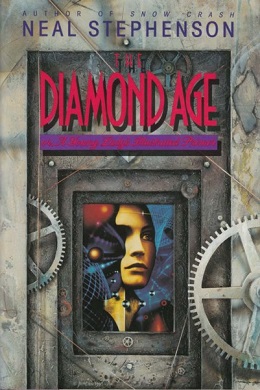
The Diamond Age or, a Young Lady's Illustrated Primer

Recently read Neal Stephenson's The Diamond Age, a novel set in a futuristic society (maybe ~100 years from now) in China. Whether this book presents a dystopian or utopian vision is unclear, maybe it shows both, although the dystopian aspects (callous brutality, pervasive misogyny) are more salient.

Background (no spoilers):

In this society, nanotechnology has become the dominant means of production. (Many buildings are built out of man-made diamond because it is hard and durable, hence the title). Stephenson's novel is Marxist in that he posits a world in which the social structure arises from the means of production. Matter Compilers, or MCs, create food, clothes, etc. using molecular blueprints downloaded from a central government server. This top-down means of production makes poor people dependent on the government for their existence.

Most people are divided into phyles (aka claves) which are essentially tribes which live together in different parts of the city. One prominent phyle is that of the "Vickys" - neo-Victorians who have consciously adopted Victorian dress, mannerisms and social codes, believing that this is preferable to the amoral degeneracy of prior centuries (i.e. our time). The poor are the exception to this structure; they have no phyles, and lead lives that are nasty, brutish and short.

Nanotechnology has also become a means of ugly warfare and supports a bizarre justice system which combines Confucian principles with nanotech-based methods of execution. Rogue nanotech experts develop their own micromachines in defiance of the government's prohibition, and use them to spy, track, and kill.

My take on it:

I really, really enjoyed the first half of this book. Stephenson's vision is brilliant: complex, detailed, strikingly creative and novel, and powerful. It is also very pleasurable to read. However, I found the second half of the book chaotic and the ending unrealistic and anticlimactic. I was also troubled by the book's at times graphic misogyny, which does not seem to serve any purpose beyond reinforcing the brutality of the world. However, I highly recommend it because it is truly novel and gripping and introduces many fascinating ideas.

Stephenson's Novels