Showing posts with label family. Show all posts

Sunday, February 28, 2021

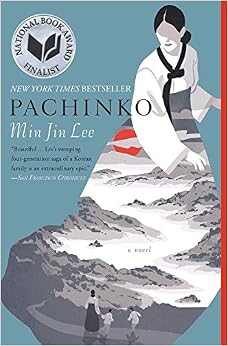
Pachinko - Min Jin Lee

Our March bookclub book was Pachinko, and WOW, it was fantastic!! The best book I've read in a long time. It tells the story of one Korean family across 4 generations, from their roots in Korea in 1883, to their lives in Japan up through 1989. 

Before reading this novel, I was ignorant of Japan's occupation of Korea, and the way Japan oppressed Korean expats after the war. (I had been aware of the shameful history of conscripted "comfort women," but not the broader context of colonization,  oppression, and forced assimilation). This ugly history is not exactly the center of this story, but it is its pervasive backdrop, and influences all of the major events in the family's lives.

The story is beautiful and heartfelt, and although parts are truly heartbreaking, it was a pleasure to read, because of the fascinating characters and their resiliency and even success, despite the many hard years of their lives. The author is clearly a brilliant observer of human nature, as her character studies read so true. The character Sunja is perhaps the central figure, as the story follows her life from young girl to septuagenarian grandmother, and her clear-eyed view of the world is deeply compelling. I would strongly recommend this book to all!

Sunday, January 18, 2015

Rabbit, Run - John Updike

Rabbit, Run is a dark and tightly controlled story about a washed-up basketball star, Rabbit, and his destructive yet sympathetic urge to find something better than mediocrity in his middle age. A powerfully human tale in compelling prose about disappointment and yearning, and the painful disparity between youth's bright dreams and pathetic, sordid reality. The kind of story that makes ones own domestic life seem heavenly.

Wednesday, April 16, 2014

The Grapes of Wrath - Steinbeck

For whatever reason, I was never required to read this book in high school, so I read it now for the first time as an adult. It's really a masterful work, very emotionally powerful and heartbreaking. The grotesque plight of the disenfranchised Oklahoma tenant farmers is told through the eyes of the Joad family. The story recounts their struggles as they are forced to leave their land and seek work in California, where they experience the cruelty of poverty and the futility of hard work and hope in the face of an oppressive system.  I am not surprised the book was so controversial in its day, the politics are very progressive and pro-labor. The book can be graphically disturbing but it is  an important story that remains very relevant today.

Friday, September 6, 2013

Fathers and Children

Lauren has already reviewed this book by Turgenev , often published under the title Fathers and Sons, providing a nice summary of its depiction of two generations of Russians, the idealists of the 1840's (the Fathers) and the nihilists of the 1860's (the Children).

Turgenev's portrait of the self-proclaimed nihilist Bazarov provoked huge controversy: opponents of the utilitarian nihilists reviled Turgenev, denouncing Bazarov as a villain.  Most nihilists dismissed the portrait as a laughable caricature, though a few actually praised him as a "new man" of the type who would rejuvenate Russia.
 "Your sort, you gentry," Bazarov tells Arkady, when the two friends come to the parting of the ways, "can never get beyond refined submission or refined indignation, and that's a mere trifle.  You won't fight.....but we mean to fight.....we want to smash other people!"
Interestingly, one of the few people in Russia who seemed to accurately understand Turgenev's portrayal was Dostoevsky, who saw Bazarov as a tragic character, doomed to unhappiness by the contradiction between his sterile and brutal intellectual beliefs and his human needs and longings. Dostoevsky's praise and understanding helped forge a strong but brief friendship with Turgenev, which, however, was quickly dashed to pieces by their widely divergent views on religion and whether Russia's future lay in adopting western ideas (Turgenev) or seeking guidance from the true Russian character, which, in Dostoevsky's view, derived from a deep faith in Christ.

I really enjoyed the book, which is lyrically written, with great sensitivity to human love and loneliness. Though Bazarov is infuriating in his brutality, he is captivating in his passions and deep emotions.


Wednesday, June 5, 2013

Yes, Chef - Marcus Samuelsson

A delightful, pleasurable book!  Marcus Samuelsson was born in a very small, primitive village in Ethiopia.  When he was 3, he, his mother and his older sister contracted tuberculosis.  Against all odds, and with amazing strength and determination, his mother carried him and, holding his sister's hand, walked with them  to a distant hospital - she died, but Marcus and his sister survived.  In a few months, they were adopted by a Swedish family who already had one adopted black child - and now had three!  The book consists of two parallel  stories - Marcus' unusual life history, and his development as a cook.  He has a passion for different kinds of tastes and cuisines.  Through exceptionally hard work and a can do attitude "Yes, Chef" - he progressed  up the "food chain" rapidly; at 24, his talent and training, together with a stroke of luck, allowed him to become the head chef at a classy Swedish restaurant in New York, Aquavit.  He quickly garnered a three-star review from Ruth Reichl and went on to other noteworthy successes - and some serious setbacks and personal trials, recounted with candor.  Great insights into the diverse world of first-class restaurants, and a warm, winning human story.

Saturday, August 18, 2012

The Mill on the Floss

George Eliot's books are highly intelligent and rewardingly insightful - the scope of setting and action is intentionally narrow, with a corresponding intensity of examination - like focusing sunlight with a magnifying glass so tightly that the spot bursts into flame. This book describes the Tulliver Family, centering on brother and sister Maggie and Tom, as they grow from childhood to young adults. The Tullivers have lived for generations as owners of a mill on the River Floss, near the larger city of St. Oggs (both fictional). The heart of the book is the troubled relationship between Maggie and Tom, made inevitable by the important difference in their characters. Tom has a strong moral sense and an unwavering confidence in the correctness of his judgments. Maggie is a sensitive and caring person, quick to empathize with others, but prone to impulsiveness that invariably leads her into troubles.
But if Tom had told his strongest feeling at that moment, he would have said, "I'd do just the same again." That was his usual mode of viewing his past actions; whereas Maggie was always wishing she had done something different.
Imprudent legal actions by Mr. Tulliver lead disastrously to bankruptcy and disgrace. Tom responds with courage and purpose, eventually paying the debts and restoring the family's honor. With the best of motives and honor, Maggie is nevertheless drawn into two conflicting romantic situations, causing a decisive break with Tom, who cuts her completely. Maggie remains devoted to Tom, however, and the book concludes with an emotional reconciliation between the two.

The preface of my edition (another beautiful Folio) states that this is Eliot's most autobiographical book - reflecting her estrangement from her own family and especially her brother, which resulted from her unconventional and socially unacceptable relationship with a married man. The book is deeply absorbing, with detailed and thoughtful exploration of relationships, with moving descriptions of powerful consequences resulting from small choices, and with a variety of strong characters - some good, some weak, some generous and some selfish - but every one convincingly and sympathetically rendered. Very highly recommended!

Monday, January 3, 2011

Anna Karenina

Another post on a book I read a year ago, so my thoughts are not as fresh. However, I have thought about the book a lot since then so have more broad-picture type comments.

Anna Karenina is one of the best books I have ever read. Tolstoy's writing is incredibly realistic, complex, deep, moving, and beautiful, and his thinking is prophetic. For me, the best things about this book are:

1. The complexity, coherence and realism of the world that Tolstoy invents. His writing comes as close to representing reality on paper as I can imagine is possible, and he does this in such a way that it feels completely natural. It is also fascinating: he knew such an immense about about so many things! Horse keeping, hunting, domestic life, business affairs, fashion, politics, relationships, gambling, agriculture, adultery, etc, etc. - all topics on which Tolstoy writes in depth and with ease.

2. The complexity, understanding and sympathy with which Tolstoy regards humanity: from the peasant to the nobleman and from the virtuous to the amoral, Tolstoy seems to understand everyone. The grace with which he is able to portray the inner life of various individuals is unparalleled. Anna Karenina is the greatest exception to this sweeping realism: for me she felt (at times) flat and under-explored, which was disappointing. Lyovin, on the contrary, is shockingly real, perhaps aided by the near-autobiographical nature of his character (by many accounts).

I cannot recommend this book highly enough.

Fathers and Sons


I realized I never made this post, even though I read the work last Christmas, so here goes: my thoughts on Turgenev's (1862) Fathers and Sons (Отцы и дети is actually Fathers and Children, although it's true that I don't recall any daughters in the novel).

This book is truly genius. I think of it often. The two generations under discussion are the Fathers (1840s) and Sons (1860s). The book describes (primarily male) family and friend relationships and the way that these interactions evolved during a time of major social change: the emancipation of the serfs occurred in 1861 and freed millions of people from serfdom, causing great upheaval in landed/aristocratic families and in society. The Fathers and Sons represent conflicting ideologies which are very interesting to consider, because their opposition foreshadows the 1917 revolution.

One of the two primary Sons in the book is Arkady Nikolaevich Kirsanov. He has recently graduated from St. Petersburg University where he became friends with a man named Bazarov. The Sons' values are boldly and at times offensively embodied by the larger-than-life Bazarov, a loud-mouthed, frog-dissecting, arrogant nihilist. These values include: egalitarianism, nihilism, and rejection of sentimentality and of bourgeois values.

The book begins with Arkady taking his friend Bazarov home to meet his father, the sensitive land-owner Nikolai Petrovich Kirsanov. Although Nikolai is one of the Fathers, he is liberal for his generation, and as an educated and thoughtful man is trying to make sense of and in some ways assimilate the liberal values of the youth while holding onto his appreciation of literature, the arts and the beauty of nature.

The conflicts in this book are fascinatingly timeless and really bear thought. Although I was not bowled over when I first read the book a year ago, it has been on my mind very frequently since and I have come to appreciate it very much.

Thursday, October 15, 2009

The Master of Ballantrae


Just finished this great Robert Louis Stevenson book. The blurb: "Set at the time of the Jacobite uprising, The Master of Ballantrae tells of a family divided". Boy, are they ever! "The intensity of the feud between the Durrisdeers, and the portrait of James - an incubus 'touched with the lurid flickerings from the Pit' - draws upon the deepest, darkest corners of Stevenson's imagination". I loved it. Interestingly, James repeatedly changes from charmer to tormentor - rather like the dramatic but convincing changes in the character of Long John Silver. And this comparison made me realize how strong a theme this is in Stevenson - the entire subject of Dr. Jekyll and Mr. Hyde - and a particularly fascinating theme for me personally. Gripping tale - great read!

Saturday, May 30, 2009

Four Seasons in Rome

After visiting Jesse, Eileen, and Henry in Rome, we got to re-visit them, in a way, through this delightful book, which Jesse let me take home. Four Seasons in Rome by Anthony Doerr, describes a year with his family in Trastevere while he was supported by a Rome Prize Fellowship. The book has a story arc, but largely consists of observations on life and parenting, set against the backdrop of Rome, beautifully captured in quick, vivid sketches. The subtitle gives a flavor of this very pleasant read: "On twins, insomnia, and the biggest funeral in the history of the world."

Netherland

Karen Knudsen gave me Netherland as a present - what a great read! The framework is the story of a Dutch man, married to an English woman, living in New York following 9-11. His wife is shaken by 9-11 and her own demons, goes skittish on their marriage, and returns to England with their young child. He commutes back and forth, trying to restore their marriage and understand himself. But the story focuses chiefly on the man's involvement with cricket, and a cricket enthusiast and promoter. The jacket blurbs say it's strongly reminiscent of The Great Gatsby, and nearly in the same league. Well, I barely remember Gatsby and didn't care for it all that much - shame on me, as I know some members of this family are true believers - maybe I'll try it again. Anyway, Netherland is wonderful - many unusual and arresting observations, an unsettling atmosphere, thoughtful insights into personality. Highly recommended! And Barack Obama read it!

Thursday, February 12, 2009

A Hundred Years of Solitude by Gabriel Garcia Marquez.


Colin gave me this for my birthday and I only recently started reading it. Of course, I probably won't finish it before school's out, but maybe I can read it during spring break. Regardless I am making pretty decent headway (~1/2 way through) and I am really liking it! I was very unenthusiastic about reading it because I thought I didn't like magical realism (since Winter's Tale disagreed with me so much) but I actually think this is awesome! Very powerful visual imagery and interesting story line.

Also, this book seems to me to have been a very large influence on Jonathon Safran Foer's novel Everything is Illuminated. If anyone else has read both these books, does that strike you as well?

Update: finished the book! Thought it was very good. For anyone who is considering reading this but thinks they have no time to read: this book lent itself very well to being read 1 paragraph at a time over a period of months.

Wednesday, January 7, 2009

Working backwards (II)

More mini-reviews, of books I read March - July 2008:

Middlesex - A rare homerun from the college book club. The immigrant experience of the American century. I prefer Philip Roth - perhaps because this is Greek instead of Jewish - but I'm splitting hairs. Read it.

A Black Englishman - More typical of the college book club: mediocre. The scent and feel of India lingers appealingly, though.

Day of Battle - Volume 2 of a as-yet-unfinished 3-volume history of America's involvement in WWII in Europe. This covers the invasion of Sicily and Italy, an intriguing contrast. Sicily is Patton, Monty, and a rip-roaring success. Italy, rarely the focus of pop historys of WWII, is a winter slog.

Winter's Tale - Grand and grandiose. A time-leaping paean to NYC.

Expectant Father - A useful alternative perspective, though less needed than its author thinks.

The Nine - A pop biography of the justices of the US Supreme Court. A very fast, fun, insightful read. But, damn, it makes you realize that the Conservatives have already won this battle.

Razor's Edge - The college book club goes for a classic, but still I'm not won over. First half of the book feels like Fitzgerald (yay!) but the second half feels like a very tentative inquiry into bohemianism (boo!).

Baby Whisperer - Another perspective on raising babies. Seems good - the compromise position between kids-first and Ferber - but the compromise is ambiguous and hard to execute on. Not recommended.