Sunday, July 7, 2013

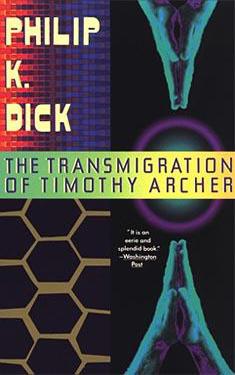
The Transmigration of Timothy Archer - Philip K. Dick


Just finished reading Philip K. Dick's The Transmigration of Timothy Archer (1982), published posthumously. (For those who may not know, transmigration is "the religious or philosophical concept that the soul or spirit, after biological death, begins a new life in a new body that may be human, animal or spiritual depending on the moral quality of the previous life's actions.")

The novel is set in the 1960s and 1970s, and follows the descent into drug addiction, radical religion, and madness of a deeply entwined but unhappy circle of five friends - intelligent but lonely Angel Archer, "professional student" at Cal Berkeley and poetic grass fiend, her disaffected husband, Jeff, whose maniacally intensive study of Wallenstein and Hitler becomes a pointless bid for his father's attention, Jeff's father, the dreamy but brilliant Bishop Timothy Archer, who unwittingly destroys himself and his friends, the Bishop's secret lover, the spiteful barbiturate addict Kirsten, and Kirsten's angelic son, the schizophrenic Bill.

The action begins on the day of John Lennon's death, with Angel's attempts to make sense of the "retributive fate" which has enveloped her life and destroyed those closest to her. For all this darkness, the book is a fairly light read, with some good humorous bits. For Philip K. Dick enthusiasts, it is also an interesting window into his thoughts in later years, and perhaps his most mature piece of writing. Although the repetitive nature of some of the lines was at times tedious for me, I believe it was a deliberate stylistic choice to evoke the obsessive nature of Angel's thoughts, and was effective for that purpose.

Bishop Archer's darkly comic misadventures are in fact based on the doings of the unfortunate Bishop James Pike - definitely worth reading a bit about that man, although save it for after you've read the novel - spoiler alert!

Tuesday, July 2, 2013

The 5th Wave

Janet Maslin recently wrote a piece for the New York Times about quality beach reads, and The 5th Wave is the first I've tackled from her list. It is a post-apocalyptic young adult novel about an alien invasion - War of the Worlds plus The Hunger Games plus The Stand. A great page turner - or wait for the movie, as it's already been optioned by Somy.

Friday, June 14, 2013

The Fantastic Flying Books of Morris Lessmore


This wonderful children's book was so moving that I was unable to finish reading it to Henry, Oliver, and Eve - so Henry finished reading it aloud to us. It is even more touching if you know the author's personal history. The illustrations are beautiful, and the book has been turned into an Oscar-award-winning animated short.

(Sorry no links - I'm posting from my phone.)

Wednesday, June 12, 2013

Spiderman and The Vulture

Spiderman and The Vulture by Henry Brackenbury is a short, can't-put-it-down,  gripping account of a fierce battle between the antagonists of the title.  Forceful illustrations and muscular text drive the story forward.  Spoiler alert:  Spiderman discovers a secret power of The Vulture, but is able to catch him and turn him over to the Police.  A terrific read!

The Emperor of All Maladies

A 608 page book that describes the history of cancer research and treatment sounds like a dry-as-dust sedative.  But, this Pulitzer Prize-winning book by physician-scientist Siddhartha Mukherjee is anything but! Dr. Mukherjee subtitles his book "A Biography of Cancer," and this subtitle accurately conveys how Mukherjee characterizes the "personality" of cancer as it has been perceived over the ages.  The book also discusses changes in ideas of how cancer should be treated, especially focusing on instances when those ideas, though wholly incorrect, were persuasively, even dogmatically championed by accomplished and articulate physicians and researchers.  The scholarship is impressive, but first and foremost, this is an immensely readable and thoughtful consideration of a menacing, devastating, yet fascinating disease.  Very highly recommended!

Wednesday, June 5, 2013

Yes, Chef - Marcus Samuelsson

A delightful, pleasurable book!  Marcus Samuelsson was born in a very small, primitive village in Ethiopia.  When he was 3, he, his mother and his older sister contracted tuberculosis.  Against all odds, and with amazing strength and determination, his mother carried him and, holding his sister's hand, walked with them  to a distant hospital - she died, but Marcus and his sister survived.  In a few months, they were adopted by a Swedish family who already had one adopted black child - and now had three!  The book consists of two parallel  stories - Marcus' unusual life history, and his development as a cook.  He has a passion for different kinds of tastes and cuisines.  Through exceptionally hard work and a can do attitude "Yes, Chef" - he progressed  up the "food chain" rapidly; at 24, his talent and training, together with a stroke of luck, allowed him to become the head chef at a classy Swedish restaurant in New York, Aquavit.  He quickly garnered a three-star review from Ruth Reichl and went on to other noteworthy successes - and some serious setbacks and personal trials, recounted with candor.  Great insights into the diverse world of first-class restaurants, and a warm, winning human story.

Galileo's Dream

Quite an unusual story, from Kim Stanley Robinson, author of the Mars Trilogy.  Well, two stories: one is the life of Galileo in Italy and the second is set in about the year 3000 on the planets of Jupiter.  Humans who have settled the planets have a way to time travel and, and for reasons never made completely convincing, they retrieve Galileo from time to time, to help settle some ongoing disputes.  The second of these narratives is a little loopy, but interesting.  Without serious spoilers, it's fair to reveal that the crux of some of the major dispute is whether Galileo is spared or martyred  for his heretical views.  A brief but terrifying part of the book allows Galileo and the reader) to visualize/experience being burned at the stake.  The main narrative describes  Galileo's life, vigorously portraying his vitality, his passion for experimentation, his astonishing breadth of interests and achievements, and his loving but tragic relationships with his daughters.  Not a perfect book, but a wonderful, absorbing read.