Wednesday, July 8, 2015

Seveneves - Neal Stephenson

Stephenson's fascinating new sci-fi novel, Seveneves, reads much like Kim Stanley Robinson's Mars trilogy in its realistic and highly-detailed portrayal of space exploration technology. The novel opens when an unknown force - the Agent - causes our Moon to explode. After a period of global bafflement, American scientist and media personality Doc Dubois realizes that the moon's fragmentation will continue exponentially, ultimately causing a Hard Rain of meteorites to obliterate the earth's service in a terrible holocaust lasting thousands of years. Scientists all over earth come to the same conclusion within a matter of weeks, and the entire world's resources are dedicated to preparing to save as many humans as possible by getting them onto a space station, along with earth's genetic data. If this feels like a spoiler, it's not, this merely sets the stage for all the action that unfolds from there! About the latter third of the book is dedicated to even more radical extrapolation from these initial conditions... Very unique and thought-provoking.

Stephenson is a brilliant social critic, and his book is rich with insights and neologisms like "amistics" -
"choices that different cultures made as to which technologies they would, and would not, make part of their lives. The word went all the way back to the Amish... who had chosen to use certain modern technologies, such as roller skates, but not others, such as internal combustion engines. All cultures did this, frequently without being consciously aware that they had made collective choices."
Highly recommend!

The Peripheral - William Gibson

The Peripheral is Gibson's most recent novel, and it did not disappoint. The tale opens in a a world that appears to be our near future, the logical extension of our society's tendency to favor technological advancement amidst crumbling physical infrastructure. The increasingly unstable economy is marked by intensified monopolization, and the average person can only get wealthy by "funny" means - "building" (producing and selling drugs), or "fabbing" (3D printing) prohibited items. Our morally-conscious protagonists - a wounded special ops veteran named Burton and his spunky sister, Flynne - choose instead to eke out a living by playing security forces in a video game for a mysterious employer. It is during one of these gaming sessions that Flynne becomes sole witness to a gruesome murder, an event that ignites a series of radical changes in their lives and world. The novel is ultimately set in two futures, whose inhabitants are able to influence each other by means of shared "peripheral" technology. Fascinating stuff, as always!

Wednesday, June 17, 2015

Rudin

I have been undergoing a change in viewpoint with respect to Turgenev.  I love Dostoevsky's novels - powerful, compelling, and full of passionate beliefs and actions.  And I know that Dostoevsky despised Turgenev, believing he had lost his roots in the Russian soil and people, and had become infatuated with Western culture - probably the greatest sin a Russian writer could commit in Dostoevsky's eyes.  Dostoevsky drew a wickedly funny, vitriolic parody of Turgenev in The Possessed.  But I really enjoyed Turgenev's Fathers and Sons, and Turgenev is portrayed as charming and shrewd in Stoppard's Coast of Utopia plays.

Well, like Fathers and Sons, Rudin is lyrical, thoughtful and, finally, sad, though leavened with a little uplifting sentiment.  Like the nihilist Bazarov in Fathers and Sons, Rudin also represents a kind of Russian type - in this case, a lofty intellectual who cannot transform his dreams into action.  When young, he is handsome, articulate and inspiring, attracting the interest and sympathy, particularly, of women.  But he is incapable of realizing his idealistic goals and, ultimately, fails those who placed trust in him.
"You have so often talked of self-sacrifice," she broke in, "but do you know, if you had said to me to-day at once, "I love you, but I cannot marry you, I will not answer for the future, give me your hand and come with me" - do you know, I would have come with you; do you know, I would have risked everything?  But there's all the difference between word and deed, and you were afraid now, just as you were afraid the day before yesterday at dinner of Volintsev."
and
"But up to this time I believed in you, believed in every word you said....For the future, pray keep a watch on your words, do not fling them about at hazard."
This is all terribly sad, but Rudin is redeemed somewhat at the end by an unlikely defender, Lezhnyov, who says:
But as for character, that's just his misfortune, that there's no character in him....But that's not the point.  I want to speak of what is good, of what is rare in him.  He has enthusiasm; and believe me, who am a phlegmatic person enough, that is the most precious quality in our times.  We have all become insufferably reasonable, indifferent, and slothful; we are asleep and cold, and thanks to any one who will wake us up and warm us!  It is high time!  Do you remember, Sasha, once when I was talking to you about him, I blamed him for coldness?  I was right, and wrong too, then.  The coldness is in his blood - that is not his fault - and not in his head.  He is not an actor, as I called him, or a cheat, nor a scoundrel; he lives at other people's expense, not like a swindler, but like a child....Yes; no doubt he will die somewhere in poverty and want; but are we to throw stones at him for that?  He never does anything himself precisely, he has no vital force, no blood; but who has the right to say that he has not been of use?  that his words have not scattered good seeds in young hearts, to whom nature has not denied, as she has to him, powers for action and the faculty of carrying out their own ideas?  Indeed, I myself, to begin with, have gained all that from him..."
I really enjoyed this book and recommend it highly.


Monday, June 1, 2015

Writing on the Wall: Social Media - The First 2,000 Years

Recently finished this book by Tom Standage, author of An Edible History of Humanity. I would not have picked this book up if I'd realized who it was by, because Standage's unsavory politics in AEHH left a bad taste in my mouth, and I was unimpressed by his derivative style. However, this book was (mostly) free of political rhetoric, and I really enjoyed the discussion of "really old" media. I particularly enjoyed the descriptions of the graffiti at Pompeii and the Roman letter abbreviations like SVBEEV (si vales, bene est, ego valeo = If you are well, that is good; I'm well.) I would like to find a book dealing just with this period of social media.

Monday, May 18, 2015

What I Talk About When I Talk About Running

Running is what he talks about.  The book is less a memoir than a journal of Murakami's daily running and participation in marathons over a period of several years.
By his own account, he's not an exceptional runner, but he's a very determined runner, for whom finishing marathons, ideally with a time improvement, is extremely important.  Although focused on running, the book does relate his decision and determination to run to his writing. He desires to write into old age and states that fatigue is the enemy of writing - thus, for him, running is a discipline to maintain the strength and endurance necessary to continue writing.
I found the book to be mildly interesting, but one feature really struck me.  When I had read The Wind-up Bird Chronicle, I felt that the main character, Toru, was so flat, rational and unemotional that he did not seem real to me - his character was so different from my own and people I know that I almost believed that no one could actually be like that.  In What I Talk About, Murakami seems to have a personality very similar to Toru's, very flat and rational, so that it seems startling and almost incomprehensible that his writing is so vivid!  In fact, I almost wondered if the voice of Murakami in this book is actually not his own, but a deliberate replication or recreation of the persona he invented for Toru.

Thursday, May 14, 2015

Dawn - Octavia Butler

Octavia Butler's Dawn is a brilliant exploration of human nature under oppressive conditions, and of the psychology of surviving assimilation. I don't want to give away too much, but suffice to say that her highly original post-apocalyptic vision is powerful, visceral, and disturbing.

This was also the first book I'd read by Octavia Butler, a talented African American female sci-fi author (her Wikipedia page here).

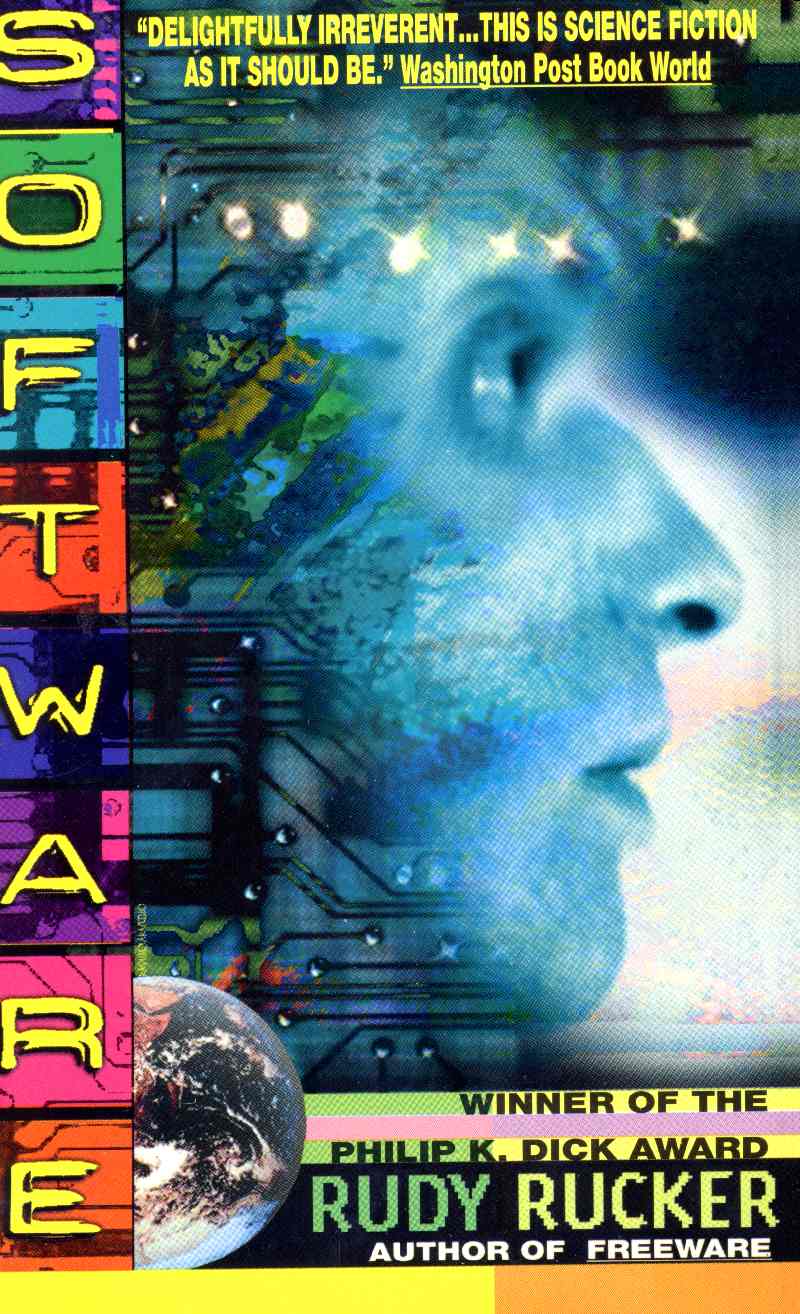
Software - Rudy Rucker

In Software, aging robot engineer Cobb Anderson has fallen on hard times. After the AI robot "boppers" he programmed to evolve learned to violate Asimov's laws and rebelled against their human overlords, Cobb was tried for treason and forced to abandon his groundbreaking scientific studies. A now decrepit has-been with nothing to occupy his time but his old hippy girlfriend and a bottle of booze, Cobb has basically given up on life. That is, until his first and best robot, Ralph Numbers, shows up and promises to make him immortal.

This exciting and compelling novel explores the meaning of humanity and the potentially transformative power of technology through the colorful exploits of Cobb and his junkie side-kick, the flamboyant and foul-mouthed "Sta-Hi."

It deals with similar questions as do Bicentennial Man and Ghost in the Shell - what really makes someone a human? What is it that we experience as the self? In my bookclub, we call this latter question the "phone booth" problem (one description of this thought experiment here).
"You wanted to know who I am. I gave you one answer. A robot-remote. A servo-unit operated by a program stored in a bopper spaceship. But... I'm still Misty-girl, too. The soul is the software, you know. The soft ware is what counts, the habits and the memories. The brain and the body are just meat, seeds for the organ-tanks." 
I will definitely look forward to reading the second and third parts of this trilogy, and thanks to my IT friend Josh for the recommendation! (By the way, there are versions of these books on Rucker's website, but some of the more graphic language/brutal phrasing seems to have been edited out in those versions.)