Thursday, August 22, 2019

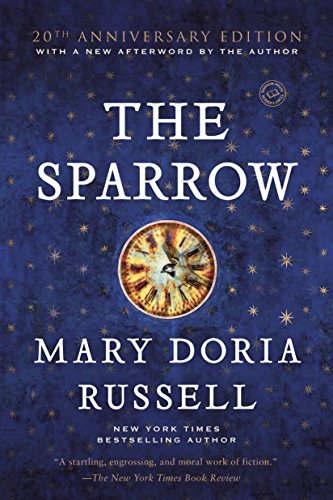
The Sparrow - Mary Doria Russell

I read The Sparrow on a recommendation from Mark's sister, Kelly, who said it is her favorite book. WOW! It is a masterpiece. Totally brutal without being vulgar, and wholly fresh and unexpected.

The story is told from both ends - an idealistic Jesuit monk bonding with his close-knit group of friends, and this same monk, broken almost beyond recognition, after his return from a first-contact mission gone horribly awry.

I don't want to say too much lest I spoil anything, but this is definitely a first-rate book, which I highly recommend! It is rough but very powerful and poignant.

Jesse's review here
Dad's review here

Sunday, August 18, 2019

The Neapolitan Novels


Like millions of others, I found Elena Ferrante’s Neapolitan novels (My Brilliant Friend, The Story of a New Name, Those Who Leave and and Those Who Stay, The Story of the Lost Child) to be fully absorbing and addicting – I don’t say riveting, as many times I alternated between can’t put it down and can’t keep reading. The four books comprise a single, long story of the lifelong, deep and conflicted relationship between two girls, Elena (or Lenù), the narrator, and Rafaella (Lila).  The girls grow up in a poor and violent neighborhood of Naples, from the 1950’s to 2014  – the pervasive violence is not always due to the activities of the camorra, the “secret” crime syndicate that was widespread in Campania, but is embedded in the families and neighborhoods, and especially in the relationships between men and women. 
I was angry.  I said, “You want to use me to con them?”

She understood that she had offended me.  She squeezed my hand hard. “I didn’t intend to say something unkind.  I meant only that you are good at making yourself liked.  The difference between you and me, always, has been that people are afraid of me and not of you.”

“Maybe because you’re mean,” I said, even angrier.

“Maybe,” she said, and I saw that I had hurt her as she had hurt me.  Then, repenting, I added immediately, to make up: “Antonio would get himself killed for you: he said to thank you for giving his sister a job.”

“It’s Stefano who gave the job to Ada,” she replied. “I’m mean.”
The relationship between Lenù and Lila is synergistic – on her own, Lenù is book-smart, but a striver, who says she is only fully alive and most creative when working with, or stimulated by Lila.  In contrast, Lila is strong, exceptionally creative and fiercely independent, but seems to seek and need the validation of her accomplished friend.  And their lives and friendship are framed in the books within the larger currents of Italian political and social life, which are fully and grippingly explored.  Still, there are key events in the books whose meaning and significance I cannot quite grasp but which remain in my mind long after closing the books.  Fascinating books!
-->

Saturday, July 27, 2019

One Hundred Poems from the Japanese


Kenneth Rexroth was a highly-regarded poet and influential leader of the San Francisco School of poets in the 1950’s (but he pleaded innocent to the suggestion that he was a Beat Poet!)  In One Hundred Poems from the Japanese, he offers a history of Japanese poetry from the significant period of the 700s to the late 1100s, through translations of the works of major figures.  All of the poems are short, characteristic of Japanese poetry; haikus were a later form that Rexroth did not value as highly, and he offers only a few famous examples in an appendix). 

Many of the poems, read alone, are strikingly lovely and/or thoughtful:
When I left my girl
In her grave on Mount Hikite
And walked down the mountain path,
I felt as though I were dead.
The meaning and significance of the poems is immensely enhanced by Rexroth’s introduction and by notes on many of the poems, discreetly located at the end of the book.  I had been unaware of some important themes and devices that, when explained by Rexroth, opened entirely new perspectives on what had seemed to me to be beautiful but simple moments in nature:
Though the purity
Of the moonlight has silenced
Both nightingale and
Cricket, the cuckoo alone
Sings all the white night
In a note, Rexroth briefly explains the significance of the different birds in Japanese literature; for example, the cuckoo “is also supposed to be a spirit from Hell, and, again, symbolizes the pleasures of the flesh, courtesans and prostitutes, sacred and profane”.  He suggests that this poem could mean “The salvation of Buddha has enraptured both the householder and the monk or nun, but the prostitute worships in her own way, all through the night.”

A very rewarding book.

Thursday, July 11, 2019

Crazy Loco | Stories by David Rice

This is a funny, sweet, wise, loopy book of short stories about kids growing up in Mexican-American families in South Texas.  Laughed and cried.  Wonderful.

Friday, June 28, 2019

Inheritance


All my life I had known there was a secret.
What I hadn’t known: the secret was me.

Inheritance, a particularly interesting and thoughtful memoir, was written by Dani Shapiro, a successful novelist, memoirist and professor of creative writing.  Both her parents were Jewish and her ancestors, on her father’s side, were exceptionally distinguished rabbis and leaders of national Orthodox Jewish associations.  Dani spoke Hebrew fluently, having attended a Joseph Schechter Jewish Day School, a prestigious prep school and then Sarah Lawrence, where she was strongly influenced by Grace Paley.  It’s not a terrible spoiler (it's recounted within the first few pages of Inheritance) to say that Dani was literally stunned and disoriented to discover, through incidental DNA testing, that her father, Paul Shapiro, was not her biological father.  With the help of her husband, Michael Meran, a journalist and screenwriter, Dani quickly was able to identify a person who was almost certain to be her biological father. 

The shocking DNA evidence triggers intense self-searching and quests for understanding. How could her parentage have been so estranged from Jewish law and tradition?  Which members of her family (almost all now deceased) knew the secret of her parentage?  How could she herself, blond and blue-eyed, not have known? 

And, finally, what relationships might develop with her new family and how would she be affected by discovering this whole new side of herself?  I highly recommend this most emotional and thoughtful memoir.
-->

Tuesday, June 18, 2019

Daughter of the Samurai

My thanks to Lauren, who, several years ago,  recommended this unusual, interesting, and charming book!  Etsu Inagaki Sugimoto was born in a small Japanese village in 1874, just twenty years after Mathew Perry and "the black ships" forced Japan to open to the world.  Etsu's father had once been a high samurai official and she was brought up in the stringent and severe samurai tradition.   She was disciplined and courageous, yet she also proved to be flexible, open-minded and surprisingly thoughtful and sweet.  In Daughter of the Samurai, Etsu relates and reflects on her early experiences in traditional Japan and her later life in America.

When still very young, Etsu was betrothed to Matsuo, a friend of her brother.  Before she ever met Matsuo, however, he moved to America to set up a business. Her family then allowed Etsu to move to Tokyo so that she could receive a "western education" that would prepare her for her new life - in Cincinnati!   Etsu and Matsuo had two daughters, but after Matsuo died, she returned to Japan for several years.  Later, they moved back to America, where Etsu eventually taught Japanese language and culture at Columbia University and authored several books. I discovered that her youngest daughter, Chiyo, also became an author; one of her books had a title,  "But the ships are sailing -- sailing," which puzzled me until I read the concluding paragraphs of Daughter of the Samurai:
"I wonder why they were called "black ships." Do you know, Honourable Grandmother?" 
"Because far out on the waters they looked like clouds of black smoke rolling nearer and nearer, and they had long, black guns that roared. The red barbarians cared nothing for beauty. They laughed at the Japanese boats, whose sails were made of rich brocade and their oars of carved wood, inlaid with coral and mother-of-pearl. They talked like tradesmen and did not want to learn the hearts of the children of the gods." 
The grandmother stopped and slowly shook her head. 
"And after that?" asked the eager little voice. "And after that, Honourable Grandmother?" 
"The black ships and the rude barbarians sailed away," she concluded, with a deep sigh. "But they sailed back many times. They are always sailing. And now the people of our sacred land talk like tradesmen and no longer are peaceful and content." 
"Will they never be peaceful and content again?" asked the little girl, with anxious eyes. "The honourable teacher said that sailing ships bring lands nearer to each other." 
"Listen!" said the grandmother, holding herself very straight. "Little Granddaughter, unless the red barbarians and the children of the gods learn each other's hearts, the ships may sail and sail, but the two lands will never be nearer." 
Years passed, and Etsu-bo, the little girl who had listened to the story of the black ships and the red barbarians, herself went sailing on a black ship that moved without sails, to a new home in the distant land of the red barbarians. There she learned that hearts are the same on both sides of the world; but this is a secret hidden from the people of the West. That makes another chapter to my grandmother's tale - another chapter, but not the last.  The red barbarians and the children of the gods have not yet learned each other's hearts; to them the secret is still unknown, but the ships are sailing---sailing----

Tuesday, May 28, 2019

The Blessing Way and Dance Hall of the Dead - Tony Hillerman

Over Memorial Day weekend, my friends and I went camping, and I finally had some time to relax and read. Inspired by dad, I decided to give Tony Hillerman a try, and I'm glad I did! I read the first two of his Navajo country murder mysteries, The Blessing Way (1970) and Dance Hall of the Dead (1973).

I really enjoyed these novels, particularly the worldview conveyed by the protagonist, Navajo sheriff Joe Leaphorn:

"Leaphorn never counted on luck. Instead he expected order—the natural sequence of behavior, the cause producing the natural effect, the human behaving in the way it was natural for him to behave. He counted on that and upon his own ability to sort out the chaos of observed facts and find in them this natural order. Leaphorn knew from experience that he was unusually adept at this. As a policeman, he found it to be a talent which saved him a great deal of labor. It was a talent which, when it worked unusually well, caused him a faint subconscious uneasiness, grating on his ingrained Navajo conviction that any emergence from the human norm was unnatural and—therefore—unhealthy. And it was a talent which caused him, when the facts refused to fall into the pattern demanded by nature and the Navajo Way, acute mental discomfort."

When I read this passage, I was strongly reminded of a quote by Hercules Poirot in the film version of the Murder on the Orient Express -

"I can only see the world as it should be. And when it is not, the imperfection stands out like the nose in the middle of a face. It makes most of life unbearable. But it is useful in the detection of crime."

I'm not sure if this characterization reflects a shared reality among talented detectives, or whether it is a purely literary conceit, but I thought this parallel was interesting.

The books also treat fairly extensively on Navajo culture and religion, its beliefs, and its rituals. My experience with Native American culture, and Navajo culture in particular, is fairly limited, so I was very interested in the insights from these works. (Although Hillerman is White, it seems he was was considered a true friend of the Navajo people and an excellent student of their culture, and his books, although works of fiction, are evidently praised for their accuracy in this regard.)

Finally, I really enjoyed the depictions of nature, and especially the scenes where Leaphorn applies his skilled tracking abilities to locate missing persons. The books are very successful in conveying a sense of the rich beauty and detail of nature, which I appreciated.

I will definitely be reading more Hillerman!