
Saturday, April 5, 2014
A Delicate Truth

Ethan Frome

This painting, Home at Montclair by George Inness (interestingly, from the collection at the Clark Art Institute in Williamstown), is shown on the front cover of the Signet Classic edition of Ethan Frome and is a perfect image for the setting and events of the book: bleak, cold, dark and offering little hope for momentary joy, let alone release. Well, what the heck - it's Edith Wharton!
Starkfield (!), Massachussetts is a rare departure from Wharton's usual metropolitan world of wealth and privilege, but the theme is again how chance circumstances of life can crush the hopes of an individual, in this case, Ethan Frome, an admirable and likable character who meets and accepts an inexorable and cruel fate. The book is simply and beautifully written - and very sad.
Friday, February 21, 2014
The London Monster: A Sanguinary Tale - Jan Bondeson
 Bondeson's tale is a stranger-than-fiction account of the "Monster," a savage serial stabber in 1790s London, who preyed upon unaccompanied young women by with a "tremulous eagerness," accompanying his attacks with shockingly foul and indecent language. Although the Monster (or perhaps, Monsters) employed a variety of sinister stratagems of assault, including stabbing unsuspecting maidens in the face using a knife hidden inside a bouquet of artificial nosegays, and tearing at women's exposed arms with some sort of metal claw, his preferred method of attack was to slash at his victims' thighs and buttocks, inspiring fearful aristocratic women to wear copper petticoats, and lower class women to hide frying pans under their skirts.
All told, the Monster attacked somewhere between 15-30 women, causing mass hysteria and vigilante mob action, before a local pervert and malcontent, artificial flower-maker Rhynwick Williams, was brought to trial and ultimately convicted (although both then and now, doubts remain about his guilt), essentially ending the slew of attacks and putting an end to the witch-hunt.
The book is largely an exploration of the panic caused by these stabbings, as well as the popularity of the subject in the media (the book contains ribald poetry, bawdy newspaper cartoons, and descriptions of various Monster plays from the period), as well as the bizarre circumstances of the two trials.
Pretty odd, but interesting!
Monday, February 17, 2014
The Analects of Confucius - trans. by Legge
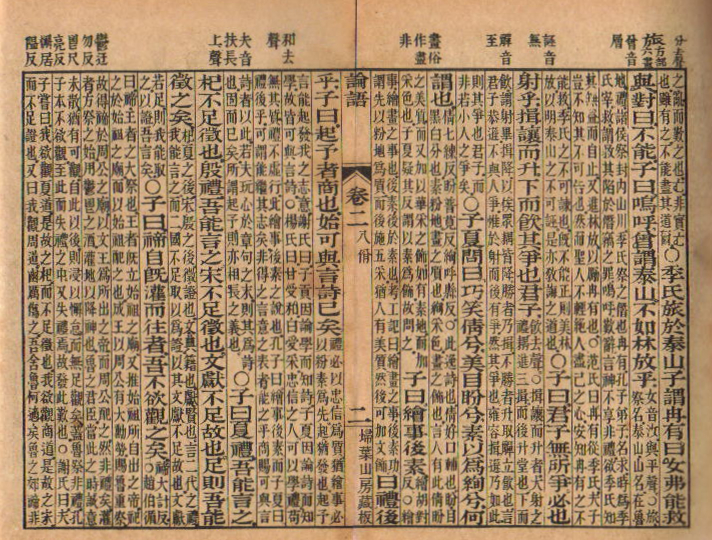
The Master said, "Riches and honours are what men desire. If it cannot be obtained in the proper way, they should not be held. Poverty and meanness are what men dislike. If it cannot be avoided in the proper way, they should not be avoided."Other quotes, while interesting or thought-provoking, were less clear to me. For example,
The Master said, "A cornered vessel without corners---A strange cornered vessel! A strange cornered vessel!"I think this would be a good book to keep around to re-read and consider in small sections over a period of time.
Monday, February 10, 2014
Author Tags!
Well, it took me forever, but I have gone back and added author tags to everyone's posts. It was irking me that I couldn't see a list of all posts by X person - now you can! In the righthand sidebar, under the Popular Labels wordcloud (which includes all tags used in at least 4 posts), there is now an Authors wordcloud. Make more posts, be sure to use your author label, and your name will become bigger in the cloud. :)
Hope this is useful for everyone!
Hope this is useful for everyone!
Sunday, February 9, 2014
A Connecticut Yankee in King Arthur's Court

Twain wrote the sweet and simple Prince and the Pauper in 1881, followed by Huck Finn - not so sweet or simple - and then Connecticut Yankee in 1889. While Prince and the Pauper celebrates human mercy, Connecticut Yankee emphasizes
The truth was, the nation as a body was in the world for one object, and one only: to grovel before king and Church and noble; to slave for them, sweat blood for them, starve that they might be fed, work that they might play, drink misery to the dregs that they might be happy, go naked that they might wear silks and jewels, pay taxes that they might be spared paying them, be familiar all their lives with the degrading language and postures of adulation that they might walk in pride and think themselves the gods of this world. And for all this, the thanks they got were cuffs and contempt; and so poor-spirited were they that they took even this sort of attention as an honor.There is much humor - some sly (The chapter titled Morgan le Fey starts, "If knights errant were to be believed, not all castles were desirable places to seek hospitality in.") and some uproarious:
It was a very fine show. In a gallery a band with cymbals, horns, harps, and other horrors, opened the proceedings with what seemed to be the crude first-draft or original agony of the wail known to later centuries as 'In the Sweet By and By'. It was new, and ought to have been rehearsed a little more. For some reason or other the queen had the composer hanged after dinner.But the foundation of the book is the brutal and callous treatment of poor or powerless people by the lords and Church. Some of these episodes are heart-rending. And, without spoilers, the conclusion of the book is that in general, men are powerfully molded by society, making it nearly impossible to reform the oppressor or free the oppressed.
This is a powerful and wonderful book, simply but beautifully written, portraying, with love, sympathy, humor and horror, the full range of human behavior.
Anathem - Neal Stephenson
Today I finished my 6th book of 2014, Stephenson's Anathem. WOW!
 The book is set on the planet Arbre, quite similar to our own, but divided in the present time (and for the past several thousand years) into the Saecular and Mathic worlds. Inside the "maths", or cloisters, live the Avout, non-religious men (fraas) and women (suurs) who have devoted their lives to intense scholarship and medieval asceticism, almost wholly without advanced praxis (technology). They live secluded from the outside world, except for a 10-day holiday called Apert during which the gates are opened, when the "extras" are free to come into the math, and the Avout are free to leave and explore extramuros. Depending on whether an Avout is a Unitarian, Tenner, Hundreder, or Thousander, his or her order will have the chance to celebrate Apert only once a year, decade, century, or millenium. In the mean time, all knowledge of the Saecular world is strictly avoided.
The book opens as Fraa Erasmas, a Tenner, is about to celebrate his first Apert since joining his math, the Concent of Saunt Edhar, as a young boy. Over the course of this holiday, however, he and his fraas and suurs discover that something very serious and shocking has been happening extramuros. Dun dun dun!
Of course I won't give away more, but suffice to say, this book is pure Stephenson genius. A beautifully rich world filled with highly likable characters (especially Fraa Jad!) engaged in a gripping and meaningful quest.
Recommended if you enjoyed: The Name of the Rose, Reamde
Stephenson's Novels
 The book is set on the planet Arbre, quite similar to our own, but divided in the present time (and for the past several thousand years) into the Saecular and Mathic worlds. Inside the "maths", or cloisters, live the Avout, non-religious men (fraas) and women (suurs) who have devoted their lives to intense scholarship and medieval asceticism, almost wholly without advanced praxis (technology). They live secluded from the outside world, except for a 10-day holiday called Apert during which the gates are opened, when the "extras" are free to come into the math, and the Avout are free to leave and explore extramuros. Depending on whether an Avout is a Unitarian, Tenner, Hundreder, or Thousander, his or her order will have the chance to celebrate Apert only once a year, decade, century, or millenium. In the mean time, all knowledge of the Saecular world is strictly avoided.
The book opens as Fraa Erasmas, a Tenner, is about to celebrate his first Apert since joining his math, the Concent of Saunt Edhar, as a young boy. Over the course of this holiday, however, he and his fraas and suurs discover that something very serious and shocking has been happening extramuros. Dun dun dun!
Of course I won't give away more, but suffice to say, this book is pure Stephenson genius. A beautifully rich world filled with highly likable characters (especially Fraa Jad!) engaged in a gripping and meaningful quest.
Recommended if you enjoyed: The Name of the Rose, Reamde
Stephenson's Novels
- The Big U (1984)
- Zodiac (1988)
- Snow Crash (1992)
- Interface (1994)
- The Diamond Age: or A Young Lady's Illustrated Primer (1995)
- The Cobweb (1996)
- Cryptonomicon (1999)
- The Baroque Cycle
- Quicksilver (2003), volume I
- The Confusion (2004), volume II
- The System of the World (2004), volume III
- Anathem (2008)
- The Mongoliad (2010–2012)
- Reamde + Colin's review (2011)
Subscribe to:
Posts (Atom)