Friday, December 31, 2010

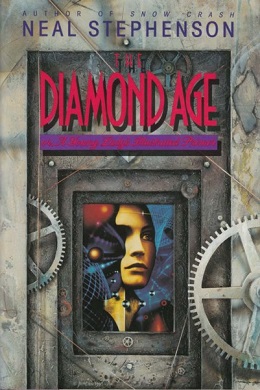
The Diamond Age or, a Young Lady's Illustrated Primer

Recently read Neal Stephenson's The Diamond Age, a novel set in a futuristic society (maybe ~100 years from now) in China. Whether this book presents a dystopian or utopian vision is unclear, maybe it shows both, although the dystopian aspects (callous brutality, pervasive misogyny) are more salient.

Background (no spoilers):

In this society, nanotechnology has become the dominant means of production. (Many buildings are built out of man-made diamond because it is hard and durable, hence the title). Stephenson's novel is Marxist in that he posits a world in which the social structure arises from the means of production. Matter Compilers, or MCs, create food, clothes, etc. using molecular blueprints downloaded from a central government server. This top-down means of production makes poor people dependent on the government for their existence.

Most people are divided into phyles (aka claves) which are essentially tribes which live together in different parts of the city. One prominent phyle is that of the "Vickys" - neo-Victorians who have consciously adopted Victorian dress, mannerisms and social codes, believing that this is preferable to the amoral degeneracy of prior centuries (i.e. our time). The poor are the exception to this structure; they have no phyles, and lead lives that are nasty, brutish and short.

Nanotechnology has also become a means of ugly warfare and supports a bizarre justice system which combines Confucian principles with nanotech-based methods of execution. Rogue nanotech experts develop their own micromachines in defiance of the government's prohibition, and use them to spy, track, and kill.

My take on it:

I really, really enjoyed the first half of this book. Stephenson's vision is brilliant: complex, detailed, strikingly creative and novel, and powerful. It is also very pleasurable to read. However, I found the second half of the book chaotic and the ending unrealistic and anticlimactic. I was also troubled by the book's at times graphic misogyny, which does not seem to serve any purpose beyond reinforcing the brutality of the world. However, I highly recommend it because it is truly novel and gripping and introduces many fascinating ideas.

Stephenson's Novels

Rumpole of the Bailey


I recently finished reading Sir John Mortimer's Rumpole of the Bailey. The witty and poetry-quoting protagonist of this book is Rumpole, a 68-year-old barrister who is a defense attorney for England's petty criminals. The novel is broken down into short stories about different cases that he has been involved in. This book is totally hilarious. The language is also quite pleasing - the book is full of nicely turned phrases. It reminds me a bit of Mr. Sammler's Planet, but is comic rather than existential. I highly recommend it!

Monday, November 29, 2010

Apolo Ohno-- ZERO REGRETS!!!

AW YEAH WHAT AN INSPIRING TITLE!!!

The rest of the book is OK. The problem with it is that Apolo didn't have to overcome any super-tough and challenging obstacles in his familial and emotional life to achieve his dreams. Sure, he grew up without a mom, but he never makes this out to be a super big deal. There are only really two events that try and fit the "monumental challenge" criteria:

One, he ran away from home, once, because his dad wanted him to go to a speed-skating training camp and he wanted to party.

Two, he had crappy committment, and his dad dropped him off at a cabin for nine days, where he called his dad and decided he wanted to stop being an idiot and get down to work.

Sadly, these things just make him look like kind of a crybaby, rather than a story to inspire millions. I would recommend people find more inspirational books instead of reading this. Nonetheless, the story was quite an interesting read if you want to find out about Ohno's life and accomplishments.

P.S. Apolo is indeed quite arrogant. I thought it was funny, but it really annoyed my mom, so if you're against that kind of thing, you may have trouble with this book.

Thursday, November 11, 2010

Personal Impressions

This book consists of portraits of people whom Isaiah Berlin, in almost every case, knew personally. Some, such as Chaim Weizmann, Felix Frankfurter, and Aldous Huxley, are very well known. The portraits focus on personal characteristics rather than achievements and each is written in vivid, highly engaging language that conveys thoughtful impressions of the characteristics that make people interesting or compelling as friends, or statesmen, or contributors to the worlds of learning or the arts. Berlin has keen insights and a very appreciative view of others' personalities, whether they be congenial or prickly. His comments on Pasternak and other Russian writers of the 30's through the 50's show many individuals acting with tact and courage in the face of official intimidation up to and including liquidation. For me, his portraits of Churchill and Roosevelt (he knew neither personally) shed new and very interesting light on how these allies so powerfully affected events in Western society and World War II. (Berlin does not say this directly, but his portraits define Churchill and Roosevelt as quintessential hedgehog and fox, respectively). Just a couple delightful excerpts: Of the historian L.B. Namier:
Hence those who met him were divided into some who looked on him as a man of genius and a dazzling talker and others who fled from him as an appalling bore. He was, in fact, both.
Berlin judges Boris Pasternak to be a genius and explains his criteria:
I can only say this: the dancer Nijinski was once asked how he managed to jump so high. He is reported to have answered that he saw no great problem in this. Most people when they leapt in the air came down at once. "Why should you come down immediately? Stay in the air a little before you return, why not?" he is reported to have said. One of the criteria of genius seems to me to be the power to do something perfectly simple and visable which ordinary people cannot, and know that they cannot do - nor do they know how it is done, or why they cannot begin to do it. Pasternak at times spoke in great leaps; his use of words was the most imaginative I have ever known; it was wild and very moving.

Monday, November 8, 2010

Uno cosi cosi, One Great


Read two mysteries recently. One was The Shape of Water by Andrea Camilleri, recommended by our Italian tutor. This was set in Sicily and was a light, enjoyable crime story, introducing Inspector Montalbano, versus the criminal results of a mixture of passion and ambition. Short, quick and fun, but not particularly special. The other was another of Upfield's Bony mysteries, Death of a Swagman. These are invariably delightful and absorbing. To be perfectly honest, I could level a couple small complaints; for example, sometimes they wrap up a little too quickly to be convincing or fully satisfying. But for fascinating sketches of Australian outback and warm, interesting and, in this case, highly comic, human interactions, they're unbeatable. I will be very sad when I've read the last of them!

Monday, November 1, 2010

Kim Stanley Robinson's Mars Trilogy


Wow! Many thanks to Colin for recommending this fascinating, compelling science fiction novel (the first of a trilogy) describing the colonization of Mars.
Many significant Earth-bound themes are thrown into sharp relief, accentuated by the open possibilities for establishing a new (?) world order on Mars. Some of these issues are represented by key members of the First Hundred to settle on the planet: Idealism (John Boone) versus political manipulation (Frank Chalmers), eco-preservation (Ann Clayborne) versus aggressive terraforming (Sax Russell), and revolutionary democratic forms of government (Arkady Bogdanov) vs. control by transnational corporations (Phylis Boyle). The characters are interesting individuals and Mars is depicted in astonishing and deeply-researched detail as hostile, extraordinarily strange, and awe-inspiringly beautiful.

Wednesday, September 29, 2010

Wings Above the Diamantina and Bony Buys a Woman


Wonderful descriptions of life in the Australian outback + especially intriguing puzzles + the delightful character of Detective-Inspector Napoleon Bonaparte (aka Bony) + warm interactions between people = two more very enjoyable Upfield mysteries!