This is one of the books I am reading for my thesis. In it, Harvey presents a convincing case for and way of adapting Marx's ideas to the conditions of capitalism in postmodernity, particularly in the context of globalization and the death of the Modernist utopian project in the aftermath of WWII.
Particularly interesting is Harvey's application of his "historical-geographical materialism" in his case study of Baltimore in the second half of the twentieth century, as he examines the ways that capital manipulates the construction of urban space in order to maintain its exploitative control over the working class.
In this book Harvey brilliantly addresses the worries of postmodernity and the various postmodernisms while maintaining a commitment to the utopian dream and political praxis, offering both a framework to understand the mutual interactions of geography and capital and to offer resistance to the bourgeois myth that "there is no alternative" to consumer capitalism, democracy, and the tyranny of the free market.
I read two chapters of this book for a class in my sophomore year, and it has been highly influential in the development of my own political sympathies. Harvey's writing is clear and accessible (for the most part, although some background in literary theory and intellectual history of the twentieth century is useful) and completely devoid of the obscurantism that plagues a lot of academic writing. Fascinating and highly enjoyable.
Monday, February 28, 2011
Sunday, January 9, 2011
Animals in Translation

I almost always finish books I start. The first book I never finished was Penrod by Booth Tarkington. And I have bookmarks still stuck in the early parts of Moby Dick and Don Quixote. I have concluded that, in general, the likelihood that I will complete a book is proportional to the rate at which I read it. Further evidence, at the other end of the spectrum, would be The Girl Who Played with Fire.
But now I have to reconsider this theory, based on a most unusual experience with Temple Grandin's Animals in Translation. I heard about the very interesting Temple Grandin on a flight to Portland, from a woman who ran a ranch for abandoned or abused horses. Temple Grandin is both extremely intelligent and autistic, and uses these traits to make amazing observations about how animals (and humans) think. She is particularly famous for having devised both mechanisms and evaluation schemes designed to make slaughterhouses more humane. She's so remarkable that she was the subject of a semi-biographical HBO movie.
Well, I thought Animals in Translation was fascinating, but I could not read more than 10 pages or so at a time, so it took me forever to get through. It's still not clear to me exactly why I could only read so little at a time - the writing is simple and clear. Partly I think it's because the book seemed a little disorganized to me.
But Temple Grandin discusses a lot of contemporary neuroscience research that is extremely interesting, and she has unusual ideas and insights. Just as one example, she cites evidence that wolves (and their descendants, dogs) co-evolved with humans, in very meaningful ways. "Basically, two different species with complementary skills teamed up together". She strongly believes, and cites some supporting evidence, that humans also picked up many "human" traits from wolves, including hunting in groups, complex social structures, loyal same-sex and nonkin friendships, and more. I'm only hinting at the thoughtful and sometimes provocative views she expresses here and in other parts of the book. Very highly recommended!
Monday, January 3, 2011
Anna Karenina
Anna Karenina is one of the best books I have ever read. Tolstoy's writing is incredibly realistic, complex, deep, moving, and beautiful, and his thinking is prophetic. For me, the best things about this book are:
1. The complexity, coherence and realism of the world that Tolstoy invents. His writing comes as close to representing reality on paper as I can imagine is possible, and he does this in such a way that it feels completely natural. It is also fascinating: he knew such an immense about about so many things! Horse keeping, hunting, domestic life, business affairs, fashion, politics, relationships, gambling, agriculture, adultery, etc, etc. - all topics on which Tolstoy writes in depth and with ease.
2. The complexity, understanding and sympathy with which Tolstoy regards humanity: from the peasant to the nobleman and from the virtuous to the amoral, Tolstoy seems to understand everyone. The grace with which he is able to portray the inner life of various individuals is unparalleled. Anna Karenina is the greatest exception to this sweeping realism: for me she felt (at times) flat and under-explored, which was disappointing. Lyovin, on the contrary, is shockingly real, perhaps aided by the near-autobiographical nature of his character (by many accounts).
I cannot recommend this book highly enough.
Labels:
adultery,
classic,
family,
fiction,
LMB,
realism,
romance,
russian lit,
social commentary,
Tolstoy
Fathers and Sons
I realized I never made this post, even though I read the work last Christmas, so here goes: my thoughts on Turgenev's (1862) Fathers and Sons (Отцы и дети is actually Fathers and Children, although it's true that I don't recall any daughters in the novel).
This book is truly genius. I think of it often. The two generations under discussion are the Fathers (1840s) and Sons (1860s). The book describes (primarily male) family and friend relationships and the way that these interactions evolved during a time of major social change: the emancipation of the serfs occurred in 1861 and freed millions of people from serfdom, causing great upheaval in landed/aristocratic families and in society. The Fathers and Sons represent conflicting ideologies which are very interesting to consider, because their opposition foreshadows the 1917 revolution.
One of the two primary Sons in the book is Arkady Nikolaevich Kirsanov. He has recently graduated from St. Petersburg University where he became friends with a man named Bazarov. The Sons' values are boldly and at times offensively embodied by the larger-than-life Bazarov, a loud-mouthed, frog-dissecting, arrogant nihilist. These values include: egalitarianism, nihilism, and rejection of sentimentality and of bourgeois values.
The book begins with Arkady taking his friend Bazarov home to meet his father, the sensitive land-owner Nikolai Petrovich Kirsanov. Although Nikolai is one of the Fathers, he is liberal for his generation, and as an educated and thoughtful man is trying to make sense of and in some ways assimilate the liberal values of the youth while holding onto his appreciation of literature, the arts and the beauty of nature.
The conflicts in this book are fascinatingly timeless and really bear thought. Although I was not bowled over when I first read the book a year ago, it has been on my mind very frequently since and I have come to appreciate it very much.
Labels:
aristocracy,
classic,
family,
fiction,
LMB,
mid-1800s,
nihilism,
politics,
revolutionary,
Russia,
russian lit,
serfdom,
social commentary,
Turgenev
Saturday, January 1, 2011
Tales Behind the Tombstones: The Deaths and Burials of the Old West's Most Nefarious Outlaws, Notorious Women, and Celebrated Lawmen
Tales Behind the Tombstones is a delightful collection of short biographies of colorful figures from the Old West, including desperadoes such as Billy the Kid and Jesse James, prostitutes (or "soiled doves") such as Julia Bulette, women's rights activists, sheriffs, and others. The language is lively and engaging and there are numerous black and white photos of these individuals and in many cases of their gravestones. It was fascinating to read about these individuals' very unusual and exciting lives. Definitely recommend!
Labels:
biography,
cowboy,
crime,
criminal justice,
death,
history,
light reading,
LMB,
Moby Dickens,
nonfiction,
old west,
outlaw,
prostitutes,
tombstones,
western
Friday, December 31, 2010
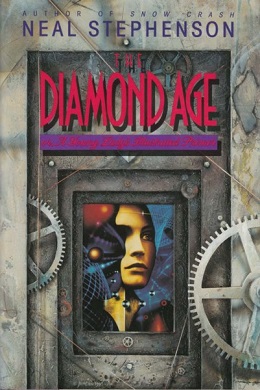
The Diamond Age or, a Young Lady's Illustrated Primer
Background (no spoilers):
In this society, nanotechnology has become the dominant means of production. (Many buildings are built out of man-made diamond because it is hard and durable, hence the title). Stephenson's novel is Marxist in that he posits a world in which the social structure arises from the means of production. Matter Compilers, or MCs, create food, clothes, etc. using molecular blueprints downloaded from a central government server. This top-down means of production makes poor people dependent on the government for their existence.
Most people are divided into phyles (aka claves) which are essentially tribes which live together in different parts of the city. One prominent phyle is that of the "Vickys" - neo-Victorians who have consciously adopted Victorian dress, mannerisms and social codes, believing that this is preferable to the amoral degeneracy of prior centuries (i.e. our time). The poor are the exception to this structure; they have no phyles, and lead lives that are nasty, brutish and short.
Nanotechnology has also become a means of ugly warfare and supports a bizarre justice system which combines Confucian principles with nanotech-based methods of execution. Rogue nanotech experts develop their own micromachines in defiance of the government's prohibition, and use them to spy, track, and kill.
My take on it:
I really, really enjoyed the first half of this book. Stephenson's vision is brilliant: complex, detailed, strikingly creative and novel, and powerful. It is also very pleasurable to read. However, I found the second half of the book chaotic and the ending unrealistic and anticlimactic. I was also troubled by the book's at times graphic misogyny, which does not seem to serve any purpose beyond reinforcing the brutality of the world. However, I highly recommend it because it is truly novel and gripping and introduces many fascinating ideas.
Stephenson's Novels
Stephenson's Novels
- The Big U (1984)
- Zodiac (1988)
- Snow Crash (1992)
- Interface (1994)
- The Diamond Age: or A Young Lady's Illustrated Primer (1995)
- The Cobweb (1996)
- Cryptonomicon (1999)
- The Baroque Cycle
- Quicksilver (2003), volume I
- The Confusion (2004), volume II
- The System of the World (2004), volume III
- Anathem (2008)
- The Mongoliad (2010–2012)
- Reamde + Colin's review (2011)
Labels:
China,
crime,
criminal justice,
dystopia,
fiction,
futuristic,
law,
legal system,
LMB,
Marx,
nanotechnology,
Neal Stephenson,
sci-fi,
science,
social commentary,
utopia
Rumpole of the Bailey
I recently finished reading Sir John Mortimer's Rumpole of the Bailey. The witty and poetry-quoting protagonist of this book is Rumpole, a 68-year-old barrister who is a defense attorney for England's petty criminals. The novel is broken down into short stories about different cases that he has been involved in. This book is totally hilarious. The language is also quite pleasing - the book is full of nicely turned phrases. It reminds me a bit of Mr. Sammler's Planet, but is comic rather than existential. I highly recommend it!
Labels:
comedy,
crime,
criminal justice,
humor,
law,
legal system,
LMB,
Sir John Mortimer
Subscribe to:
Posts (Atom)