Sunday, October 5, 2014

My Antonia


My Antonia is Willa Cather’s clear-eyed look back at her roots in the American plains.  There are a number of small sub-plots, but the book primarily is a portrait of a time and place, especially of the serene but harsh plains landscape and its powerful effects on those who grow up there.  
In the morning, when I was fighting my way to school against the wind, I couldn't see anything but the road in front of me; but in the late afternoon, when I was coming home, the town looked bleak and desolate to me.  The pale, cold light of the winter sunset did not beautify - it was like the light of truth itself.  When the smoky clouds hung low in the west and the red sun went down behind them, leaving a pink flush on the snowy roofs and the blue drifts, then the wind sprung up afresh, with a kind of bitter song, as if it said : This is reality, whether you like it or not.  All those frivolities of summer, the light and shadow, the living mask of green that trembled over everything, they were lies and this is what was underneath.  This is the truth."  It was as if we were being punished for loving the loveliness of summer.
The book is focused on the memory of Antonia, the daughter of the Shimerdas, new immigrants from a city in Eastern Europe, who find life on the plains to be very different and particularly hard. Although some of the neighbors helped them, many were too busy surviving on their own to help people so little adapted to their new location.  Antonia's father, Mr. Shimerda, a cultured man and talented musician, is never able to adapt and commits suicide, which leads to a particularly moving scene at his deepest winter funeral.

Cather draws a dramatic difference between the “country girls” and the “town girls” in the plains, although these "town girls" are living in such small, rural towns that we would hardly think of them as “city girls”!  Though she faces many difficulties, Antonia has a joy and strength that allow her to triumph over the hardships.  The book is basically pretty realistic, although the harsh setting and events are viewed forgivingly.  I found this to be a very satisfying book that offered insights into the character of the midwest and the challenges facing immigrants.


Saturday, October 4, 2014

The Lure of the Bush, and The Black Virgin


Two more books by Arthur Upfield, featuring the charming “half-caste” detective, Bony.  Although I picked these two to read at random, they turned out to have a powerful common theme – the lure of the bush – the irresistible force of the Australian outback and especially of the aboriginal way of life.  The Black Virgin featured two interesting mysteries – an inexplicable murder coupled with the disappearance of a hired man at an outback station and the puzzling, unfulfilled love affair between the son of the owner of the outback station and a strong, attractive, and talented neighbor.  Methodical and creative investigations by Bony eventually unified and resolved the two mysteries as suggested by the title, but both mysteries were quite interesting reading.  The Lure of the Bush had more striking characters: William Clair, an outback swagman bent on revenge; King Henry, a handsome, physically powerful, and charismatic chief who has recently returned to his tribe after a long absence; the diminutive, but forceful Mrs. Thornton,  a fierce admirer of the real Napoleon Buonaparte - and some protagonists who are less colorful.  In this case, Bony's solution to the dramatic murder opens up a veiled family history that explains how the lure of the bush underlies a mysterious love affair and disappearance.  Quite lively reading!

The Wind-Up Bird Chronicle

This book by Haruki Murakami was highly recommended by Lauren and was completely absorbing and very rich.  Simple writing, but compelling – parts were very funny, or horrifying, or terribly sad, or sexually stimulating, or thought-provoking.  The simplicity of the writing seemed to imply or even emphasize the normalcy of life – but this was strongly contradicted by the strangeness of some of the characters, the mysterious relationships between different plot lines, the magical nature of many key events, and some deeply embedded philosophical issues.


I was captivated by the book, but found it hard to “understand”.  For example, take the title – the wind-up bird is something that the protagonist, Toru Okada, hears, but never sees – a “bird” apparently, that lives somewhere in the trees near his home, and often makes a strange call or noise that sounds like a mechanical wind-up bird.  Mr. Okada frequently comments that the bird winds up, or starts, the day, so the world can go on.  But the bird is sometimes described not as an actual flesh-and-blood animal but like a strictly mechanical contrivance that has no emotions, no goals, no remorse.  And, importantly, but mysteriously, Mr. Okada’s neighbor begins referring to him as Mr. Wind-Up Bird – and this nickname seems a little edgy… that he is a bit of a character and a little mechanical himself.  And, indeed, Mr. Okada is extremely emotionless and seems rather passive, yet eventually turns out to have extraordinary powers – powers that seem really to wind-up or change the world.  So, does the wind-up bird represent “fate” versus “free will”?

Very captivating and very thought-provoking…..and perhaps, like Shakespeare, doesn’t provide clear answers or conclusions!  

Sherlock Holmes: Complete Stories & Novels

I can't remember when I first read the Holmes stories and novels - but I loved them and re-read the stories from beginning (The Adventures of Sherlock Holmes)  to end (The Casebook of Sherlock Holmes) every few years - before reading again, I waited until I couldn't really remember the endings, so I had to wait longer and longer in between reads.

Well, it had been quite awhile since I last read them, but my interest was piqued again when Jesse recommended the Sherlock TV episodes with Benedict Cumberbatch and Martin Freeman.  The episode I watched with Jesse was A Study in Pink - fantastic! - loosely based on the novel A Study in Scarlet.  I thought I would read A Study in Scarlet to compare to the TV adaptation, and I realized that though I had re-read the stories several times, I had only read the novels once (except for Hound of the Baskervilles, which I love and have re-read several times).  So, the game was afoot, I was off and reading - the novels and then all the stories - (accelerated by having loaded them onto my phone and reading at all odd moments of inactivity)..

Well, the novels are pretty good reads, but (except for Hound) are basically a long backstory wrapped at each end: a short introduction that describes a case presented to Holmes and an ending that provides Holmes' solution.  Each of these is a good case and a good yarn, but generally not a full-length mystery (Hound is an exception - it's perfect!)  Of the other three, the Valley of Death was terrific: a compelling case and a completely absorbing and fascinating backstory.

This time, on reading the stories, I had some new favorites.  Some of the most famous (eg, A Scandal in Bohemia) no longer held quite the same fascination for me, though another famous one, Silver Blaze, still seemed magnificent (eg, "Is there any point to which you would like to draw my attention?"  "To the curious incident of the dog in the night-time."  "The dog did nothing in the night-time!" "That was the curious incident").    But this time around, some others really captured my interest


Monday, September 29, 2014

Future Shock - Alvin Toffler

Very much enjoyed Toffler's Future Shock, especially the second half.

The first part of the book explains at somewhat tedious length the titular psychological condition (the complete breakdown of adaptive functioning Toffler asserts is caused by overwhelming levels of change and novelty), which Toffler argues will become epidemic as society continues to change at an increasing pace. Although the quaintly-phrased doom and gloom is a bit tiresome, I agree with his overall theory, that there may be optimal levels of transience, novelty, and choice in society (which we are heedlessly zooming past), beyond which the average person finds it difficult to cope. Although I won't attempt to prove these connections here, I also believe that many of the psychological ills of our time (such as widespread Generalized Anxiety Disorder) are fairly linked to these same tendencies in society. (Also fascinating that this book was written in 1970, before the explosion of the internet, which has radically transformed our society in ways undreamt of even in this work!)

More interesting to me, however, is the second part of the book, which proposes individual and society-wide methods for treating the symptoms of change, as well as more radical proposals to control change itself. Toffler rejects the "regressive" hippies who would shun all technology and change, but he applauds the creation of enclaves of the past, which he sees as a sort of insurance against devestating disasters in the broader community. His strongest weapon against FS, however, is "imagineering" of the future by EVERYONE, and vast systems to integrate these predictions and disseminate findings about the most likely futures, according to the logic "forewarned, forearmed." He speaks in praise of science fiction here, as a "sociology of the future," an especially progressive stance at a time when the genre was held in "contempt" - his word. (I think William Gibson is personally carrying that torch for our whole society!)

What was a bit depressing about this book were the ways in which Toffler's predictions have NOT come true. Extrapolating logically from the increases in technological efficiency and output which had increased the standard of living for many, Toffler assumed that we would quickly use this wealth to end radical poverty inequalities, and with basic needs satisfied for all, could focus our surplus on moving up the needs hierarchy to focus on loftier goals like fulfillment and meaning. (He was not a socialist, by the way, his assumption that this would happen was not ideologically driven, but simple deduction.) Sadly, while this may have made sense at the optimistic time at which he was writing, on the contrary, wealth has become even MORE concentrated in the hands of a greedy few, and we haven't even begun to work on these deeper issues.

Much food for thought here!

Sunday, August 24, 2014

Predictably Irrational - Dan Ariely

Predictably Irrational is a selection of short essays on the ways in which people are influenced by context and cognitive shortcuts (heuristics) to repeatedly make suboptimal choices. This field of economics, called behavioral economics, appears to be just catching up to what cognitive psychologists have been studying for decades. It was nonetheless an interesting book written in an engaging, chatty tone, and cited various studies by Ariely which provide new examples of these "predictably irrational" behaviors from an economic standpoint.

Saturday, August 23, 2014

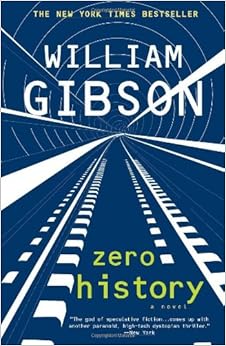
Zero History - William Gibson

Finally finished the last book in Gibson's Blue Ant/Bigend trilogy. Liked this much better than Spook Country, even though the protagonist was again Hollis Henry, whom I do not particularly care for (she is flavorless and lovelorn, snooze).

In this work, a mysterious line of wondrously simple denim clothing called "Gabriel Hounds" catches Bigend's eye for their innovative use of secrecy in marketing, and he hires Hollis to identify the brand's creator. When Hollis objects she is hardly the best person for this job, suggesting instead someone who might understand the fashion world better, Bigend replies, "But that's exactly it. Because they 'understand all that' they won't find the edge. They won't find the new. And worse, they'll trample on it, inadvertently crush it, beneath a certain mediocrity inherent in professional competence." Bigend is an immensely compelling figure, who prides himself on his ability to always select the exact right person for a given job... makes me wish I could work for someone like him!

Hollis' partner in the search for the Hounds' creator is Bigend's rescued drug addict, hyper-alert and sensitive Russian translator Milgrim, who has been put to work researching military uniform contracts. Of course, working for Bigend means being swept up in his machinations, and this tale follows the ensuing drama.

Always a pleasure to read Gibson, and now I've read his entire works!

The Sprawl Trilogy:
The Bridge Trilogy:
The Bigend Books: