Saturday, March 28, 2015

Mandela: My prisoner, my friend

This very personal and unpretentious memoir by Christo Brand helps fill in many dimensions of Mandela's life during imprisonment and also the varying faces of apartheid.  Brand grew up in South Africa in unusual circumstances - though of Afrikaans descent, his parents were very open-minded and, within the limits of South African society and rules, were open to relations with all people.  Accordingly, when he became a warder in the South African Prison system at age 18 (to avoid military service), he was a combination of naive obedience to the system coupled with an open-minded outlook toward people of all races.

When assigned to the maximum security prison on Robben Island, he was surprised to find that he was to oversee not the hardened criminals he expected, but "even worse", murderous terrorists, as the government had depicted them - especially including Nelson Mandela, who was 60 and had already served many years.  Brand soon found that these were serious, decent and kind people, and over time, he began helping them in small ways that seemed to him to be only human, yet could easily have resulted in his dismissal.

One feature of imprisonment for the "Rivonians" (so-called because of the trial that resulted in their life sentences, held at Rivonia) that I had not known about and that weighed on them very heavily was that they were forbidden from seeing or even hearing the voices of children at any time, especially their own children.  Thus, when Brand once secretly made a startling exception to the rules and allowed Mandela to briefly hold his granddaughter, it was particularly meaningful and helped cement their relationship.  Not surprisingly, the book reveals Mandela to be amazingly patient, disciplined and kind to all - though also quite impressively resolute when he felt it necessary.  An easy, heart-warming read - very highly recommended.

Monday, March 23, 2015

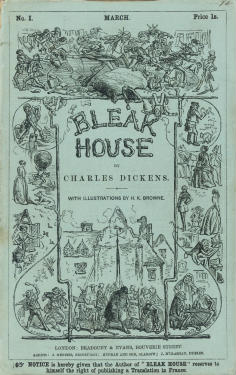
Bleak House - Charles Dickens

I find Dickens' novels to be delicious and satisfying like a nice Stilton, and Bleak House is no exception. The tale is told from the perspective of Esther, a schoolmarmish and self-effacing young woman who lives to nurture others. Characteristically, the novel weaves Esther's own story into a complex tapestry of interconnected narratives and broader themes.

Esther is raised by a severe old woman and haunted by a vague suggestion that she was born into shame (a mystery which is gradually explored over the course of the novel). After the old woman dies, Esther is rescued by a wealthy patron, John Jarndyce, who pays for her education and finishing and then sets her up as caretaker of his estate, Bleak House. In addition to managing the keys and accounts, Esther dedicates herself to the care of John's beautiful niece, Ada, and acts as a chaperone and confidant to Ada and her carefree beau, cousin Richard.

The novel's principal theme is revealed through the story of Ada and Richard - the wards of Jarndyce - as the destructive power of the sprawling and ineffective Chancery justice  system, which was ultimately reformed in part due to Dickens' powerful critique.

A poetic and very human look at the beauty and tragedy of the domestic sphere across multiple societal classes. Dickens captures the crude wisdom of impoverished women despite the ignorance, violence, and squalor of their existence, and through Esther's prim but compassionate eye, satirizes the conceits of those blustering do-gooders who would help the poor by giving them books they cannot read. He is also as adept at capturing the foibles and tragedies of the nobility as he is at portraying the life of the very poor. All in all, a very vibrant picture of the human condition.

Sunday, February 15, 2015

The Coast of Utopia I, II, and III


These three plays by Tom Stoppard bring to life some of the Russian revolutionaries during the period from 1833 to 1866.  Michael Bakunin and Alexander Herzen are particularly featured - Bakunin as a somewhat juvenile, but infectiously enthusiastic inciter of armed revolution and Herzen as a thoughtful, clear-headed intellectual who believes in incremental change.  Herzen to Bakunin:
Stop!- 'Destruction is a creative passion' You're such a . . . child! We have to go to the people, bring them with us, step by step.
Later, Bakunin offers a toast "The liberty of each, for the equality of all!" and Herzen objects "What does that mean?  It doesn't mean anything" and Bakunin replies "It means I am not free unless you, too, are free - and Herzen says "That's nonsense - you were free when I was locked up."  Herzen finally concludes

"I am devoted to you, Bakunin. I delight in the fanfare, no, the funfair of your pronouncements.  I would name my child for you, but equally I would name you for my child, because everything which is simple you make difficult and everything difficult simple.  You've made yourself a European reputation by a kind of revolutionary word-music from which it is impossible to extract an ounce of meaning, let alone a political idea, let alone a course of action". 

Stoppard's dialog is, naturally,  fast and clever, but there are moments of heart-rending tragedy, and the personalities are indelible.


Sunday, January 18, 2015

The Werewolf of Paris - Guy Endore

I am delighted to have discovered Endore's 1933 The Werewolf of Paris via Mark, who found an old copy in a thrift store and thought it sounded like something I would enjoy. Did I ever! It is written in an extremely charming and engaging style. and vividly describes life in Paris in the 1870s.

The novel begins with a frame story in which a young, penniless scholar discovers a manuscript documenting the trial of the young army officer, Bertrand Caillet, who has been charged with violently attacking a fellow officer. The manuscript is the work of Bertrand's uncle, Aymar, who tries desperately to convince the Court that Bertrand, a werewolf, ought to be burned at the stake for the greater good. This assertion, of course, is anathema in the age of reason.

Aymar is a compelling character: a former revolutionary skeptic whose experiences with the boy have convinced him that there is more to the world than modern science would lead us to believe. In making his case for the existence of the supernatural, Aymar argues: "Let us beware of judging hastily. The Catholic Church is said to have burned 300,000 witches, until the world exclaimed in horror: 'What gross superstition! There are no witches.' And truly there were none. At any rate there were no more."

I am amazed that this work has never been made into a movie, it would be a wonderful one.

Rabbit, Run - John Updike

Rabbit, Run is a dark and tightly controlled story about a washed-up basketball star, Rabbit, and his destructive yet sympathetic urge to find something better than mediocrity in his middle age. A powerfully human tale in compelling prose about disappointment and yearning, and the painful disparity between youth's bright dreams and pathetic, sordid reality. The kind of story that makes ones own domestic life seem heavenly.

Saturday, January 17, 2015

The Design of Everyday Things - Donald Norman

A recent bookclub selection was Donald Norman's The Design of Everyday Things, a book touting Norman's theory of human-centered design (the concept that machines should be attuned to human behavior, not the other way around), and his rules for creating technology which usefully interfaces with human behavior. One interesting lesson from Norman is his conviction that the human tendency for error should be explicitly factored into design choices, for everything from washing machines to airplane control towers. I would recommend this book to everyone, because his theory is very clear and convincing, and can be applied to many aspects of life.

Red Planet - Robert Heinlein

Really enjoyed Heinlein's short novel about two boys, Jim and Frank, and their exploits at a boarding school on Mars. The plot unfolds amidst a political conflict between the freedom-loving people of Mars and their greedy and callous Earth overlords, and centers around Jim's relationship with the Martian "bouncer" Willis, a small, furry, tentacled creature with remarkable powers of imitation.

Written in 1949, the novel is reminiscent of a Hardy Boys style adventure, but the ideas are refreshingly modern (with the exception of the frequent sexism, which tends to mar the quaint tone). Still, a charming book with an interesting conception of alien life.

Also, Willis was so cute!
Some artist's conception of Willis