Very much enjoyed Toffler's Future Shock, especially the second half.
The first part of the book explains at somewhat tedious length the titular psychological condition (the complete breakdown of adaptive functioning Toffler asserts is caused by overwhelming levels of change and novelty), which Toffler argues will become epidemic as society continues to change at an increasing pace. Although the quaintly-phrased doom and gloom is a bit tiresome, I agree with his overall theory, that there may be optimal levels of transience, novelty, and choice in society (which we are heedlessly zooming past), beyond which the average person finds it difficult to cope. Although I won't attempt to prove these connections here, I also believe that many of the psychological ills of our time (such as widespread Generalized Anxiety Disorder) are fairly linked to these same tendencies in society. (Also fascinating that this book was written in 1970, before the explosion of the internet, which has radically transformed our society in ways undreamt of even in this work!)
More interesting to me, however, is the second part of the book, which proposes individual and society-wide methods for treating the symptoms of change, as well as more radical proposals to control change itself. Toffler rejects the "regressive" hippies who would shun all technology and change, but he applauds the creation of enclaves of the past, which he sees as a sort of insurance against devestating disasters in the broader community. His strongest weapon against FS, however, is "imagineering" of the future by EVERYONE, and vast systems to integrate these predictions and disseminate findings about the most likely futures, according to the logic "forewarned, forearmed." He speaks in praise of science fiction here, as a "sociology of the future," an especially progressive stance at a time when the genre was held in "contempt" - his word. (I think William Gibson is personally carrying that torch for our whole society!)
What was a bit depressing about this book were the ways in which Toffler's predictions have NOT come true. Extrapolating logically from the increases in technological efficiency and output which had increased the standard of living for many, Toffler assumed that we would quickly use this wealth to end radical poverty inequalities, and with basic needs satisfied for all, could focus our surplus on moving up the needs hierarchy to focus on loftier goals like fulfillment and meaning. (He was not a socialist, by the way, his assumption that this would happen was not ideologically driven, but simple deduction.) Sadly, while this may have made sense at the optimistic time at which he was writing, on the contrary, wealth has become even MORE concentrated in the hands of a greedy few, and we haven't even begun to work on these deeper issues.
Much food for thought here!
Monday, September 29, 2014

Sunday, August 24, 2014
Predictably Irrational - Dan Ariely
Predictably Irrational is a selection of short essays on the ways in which people are influenced by context and cognitive shortcuts (heuristics) to repeatedly make suboptimal choices. This field of economics, called behavioral economics, appears to be just catching up to what cognitive psychologists have been studying for decades. It was nonetheless an interesting book written in an engaging, chatty tone, and cited various studies by Ariely which provide new examples of these "predictably irrational" behaviors from an economic standpoint.
Saturday, August 23, 2014
Zero History - William Gibson
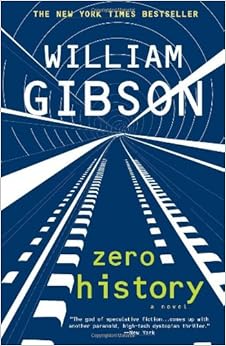 Finally finished the last book in Gibson's Blue Ant/Bigend trilogy. Liked this much better than Spook Country, even though the protagonist was again Hollis Henry, whom I do not particularly care for (she is flavorless and lovelorn, snooze).
In this work, a mysterious line of wondrously simple denim clothing called "Gabriel Hounds" catches Bigend's eye for their innovative use of secrecy in marketing, and he hires Hollis to identify the brand's creator. When Hollis objects she is hardly the best person for this job, suggesting instead someone who might understand the fashion world better, Bigend replies, "But that's exactly it. Because they 'understand all that' they won't find the edge. They won't find the new. And worse, they'll trample on it, inadvertently crush it, beneath a certain mediocrity inherent in professional competence." Bigend is an immensely compelling figure, who prides himself on his ability to always select the exact right person for a given job... makes me wish I could work for someone like him!
Hollis' partner in the search for the Hounds' creator is Bigend's rescued drug addict, hyper-alert and sensitive Russian translator Milgrim, who has been put to work researching military uniform contracts. Of course, working for Bigend means being swept up in his machinations, and this tale follows the ensuing drama.
Always a pleasure to read Gibson, and now I've read his entire works!
The Sprawl Trilogy:
- Neuromancer
- Count Zero
- Mona Lisa Overdrive
- Virtual Light
- Idoru
- All Tomorrow's Parties
Friday, August 8, 2014
The Year 1000

The first page of every chapter bears that month's illustration from the Julius Work Calendar, such as these:

Saturday, August 2, 2014
Quicksilver (The Baroque Cycle, #1) - Neal Stephenson
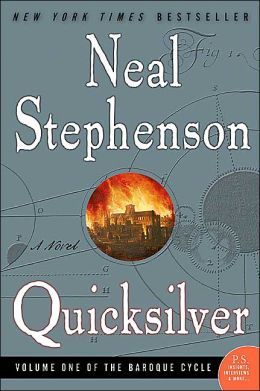
“And yet viewing several depictions of even an imaginary city, is enlightening in a way," Leibniz said. "Each painter can view the city from only one standpoint at a time, so he will move about the place, and paint it from a hilltop on one side, then a tower on the other, then from a grand intersection in the middle--all in the same canvas. When we look at the canvas, then, we glimpse in a small way how God understands the universe--for he sees it from every point of view at once. By populating the world with so many different minds, each with its own point of view, God gives us a suggestion of what it means to be omniscient.”An interesting book. I've set down The Confusion, which has a different cast of characters and didn't grab me as much, but I may return to it.
Stephenson's Novels
- The Big U (1984)
- Zodiac (1988)
- Snow Crash (1992)
- Interface (1994)
- The Diamond Age: or A Young Lady's Illustrated Primer (1995)
- The Cobweb (1996)
- Cryptonomicon (1999)
- The Baroque Cycle
- Quicksilver (2003), volume I
- The Confusion (2004), volume II
- The System of the World (2004), volume III
- Anathem (2008)
- The Mongoliad (2010–2012)
- Reamde + Colin's review (2011)
The Martian - Andy Weir
 "Robinson Crusoe in space" is how our bookclub organizer described The Martian, and this is a pretty apt description. Our intrepid astronaut hero Mark Watney is left stranded on Mars when his crew takes him for dead following a terrible accident. Using his botany and mechanical engineering skills, Mark must survive and find a way to let Earth know that he's still alive!
This fast-paced action thriller is written in a highly loose and conversational style, with entries styled as Mark's log. Recommended for fans of Kim Stanley Robinson, though this is much less literary and more of a beach read. Still fun and thought-provoking!
Also, here's a (kind of) relevant clip from Total Recall:

Thursday, July 17, 2014
Spook Country - William Gibson
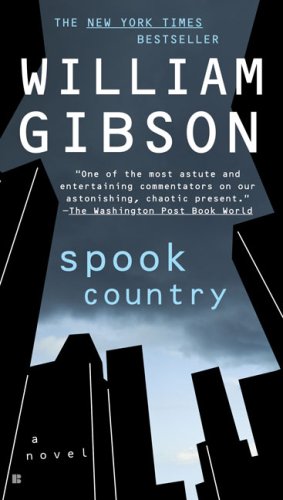
Gibson's 3 Trilogies:
The Sprawl Trilogy:
- Neuromancer
- Count Zero
- Mona Lisa Overdrive
- Virtual Light
- Idoru
- All Tomorrow's Parties
Subscribe to:
Posts (Atom)