Showing posts with label 1960s. Show all posts

Monday, September 16, 2019

Just Kids


I really enjoyed Just Kids by Patti Smith (thanks to Jillian!), which is full of vivid anecdotes, gritty wisdom and the story of her very close relationship/lifelong friendship with Robert Mapplethorpe. I’d call it a rags-to-richness story…richness, less in the sense of wealth than in the variety of her experiences, her achievements and the astonishing number of accomplished, interesting people she met or became friends with.  In all of this, she remained an unusually simple and fresh person.  Here’s a small but surprising example of her openness (although taken from M Train, rather than Just Kids):
September was ending and already cold. I was heading up Sixth Avenue and stopped to buy a new watch cap from a street vendor.  As I pulled it on an old man approached me.  His blue eyes burned and his hair was white as snow.  I noticed that his wool gloves were unraveling and his left hand was bandaged.
 --Give me the money you have in your pocket, he said.
  Either I am being tested, I thought, or I have wandered into the opening of a modern fairy tale.  I had a twenty and three singles, which I placed in his hand.
 --Good, he said after a moment, and then returned the twenty.
  I thanked him and continued on, more buoyant than before.
Patti’s  openness unlocked paths that remain invisible to more conventional souls (me).  Like, she goes to a Holy Modal Rounders concert and becomes interested in the drummer, Slim Shadow:: “..and as he slammed the drums, I thought, This guy truly embodies the heart and soul of rock and roll. He had beauty, energy, and animal magnetism.”  She decides to write an article about him for the rock magazine Crawdaddy, and, over the autumn months, they start seeing each other, as friends.  As winter comes, the impoverished Patti becomes anemic and her doctor advises her:
…to have red meat and drink porter, advice given to Baudelaire when he trudged through a winter in Brussels sick and alone.  I was a bit more resourceful than poor Baudelaire.  I donned an old plaid coat with deep pockets and lifted two small steaks from Gristede’s, planning to fry them in my grandmother’s cast-iron pan over my hot plate.  I was surprised to run into Slim on the street and we took our first non-nocturnal walk.  Worrying the meat would go bad, I finally had to admit to him I had two raw steaks in my pocket.  He looked at me, trying to detect if I was telling the truth, then slid his hand in my pocket and pulled a steak out in the middle of Seventh Avenue.  He shook his head in mock astonishment, saying “Okay, sugar, let’s eat.”
  We went upstairs and I fired up the hot plate.  We ate the steaks out of the pan.
Slim becomes concerned about Patti’s health and takes her for a lavish lobster dinner at Max’s Kansas City.  Patti begins to worry that this “handsome hillbilly might not have the money to pay the check.”  But a stunned friend of Patti’s sees her with Slim and, motioning her to meet in the ladies’ room, saying “Honey, you don’t know who he is?”  She soon informs her that “Slim” is Sam Shepard: “he’s the biggest playwright off-Broadway. He had a play at Lincoln Center.  He won five Obies!”

The heart of the book, though, is the story of the remarkable friendship/partnership between Patti and Robert Mapplethorpe, a friendship that seemed fated from the beginning.  For many years, they lived together, collaborated on art projects, and were true friends until Mapplethorpe’s death from AIDS.  Early in the book, Patti says
We headed home holding hands.  For a moment I dropped back to watch him walk.  His sailor’s gait always touched me.  I knew one day I would stop and he would keep on going, but until then nothing could tear us apart.
Just Kids is Smith’s tribute to Mapplethorpe and their friendship and it’s funny, fascinating, and deeply touching.

NB:  9-19-2019 NY Times just ran a piece on Patti Smith

Sunday, August 18, 2019

The Neapolitan Novels


Like millions of others, I found Elena Ferrante’s Neapolitan novels (My Brilliant Friend, The Story of a New Name, Those Who Leave and and Those Who Stay, The Story of the Lost Child) to be fully absorbing and addicting – I don’t say riveting, as many times I alternated between can’t put it down and can’t keep reading. The four books comprise a single, long story of the lifelong, deep and conflicted relationship between two girls, Elena (or Lenù), the narrator, and Rafaella (Lila).  The girls grow up in a poor and violent neighborhood of Naples, from the 1950’s to 2014  – the pervasive violence is not always due to the activities of the camorra, the “secret” crime syndicate that was widespread in Campania, but is embedded in the families and neighborhoods, and especially in the relationships between men and women. 
I was angry.  I said, “You want to use me to con them?”

She understood that she had offended me.  She squeezed my hand hard. “I didn’t intend to say something unkind.  I meant only that you are good at making yourself liked.  The difference between you and me, always, has been that people are afraid of me and not of you.”

“Maybe because you’re mean,” I said, even angrier.

“Maybe,” she said, and I saw that I had hurt her as she had hurt me.  Then, repenting, I added immediately, to make up: “Antonio would get himself killed for you: he said to thank you for giving his sister a job.”

“It’s Stefano who gave the job to Ada,” she replied. “I’m mean.”
The relationship between Lenù and Lila is synergistic – on her own, Lenù is book-smart, but a striver, who says she is only fully alive and most creative when working with, or stimulated by Lila.  In contrast, Lila is strong, exceptionally creative and fiercely independent, but seems to seek and need the validation of her accomplished friend.  And their lives and friendship are framed in the books within the larger currents of Italian political and social life, which are fully and grippingly explored.  Still, there are key events in the books whose meaning and significance I cannot quite grasp but which remain in my mind long after closing the books.  Fascinating books!
-->

Thursday, July 11, 2019

Crazy Loco | Stories by David Rice

This is a funny, sweet, wise, loopy book of short stories about kids growing up in Mexican-American families in South Texas.  Laughed and cried.  Wonderful.

Sunday, January 19, 2014

The Teachings of Don Juan - Carlos Castaneda

Tonight I read Carlos Castaneda's "The Teachings of Don Juan" in a single sitting (I skipped part 2, his structural analysis of the teachings, which does not interest me). I became interested in this book in a sort of roundabout way - one part of Levack's Witch-Hunt that keenly aroused my interest was the offhand reference to the hallucinogenic "flying unguents" purportedly used by medieval witches, which may (in some cases) have inspired the visions of flying to the witches' sabbath. These ointments contained plants such as atropa belladona and datura, and in my online research into their effects, I came across the following passage from Castaneda:
"There was a question I wanted to ask him. I knew he was going to evade it, so I waited for him to mention the subject. I waited all day. Finally, before I left that evening, I had to ask him, "Did I really fly?," don Juan?"

"That is what you told me. Didn't you?"

"I know, don Juan. I mean, did my body fly? Did I take off like a bird?"

"You always ask me questions I cannot answer. You flew. That is what the second portion of the devil's weed is for. As you take more of it, you will learn how to fly perfectly. It is not a simple matter. A man flies with the help of the second portion of the devil's weed. That is all I can tell you. What you want to know makes no sense. Birds fly like birds and a man who has taken the devil's weed flies as such [el enyerbado vuela asi]."

"As birds do? [Asi como los pajaros?]."

"No, he flies as a man who has taken the weed [No, asi como los enyerbados]."

"Then I didn't really fly, don Juan. I flew in my imagination, in my mind alone. Where was my body?"

"In the bushes," he replied cuttingly, but immediately broke into laughter again. "The trouble with you is that you understand things in only one way. You don't think a man flies; and yet a brujo can move a thousand miles in one second to see what is going on. He can deliver a blow to his enemies long distances away. So, does he or doesn't he fly?"
Although I am disappointed that Don Juan the man appears to have been a fiction, I still find this passage very powerful, and am still intrigued by some of the arguments Castaneda attributes to him, such as his rejection of there being only one way to understand our physical relationship with the world.

Regardless of whether you want to take it or leave it as spiritually valid, certainly no one could deny that Castaneda is a powerful storyteller, and the concluding episode was so wild and gripping I forgot I was even reading a book until it was over. A powerful "state of nonordinary reality" induced by reading!

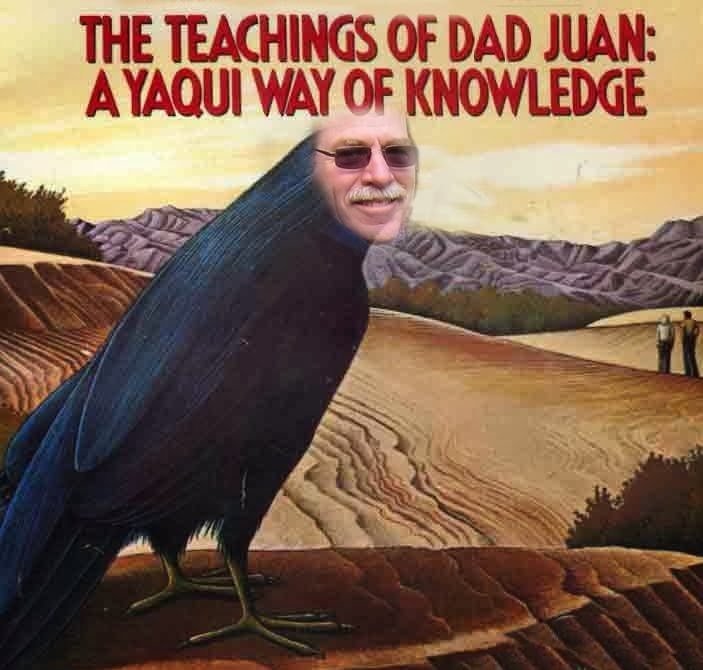
The wise Dad Juan

Monday, June 27, 2011

Douglas Adams' The Hitchhiker's Guide to the Galaxy

A(n uninspiring) milestone in my literary career: finally read The Hitchhiker's Guide to the Galaxy, which I read in 2.5 hours. Up til page 41 I found the book juvenile, boring, and silly, and felt that this was probably because I am not a prepubescent boy (no offense to you males). The first line that changed my opinion somewhat was "The robot camera honed in for a close-up on the more popular of [Zaphod's] two heads and he waved again." I suspect my satisfaction with this line is because it is atypically Philip K. Dick-esque (c.f. The Three Stigmata of Palmer Eldritch). I found the rest of this book a mix of mediocre and mildly amusing. I really don't understand the enthusiasm people feel for this work, and this is coming from a blogger who ends most posts with "Highly recommend!" The only intriguing character for me was Zaphod, although he could not redeem this book for me. Would not recommend.