Showing posts with label fantasy. Show all posts

Wednesday, July 27, 2022

The City of Brass - S.A. Chakraborty

The City of Brass grew on me as I went along. In the beginning of this story, scrappy polyglot Nahri is living in Cairo, where she uses her street smarts and unique magical healing abilities to swindle wealthy merchants. She dreams of saving enough money to become a legitimate physician, but these plans are turned on their head when she accidentally summons a mysterious djinn warrior. The rest of the novel is an romance/adventure set in the fantastical realm of Daevabad. 

Some of the writing felt a bit clunky to me, particularly the romantic bits, and I found it difficult to keep track of the byzantine djinn tribal histories. However, the Middle Eastern setting was beautifully realized, and a nice change of pace from the Euro-centric fantasy I'm used to reading. The action also heated up as the story progressed, and there were some thrilling fight scenes. Alizayd, the king's spartan and idealistic son, was my favorite character - if I continue with the next books in the trilogy, I hope we see more of him. 

Sunday, July 17, 2022

Gideon the Ninth

 Gideon the Ninth was... interesting. In this gory sci-fi/fantasy, necromancers from nine Houses compete to become Lyctors: powerful sorcerers in the service of the necromantic God. With the aid of their loyal sword-wielding partners (cavaliers, or "cavs"), the necromancers must complete a series of brutal challenges. The hero of the story is Gideon Nav, a red-haired, foul-mouthed, ass-kicking lesbian, and reluctant cav to Harrowhark, a sadistic and tight-lipped female necromancer of the Ninth House. Each House has its own flavor; the Ninth has a gothic vibe and is known for its secrecy and bone magic (perhaps the most creative device in the book). 


The concept of this story intrigued me, and the action was very exciting. However, I found it impossible to keep track of the 16+ characters (I missed the character summaries at the end of the book, which would have been really helpful). I was also disconcerted by the author's penchant for inserting modern slang into the mouths of her otherworldly characters. Finally, I was not satisfied with the answer to a central mystery, which struck me as very abrupt and contrived. 


In the final assessment, I enjoyed the read, but would likely not continue with the next books in the series. 

Thursday, January 6, 2022

Senlin Ascends Tetrology - Josiah Bancroft


At Terra's suggestion, I recently finished the BRILLIANT 4-book Babel series by Josiah Bancroft. These were easily the most creative, exciting, and compelling books I've read in a long while. The books are set in a familiar yet distinctly different world from our own, one where the major cultural epicenter and tourist attraction in the land of Ur is the famed Tower of Babel! Pedantic and rule-loving headmaster Senlin brings his quirky and beautiful young wife to visit the Tower on their honeymoon, but swiftly discovers it is far, far different from the orderly citadel of culture he had imagined! Our unlikely hero rises to meet the occasion via the most satisfying character development I've maybe ever read. 

This book defies genre classification -- perhaps it's best seen as a swashbuckler, but this epic straddles fantasy, adventure, sci-fi, steampunk, comedy, and romance. A thrilling read for over a thousand pages! Moreover, Bancroft is so creative, and so rich in interesting observations on life, love, and friendship, that he crams within one book more insights than most authors can hope to share in their entire opus.  Destined to become a classic, and should be read by all.

Sunday, February 7, 2021

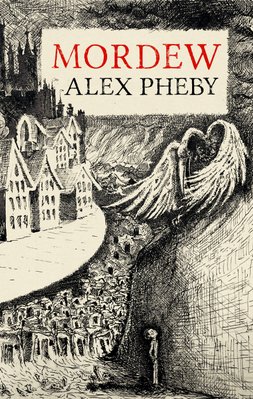
Mordew - Alex Pheby

As my contribution to our 2021 bookclub schedule, I nominated Mordew, by Alex Pheby. It appeared on a top books of 2020 list somewhere. I would describe it as grotesque fantasy, about the struggles of a slum boy named Nathan, in a city ruled by the magic of the Master. It was quite long at 617 pages, but I enjoyed it. The writing style is an interesting mix of snappy and florid, and the ideas are very creative. I love the fantasy genre, but don't often find new adult fantasy that I really enjoy. Ultimately, I did not find the plot wholly satisfying, and my attention waivered a bit toward the end, but there were lots of interesting ideas in this book. Would recommend.

Tuesday, March 15, 2016

The Call of Cthulhu - H.P. Lovecraft

My friend Terra is a huge Lovecraft enthusiast, and so at her suggestion (her Lovecraftian primer shared below), I have begun my exploration of the genre with The Call of Cthulhu, a very short novel which I greatly enjoyed. The protagonist of the novel is a Man of Science, who is deeply skeptical about his scholarly uncle's mysterious writings on a horrific beast known as Cthulhu. Full of atmosphere and delicious prose - a vivid and enjoyable tale that has definitely sparked my interest in reading more.

Lovecraftian Primer for the Novice Scholar

Books & Stories
Works by H.P. Lovecraft
(The following short stories are where I would recommend any budding cultist or bold investigator begin their journey. Many of HPL’s short stories can be found online here: http://www.dagonbytes.com/thelibrary/lovecraft/)
The Call of Cthulhu (Gives a good sense of the atmosphere and style in many HPL stories. The central source of the famed Cthulhu mythos.)
The Shadow over Innsmouth (A tale of intrigue and dread in a small town. Introduces some of Cthulhu’sfishier relatives.)
The Whisperer in Darkness (Dread terrors from above. While not explicitly about the King in Yellow, this is the only HPL story that contributes to his mythos.)

Lovecraft’s Inspiratons
Ambrose Bierce (I’ve never read any Bierce, but I hear that HPL was enamoured of his stories.)
Robert Chambers (He wrote a collection of short stories entitled “The King in Yellow” which alternates between stories of the pallid king and tales of daily life in revolutionary Paris, for some reason. I would highly recommend the story “The Repairer of Reputations” from this collection.)


Inspired by H.P. Lovecraft
(This list could go on forever – so much current fiction makes at least reference to Cthulhu or unspeakable horrors lurking beneath the waves or beyond the stars… here are a few examples I have enjoyed.)
A Study in Emerald by Neil Gaiman (Short story in Fragile Things, also available in a beautiful format here http://neilgaiman.com/mediafiles/exclusive/shortstories/emerald.pdf)
Rehearsals for Oblivion (Various short stories which all have something to say about the King in Yellow mythos. Highly recommended if the tattered king strikes your fancy.)
The Hastur Cycle (A more scholarly approach to the King in Yellow mythos. Each story is accompanied byan editor’s note explaining its literary/historical context. This collection includes “The Repairer of Reputations” as well as “The Whisperer in Darkness”.
New Cthulhu 2 (This is a short story collection by various authors that I happened across at the library. These stories take HPL themes and legends and address them in a modern setting. I found most of them to be quite enjoyable.)
Locke and Key (Graphic novel which draws from some HPL mythos, also includes a lot of magic that is not from HPL.)


Films, Shorts, & Audio
Feature Films:
The Whisperer in Darkness (Adaptation by the H.P. Lovecraft Historical Society (2011))
Die Farbe (Adaptation of HPL’s “The Color Out of Space” (2010). Filmed in Austria; subtitled)
Dagon (Inspired by “The Shadow over Innsmouth(2001). I have not seen this one yet but it is supposed to be quite good)
Re-Animator (Adaptation of HPL’s “Herbert West – Reanimator” (1985). A classic gore-fest.)
The Burrowers (Info here: http://hplfilmfestival.com/films/burrowers)


Short Films:
(While most of these are not strictly Lovecraft, they are definitely Lovecraftian and worth a viewing. If you enjoy any of these, consider coming to the H.P.Lovecraft film festival in Portland in October!)

Fat Rabbit 
Frank DanCoolo, Paranormal Drug Dealer
(Full 8 minute film is somewhere on the internet if you look hard enough. Clip can be found here: https://www.youtube.com/watch?v=NZmASfMOpxw)
Flesh and Bone (Music video.https://www.youtube.com/watch?v=BzJYFGx2pQ4)
The Mill at Calder’s End (I don’t know if you’ll be able to find the full film online, but here is a trailer https://vimeo.com/ondemand/themillatcaldersend)
The Call of Farqunglu (Lego spoof of the genre, very well done. https://youtu.be/n7o6ERhuEN4)

Dark Adventure Radio Theater
product of the H.P. Lovecraft Historical Society, these radio programmes never fail to provide an evening’s entertainment. More info here: http://www.cthulhulives.org/radio/DART/index.html


Monday, January 11, 2016

One Weird Trick (Sex Criminals Volume 1)

When Mark and I visited Arizona over the holiday break, we hung out with his friend Jordan, who works at a comic book store in Tempe. He recommended this smart, fresh, graphic novel to me. One Weird Trick is about a young woman who wants to save her library from foreclosure, her unusual superpower, and her sexcapades with a likeminded young man she meets at a party. A fun and flirty caper with nice illustrations, this is my bookclub's February pick (along with The Picture of Dorian Gray), if anyone wants to read along!

Monday, July 20, 2015

Game of Thrones: A Song of Ice and Fire - George R.R. Martin

For the past several years, Mark and I have enjoyed watching the HBO series Game of Thrones. Mark had read all of Martin's books up to the time of the TV series premiere, but I never had. Everyone says how great the books are, so I finally decided to give the first book a try. I loved it so much I tore through all 800 pages and am already a third of the way through book 2!

Martin's prose is relatively simple and straightforward, but his world is vividly portrayed in all 5 senses and his realistic character depictions make the courtly intrigues and ancient mysteries come alive brilliantly. One of my favorite characters is Lord Tyrion, a little person and son of the powerful house of Lannister. In a world where warriors rule and a disabled man is worth less than a woman, Tyrion uses his wits and humor to remain relevant and preserve his dignity in a society that has derisively termed him "the Imp." Fond of drink and whores, Tyrion is nevertheless the source of many of the book's words of wisdom. He gives several valuable pieces of advice to Jon Snow, the bastard son of powerful Lord Stark, who holds a similarly low place in their world's hierarchy. One such quote is when Tyrion explains his love of reading by saying that "a mind needs books as a sword needs a whetstone, if it is to keep its edge.”

Martin famously kills off nearly every major character (and many minor ones), and it is a strong storyteller indeed who can hold the reader's interest in the events of the world, not just in specific people.

Very exciting and more food for thought than in your usual "light reading."

Sunday, June 15, 2014

1Q84 - Murakami

At my suggestion, our bookclub's most recent selection is Murakami's 1Q84. An interesting factoid from Wikipedia: "The title is a play on the Japanese pronunciation of the year 1984 and a reference to George Orwell's Nineteen Eighty-Four. The letter Q and the Japanese number 9 (typically romanized as "kyū", but as "kew" on the book's Japanese cover) are homophones, which are often used in Japanese wordplay."

It has been a while since I've read Murakami (previously: Kafka on the Shore; The Windup Bird Chronicle), and as always, I was struck by the believability of his characters, whose inner monologues are powerfully, resonantly realistic, and the vividness of his imagery despite his relatively sparse prose (at least in the translation!). This one was a little surreal and overly sentimental for my taste at times, but I still really enjoyed it for the reasons previously mentioned. I also LOVED the Town of Cats story told within the novel:

In the story, a young man is travelling alone with no particular destination in mind. He rides the train and gets off at any stop that arouses his interest. He takes a room, sees the sights, and stays for as long as he likes. When he has had enough, he boards another train. He spends every vacation this way. 
One day, he sees a lovely river from the train window. Gentle green hills line the meandering stream, and below them lies a pretty little town with an old stone bridge. The train stops at the town’s station, and the young man steps down with his bag. No one else gets off, and, as soon as he alights, the train departs. 
No workers man the station, which must see very little activity. The young man crosses the bridge and walks into the town. All the shops are shuttered, the town hall deserted. No one occupies the desk at the town’s only hotel. The place seems totally uninhabited. Perhaps all the people are off napping somewhere. But it is only ten-thirty in the morning, far too early for that. Perhaps something has caused all the people to abandon the town. In any case, the next train will not come until the following morning, so he has no choice but to spend the night here. He wanders around the town to kill time. 
In fact, this is a town of cats. When the sun starts to go down, many cats come trooping across the bridge—cats of all different kinds and colors. They are much larger than ordinary cats, but they are still cats. The young man is shocked by this sight. He rushes into the bell tower in the center of town and climbs to the top to hide. The cats go about their business, raising the shop shutters or seating themselves at their desks to start their day’s work. Soon, more cats come, crossing the bridge into town like the others. They enter the shops to buy things or go to the town hall to handle administrative matters or eat a meal at the hotel restaurant or drink beer at the tavern and sing lively cat songs. Because cats can see in the dark, they need almost no lights, but that particular night the glow of the full moon floods the town, enabling the young man to see every detail from his perch in the bell tower. When dawn approaches, the cats finish their work, close up the shops, and swarm back across the bridge. 
By the time the sun comes up, the cats are gone, and the town is deserted again. The young man climbs down, picks one of the hotel beds for himself, and goes to sleep. When he gets hungry, he eats some bread and fish that have been left in the hotel kitchen. When darkness approaches, he hides in the bell tower again and observes the cats’ activities until dawn. Trains stop at the station before noon and in the late afternoon. No passengers alight, and no one boards, either. Still, the trains stop at the station for exactly one minute, then pull out again. He could take one of these trains and leave the creepy cat town behind. But he doesn’t. Being young, he has a lively curiosity and is ready for adventure. He wants to see more of this strange spectacle. If possible, he wants to find out when and how this place became a town of cats. 
On his third night, a hubbub breaks out in the square below the bell tower. “Hey, do you smell something human?” one of the cats says. “Now that you mention it, I thought there was a funny smell the past few days,” another chimes in, twitching his nose. “Me, too,” yet another cat says. “That’s weird. There shouldn’t be any humans here,” someone adds. “No, of course not. There’s no way a human could get into this town of cats.” “But that smell is definitely here.” 
The cats form groups and begin to search the town like bands of vigilantes. It takes them very little time to discover that the bell tower is the source of the smell. The young man hears their soft paws padding up the stairs. That’s it, they’ve got me! he thinks. His smell seems to have roused the cats to anger. Humans are not supposed to set foot in this town. The cats have big, sharp claws and white fangs. He has no idea what terrible fate awaits him if he is discovered, but he is sure that they will not let him leave the town alive. 
Three cats climb to the top of the bell tower and sniff the air. “Strange,” one cat says, twitching his whiskers, “I smell a human, but there’s no one here.” 
“It is strange,” a second cat says. “But there really isn’t anyone here. Let’s go and look somewhere else.” 
The cats cock their heads, puzzled, then retreat down the stairs. The young man hears their footsteps fading into the dark of night. He breathes a sigh of relief, but he doesn’t understand what just happened. There was no way they could have missed him. But for some reason they didn’t see him. In any case, he decides that when morning comes he will go to the station and take the train out of this town. His luck can’t last forever. 
The next morning, however, the train does not stop at the station. He watches it pass by without slowing down. The afternoon train does the same. He can see the engineer seated at the controls. But the train shows no sign of stopping. It is as though no one can see the young man waiting for a train—or even see the station itself. Once the afternoon train disappears down the track, the place grows quieter than ever. The sun begins to sink. It is time for the cats to come. The young man knows that he is irretrievably lost. This is no town of cats, he finally realizes. It is the place where he is meant to be lost. It is another world, which has been prepared especially for him. And never again, for all eternity, will the train stop at this station to take him back to the world he came from.

It sort of reminds me of what happens to the girl's parents in Spirited Away, except that there is no possibility for redemption in this world.

Friday, June 14, 2013

The Fantastic Flying Books of Morris Lessmore


This wonderful children's book was so moving that I was unable to finish reading it to Henry, Oliver, and Eve - so Henry finished reading it aloud to us. It is even more touching if you know the author's personal history. The illustrations are beautiful, and the book has been turned into an Oscar-award-winning animated short.

(Sorry no links - I'm posting from my phone.)

Saturday, January 5, 2013

Cold Days

"Cold Days", despite what you might expect from the name, is not a heartrending tale concerning furnace malfunctions, but, rather, is the 14th book in the fantasy series, "The Harry Dresden Files", a series which I have been reading for many years now, and have thoroughly enjoyed. And yes, you read that corrrectly: Jim Butcher has 14 books in the series, which beats out just about every other fantasy series I've known (except maybe for the Dragonlance chronicles, but since those are mass-produced by monkeys at typewriters, there is no comparison).

Like the other Dresden books, it was an extremely enjoyable mix of witty banter and fast-paced action, with a hint of mystery and obfuscation that made the big reveal at the book's denouement as enjoyable as laying out a full house in poker. Here, however, is when I am forced to stoop to criticism. Fans everywhere, be warned: Dresden, though it has held out for many years, has begun to reach the point of serialization.

What do I mean by this? Think James Bond: it's the exact same plot in a different country each time. Shark attacks are replaced by barfights, blondes are replaced by brunettes, and Sean Connery is replaced by Daniel Craig (though you can thank the lord that we'll always have the same Harry Dresden, assuming Jim Butcher doesn't die in a tragic automobile accident). The point is, Butcher has run out of new plot devices, and has been forced to reuse all his old characters without adding anything particularly shiny or new to any of them.

This does not mean I did not enjoy the book: in fact, it felt good to re-visit old themes, and appreciate how far things have come since the very first book. If you want a good read, this one is a winner, though reading the first 13 is beneficial (and, in fact, necessary). Just don't expect it to be full of fireworks as the previous books were.


Saturday, February 18, 2012

The Anubis Gates

... Wow. Where to begin with this book?

Okay, this is a book in the fantasy genre that, in some circles, I believe, has been sourced as an inspiration for steampunk novels, which I have yet to read. Honestly, I'm not sure why, because it had little to do with steampunk, but it had a sort of science fiction element in regards to time travel, and the rest is just straight fantasy.

"Just straight fantasy", however, can barely begin to describe the scope of this book. The story is so masterful and creative that it blew my mind. The basic idea is that a bunch of Egyptian warlocks are using their magic to change the past, thereby assuring Egypt's supremacy in the world. Our hero is Brendan Doyle, a modern expert on Coleridge, who travels to the past so as to attend one of Coleridge's lectures, but by the screwy nature of fate, he gets captured and is stuck in the past. The stories collide, and all hell breaks loose.

Again, I cannot describe just how awesome the story is. The plot devices are magnificent, the writing is great, the characters are amusing and engaging, and the extranormal aspets of the story are explained well and keep consistent with themselves throughout.

I highly recommend this book to anyone who is at all interested in fantasy, or history, or even a little science fiction. Seriously. READ IT!


Saturday, May 22, 2010

Rocannon's World

Rocannon's World is Ursula K. LeGuin's first novel, published in 1966 as a lengthening of the story "Dowry of the Angyar," which appeared in Astounding in 1964 and comprises the prologue to the novel as "Semley's Necklace". It's currently out of print, but I found it in a used book store in Seattle and there are some used on the internet as well. It is basically an epic fantasy set in a world of relativistic interstellar travel, in which an anthropologist studying quote highly intelligent life forms (a hilfer) from the galactic league of worlds is stranded on Fomalhaut II, an alien world with a heroic early age culture (think Homer) that involves living in castles and riding giant flying cats (see cover). Our boy Rocannon has to journey across the planet with a motley band of locals (think Tolkien), seeing the sights and getting into various problematic situations along the way. It's not her most mature work, but in particular the way in which she incorporates relativistic travel into the epic register is pretty impressive. Plus, giant flying cats are sweet.

Wednesday, July 29, 2009

The Graveyard Book


Just finished The Graveyard Book by Neil Gaiman - well, I have a known weakness for children's books. I heard a good review of this somewhere and I also know that Neil Gaiman is the author of the Sandman anime series. Surprisingly, the illustrations were not done by Gaiman. It's a very good story, with some nice spookiness, and some touching parts. And it was a Newbery Award winner! Strong recommendation for those who appreciate fantasy or spirits (not for you, Linda!)

Saturday, July 18, 2009

I got over it


Family members know that I really like Philip Pullman and loved The Golden Compass.....right up to the very end, when I was infuriated by the actions of Lord Asriel. It has taken me a couple years, but I finally "got over it" and read The Subtle Knife and The Amber Spyglass. Pullman is a wonderful storyteller, with an astounding imagination. There were many vivid and wholly likable or admirable characters - let's vote! Here are my rankings of favorite (well, I included some that would be more accurately characterized as "most vivid") characters:

1. Iorek Bynison
2. Lee Scoresby
3. Serafina Pekkala
4. Will Parry
5. The Golden Monkey (elected "Most Hateful Character in All Literature" six years running!)

Also, apart from the irresistible story, near the end of The Amber Spyglass, I was powerfully affected emotionally by the caring shown by the older, wise advisors, toward the young Lyra and Will.

Thursday, February 12, 2009

A Hundred Years of Solitude by Gabriel Garcia Marquez.


Colin gave me this for my birthday and I only recently started reading it. Of course, I probably won't finish it before school's out, but maybe I can read it during spring break. Regardless I am making pretty decent headway (~1/2 way through) and I am really liking it! I was very unenthusiastic about reading it because I thought I didn't like magical realism (since Winter's Tale disagreed with me so much) but I actually think this is awesome! Very powerful visual imagery and interesting story line.

Also, this book seems to me to have been a very large influence on Jonathon Safran Foer's novel Everything is Illuminated. If anyone else has read both these books, does that strike you as well?

Update: finished the book! Thought it was very good. For anyone who is considering reading this but thinks they have no time to read: this book lent itself very well to being read 1 paragraph at a time over a period of months.

Sunday, January 25, 2009

Harry Potter!


It is time to revive this blog. I've made the last 3 posts, and there's a total of just one post from nuclear family readers Noah, Will, Lauren, & Eileen.

So I'm turning to the most popular reading topic of all: Harry Potter.

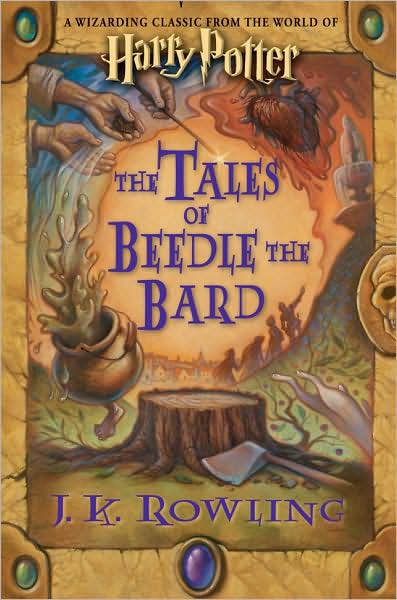
I just finished Tales of Beetle the Bard. It is very short, but quite fun. Dumbledore's "commentary" is full of his witty asides. And since profits from the book go to charity, it doesn't feel like JKR is just mining old material. Strong rec to read.

Here's the prompt for blog participation:

How do you rank the Harry Potter books?

My ranking:
Azkaban (3)
Half-Blood Prince (6)
Deathly Hallows (7)
Goblet of Fire (4)
Order of the Phoenix (5)
Sorcerer's Stone (1)
Chamber of Secrets (2)

Let the debate begin.