Showing posts with label artifical intelligence. Show all posts

Friday, May 16, 2014

All Tomorrow's Parties - William Gibson

I have been consuming Gibson in a strange and disjointed fashion over the past 3 years, picking up random books in his trilogies and reading them out of order. Maybe because I never stop thinking about Gibson's universe (!), this has not reduced my enjoyment of them in the slightest.

ATP follows Laney in the final stages of his drug-induced transformation, in which his uncanny nodal apprehension is perfected even as his body completely degenerates. Laney has sensed that a pivotal change is poised to occur in the universe, with the node centered around the enigmatic celebrity Harwood and idoru Rei Toei, and the new nanotechnology "fax machines" entering all Lucky Dragon convenience stores. As usual, a synopsis is unsatisfying for Gibson's stories, which sound absurd when summarized in this fashion, yet are immensely, masterfully believable.

I truly believe that Gibson has his finger on the pulse of our own history, much like Laney, and this is why his "future" is so powerfully present.

Highly, highly recommend.

Gibson's 3 Trilogies:

The Sprawl Trilogy:
The Bridge Trilogy:
The Bigend Books:

Monday, February 27, 2012

Ryu Mitsuse - 10 Billion Days & 100 Billion Nights


This book is utterly insane, and operates under the principle that sufficiently advanced technology is indistinguishable from magic, mystical experience, or a really incredible psychedelic voyage.

At one point, Jesus of Nazareth and Siddhartha Guatama the Buddha, who are cyborgs, fight a laser battle amidst the fortieth-century ruins of Tokyo.  I feel like that should be recommendation enough.  If dream narratives aren't your thing, though, you might find the book frustrating.

The story is a sort of metaphysical space-opera with Dickian gnostic overtones, featuring Plato, Jesus, Buddha, and the goddess Asura.  The translation is excellent and highly poetic; the original Japanese must be pretty amazing.  

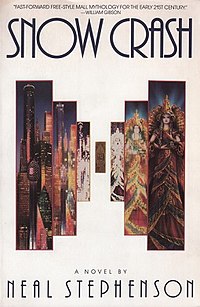
Neal Stephenson's Snow Crash


Stephenson has rapidly become one of my very favorite, if not all time favorite, authors. Snow Crash is so incredible - Stephenson's vision of the future is a rarity in its clarity, depth, and originality. The overpopulated earth has become a trashy wasteland, and the technological/economic elite have essentially moved to a digital existence, most often "goggled in" to the virtual reality of the Metaverse, where your avatar can move around and conduct business in the same way as on earth. Hackers, especially the samurai-sword wielding protagonist (named Hiro Protagonist), have the upper hand in a landscape they can control. However, the intersection between man and machine, embodied particularly in the hackers' binary-acccomodating neural pathways, has led to the dangerous potential for computer viruses to infect the user's mind. This unique vision has even more resonance given Google's recent announcement that they are developing glasses which will project a virtual reality and other information over the real world. This novel's astounding scope encompasses the exploration of memes, Glossolalia, drugs, viruses, and religion, which are depicted as being basically synonymous. A wonderful page-turner!

Thursday, December 1, 2011

William Gibson's Count Zero

Count Zero, although at times confusing, is another Gibson masterpiece. The world he envisions is Tolstoyan in its richness, fullness, and complexity. He is strikingly creative and his vision of the near (although technologically distant) future is dark, grimy, and dangerous without being oppressingly alarmist. Gibson's characters ring true and his literary grasp is impressive, and far improved from Neuromancer - he convincingly weaves together multiple narratives to reveal a complex and fascinating picture of cyberspace and its potential. In this work, Bobby, aka Count Zero, is an aspiring cyber cowboy (or "hotdogger") who gets swept up in the veiled machinations of an incomprehensibly wealthy entity named Virek. ("Entity" because Virek's body is a pool of molecules in an enormous vat, and he "lives" in the matrix.) The story follows Virek's attempts to locate the maker of mysteriously haunting collage boxes through various hitmen and an art collector. The book's themes, largely introduced in Neuromancer, include AI, systems theory, the synthesis of man and machine, and the spatial nature of cyberspace. The religious potential of the matrix is also fruitfully explored. A real page-turner and a must-read!

Gibson's 3 Trilogies:

The Sprawl Trilogy:
The Bridge Trilogy:
The Bigend Books:

Thursday, September 8, 2011

William Gibson's Neuromancer


Gibson's Neuromancer is his first book ever, and the second book of his that I have read. I previously read Idoru (out of order). Neuromancer is good - far from as excellent as Idoru; you can really tell he is an amateur writer. The narrative is choppy and often confusing and the dialogue feels false in various places. However, the ideas are still really interesting and at times purely brilliant. The book is famous as a seminal sci-fi work rather than on its own merits, so I would still suggest reading it, especially since it lays out some of the characters for the later works (e.g., Case, Molly). I'm looking forward to reading Count Zero.

Gibson's 3 Trilogies:

The Sprawl Trilogy:
The Bridge Trilogy:
The Bigend Books:

Monday, June 27, 2011

William Gibson's Idoru

In this utterly wild and brilliant book by William Gibson, two characters' narratives intersect to reveal the story of a famous rockstar - Rez of the band Lo/Rez - who is determined to marry an idoru, or virtual celebrity, despite the objections of his P.R. team and devoted, massive, scarred bodyguard Blackwell. Set in the near (but technologically greatly advanced) future, the intersecting narratives are from the perspectives of Chia, a fourteen-year-old Lo/Rez fan and skilled hacker from Seattle, and Laney, a hacker with an uncanny ability to detect "nodal points" in data. The theme of emergence is evidenced at the meta- as well as macro-level, wherein the individual stories interact to create a totality which far exceeds the sum of its parts. The tale is a true page-turner, and rife with crazy characters and novel ideas. Definitely worth reading!!

**Update**

Helpful info from Colin: Gibson's 3 Trilogies (turns out this is book 2 of one of them - oops)

Gibson's 3 Trilogies:

The Sprawl Trilogy:

The Bridge Trilogy:
The Bigend Books: