
Showing posts with label technology. Show all posts
Showing posts with label technology. Show all posts
Monday, April 18, 2016
Old Man's War - John Scalzi

Altered Carbon - Richard K. Morgan

I read Rudy Rucker's Software not long ago, so Morgan's elaboration of the consciousness-divorced-from-physicality concept was a nice "sequel." I was especially intrigued by his portrayal of the ugly consequences of wealth inequality, in a world where the technology of immortality is largely limited to the economic elite. (Kim Stanley Robinson's Mars trilogy also fruitfully explores this issue.)
I will definitely be checking out the other Takeshi Kovacs novels!
Wednesday, July 8, 2015
The Peripheral - William Gibson
The Peripheral is Gibson's most recent novel, and it did not disappoint. The tale opens in a a world that appears to be our near future, the logical extension of our society's tendency to favor technological advancement amidst crumbling physical infrastructure. The increasingly unstable economy is marked by intensified monopolization, and the average person can only get wealthy by "funny" means - "building" (producing and selling drugs), or "fabbing" (3D printing) prohibited items. Our morally-conscious protagonists - a wounded special ops veteran named Burton and his spunky sister, Flynne - choose instead to eke out a living by playing security forces in a video game for a mysterious employer. It is during one of these gaming sessions that Flynne becomes sole witness to a gruesome murder, an event that ignites a series of radical changes in their lives and world. The novel is ultimately set in two futures, whose inhabitants are able to influence each other by means of shared "peripheral" technology. Fascinating stuff, as always!
Thursday, May 14, 2015
Software - Rudy Rucker
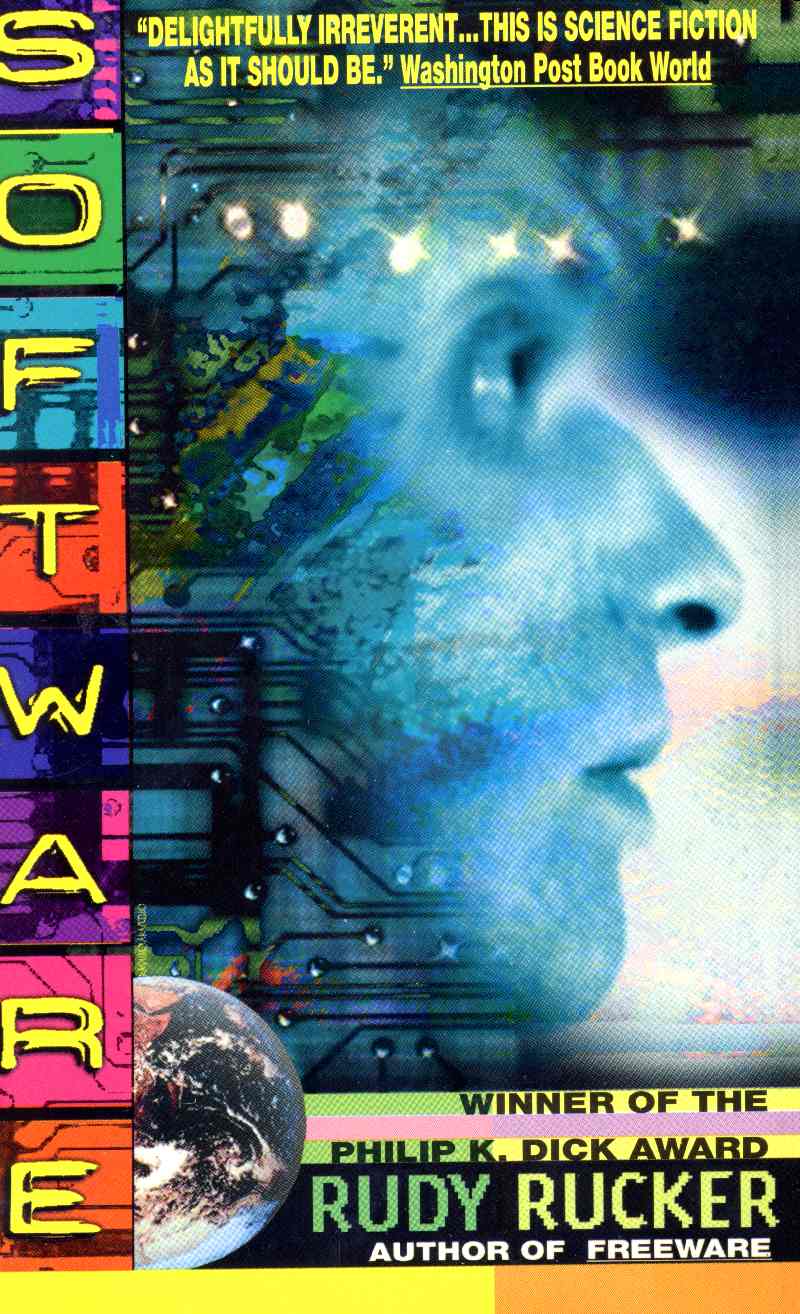
This exciting and compelling novel explores the meaning of humanity and the potentially transformative power of technology through the colorful exploits of Cobb and his junkie side-kick, the flamboyant and foul-mouthed "Sta-Hi."
It deals with similar questions as do Bicentennial Man and Ghost in the Shell - what really makes someone a human? What is it that we experience as the self? In my bookclub, we call this latter question the "phone booth" problem (one description of this thought experiment here).
"You wanted to know who I am. I gave you one answer. A robot-remote. A servo-unit operated by a program stored in a bopper spaceship. But... I'm still Misty-girl, too. The soul is the software, you know. The soft ware is what counts, the habits and the memories. The brain and the body are just meat, seeds for the organ-tanks."I will definitely look forward to reading the second and third parts of this trilogy, and thanks to my IT friend Josh for the recommendation! (By the way, there are versions of these books on Rucker's website, but some of the more graphic language/brutal phrasing seems to have been edited out in those versions.)
Saturday, January 17, 2015
The Design of Everyday Things - Donald Norman

Tuesday, January 13, 2015
The Best Science and Nature Writing 2013
December Bookclub was The Best Science and Nature Writing 2013, a collection of articles hand-picked by Siddhartha Mukherjee, author of Emperor of all Maladies (reviewed by Dad here and Lauren here).
The complete list of Mukherjee's selections is here.
Here are my thoughts on the articles I read:
MICHELLE NIJHUIS. Which Species Will Live? [log-in required]
From Scientific American
This was a bleak but interesting analysis of the techniques conservationists use to triage efforts to save different species from extinction.
BRETT FORREST. Shattered Genius
From Playboy
I was surprised this made it on the list, actually, since the topic was ostensibly the current activities of reclusive math genius Grigori Perelman, yet the interviewer only managed to exchange a few sentences with the man. More than others have achieved, but not much to go on. The discussion of the Poincaré conjecture's history was interesting, however. (Now you can say you "read Playboy for the articles"!)
DAVID OWEN. The Artificial Leaf
From The New Yorker
One man's quest to create artificial photosynthesis as a source of clean energy for the developing world. Moderately interesting.
GARETH COOK. Autism Inc.
From The New York Times
I loved this article. After Thorkil Sonne's child Lars was born with autism, Thorkil was saddened to learn that most research suggested Lars would lead a deficient life. In fact, however, Lars demonstrated impressive and unexpected talents (e.g., following a family trip at 7 years old, Lars was able to draw a perfect reproduction, from memory, of the entire highway network from Scotland to Germany). Thorkil was inspired by his son's talents to create a consulting agency specializing in matching autistic individuals with jobs for which they are uniquely suited. The agency has been a terrific success. An inspiring and very interesting story!
NATHANIEL RICH. Forever and Ever
From The New York Times Magazine
This was perhaps my favorite of the articles in this collection: the story of Shin Kubota, a marine biologist specializing in an immortal (seriously) species of jellyfish known as Turritopsis dohrnii. Dr. Kubota is unique worldwide in his ability to successfully breed and maintain the finicky Turritopsis in captivity, and has devoted his life to unlocking its secrets. He is also a minor celebrity in Japan (akin to Bill Nye in America), due to his second passion: writing and singing jellyfish-themed karaoke songs in the guise of his alter ego, Mr. Immortal Jellyfish Man (photo below). One of Kubota's charming songs is “I Am Shin Kubota":
My name is Shin Kubota
Associate professor of Kyoto University
At Shirahama, Wakayama Prefecture
I live next to an aquarium
Enjoying marine-biology research
Every day, I walk on the beach
Scooping up with a plankton net
Searching for wondrous creatures
Searching for unknown jellyfish.
Dedicate my life to small creatures
Patrolling the beaches every day
Hot spring sandals are always on
Necessary item to get in the sea
Scarlet medusa rejuvenates
Scarlet medusa is immortal

STEPHEN MARCHE. Is Facebook Making Us Lonely?
From The Atlantic
An interesting (if depressing) analysis of loneliness in the modern world, in which we are always"connected" yet feel increasingly isolated.
KEVIN DUTTON. The Wisdom of Psychopaths
From Scientific American
I did not read this entire article (it was long and sort of pop-sciencey) but it was interesting enough. The thesis is that psychopaths can teach us valuable lessons (e.g., about self-confidence and navigating conflict) if we embrace their attitudes in moderation.
The complete list of Mukherjee's selections is here.
Here are my thoughts on the articles I read:
MICHELLE NIJHUIS. Which Species Will Live? [log-in required]
From Scientific American
This was a bleak but interesting analysis of the techniques conservationists use to triage efforts to save different species from extinction.
BRETT FORREST. Shattered Genius
From Playboy
I was surprised this made it on the list, actually, since the topic was ostensibly the current activities of reclusive math genius Grigori Perelman, yet the interviewer only managed to exchange a few sentences with the man. More than others have achieved, but not much to go on. The discussion of the Poincaré conjecture's history was interesting, however. (Now you can say you "read Playboy for the articles"!)
DAVID OWEN. The Artificial Leaf
From The New Yorker
One man's quest to create artificial photosynthesis as a source of clean energy for the developing world. Moderately interesting.
GARETH COOK. Autism Inc.
From The New York Times
I loved this article. After Thorkil Sonne's child Lars was born with autism, Thorkil was saddened to learn that most research suggested Lars would lead a deficient life. In fact, however, Lars demonstrated impressive and unexpected talents (e.g., following a family trip at 7 years old, Lars was able to draw a perfect reproduction, from memory, of the entire highway network from Scotland to Germany). Thorkil was inspired by his son's talents to create a consulting agency specializing in matching autistic individuals with jobs for which they are uniquely suited. The agency has been a terrific success. An inspiring and very interesting story!
NATHANIEL RICH. Forever and Ever
From The New York Times Magazine
This was perhaps my favorite of the articles in this collection: the story of Shin Kubota, a marine biologist specializing in an immortal (seriously) species of jellyfish known as Turritopsis dohrnii. Dr. Kubota is unique worldwide in his ability to successfully breed and maintain the finicky Turritopsis in captivity, and has devoted his life to unlocking its secrets. He is also a minor celebrity in Japan (akin to Bill Nye in America), due to his second passion: writing and singing jellyfish-themed karaoke songs in the guise of his alter ego, Mr. Immortal Jellyfish Man (photo below). One of Kubota's charming songs is “I Am Shin Kubota":
My name is Shin Kubota
Associate professor of Kyoto University
At Shirahama, Wakayama Prefecture
I live next to an aquarium
Enjoying marine-biology research
Every day, I walk on the beach
Scooping up with a plankton net
Searching for wondrous creatures
Searching for unknown jellyfish.
Dedicate my life to small creatures
Patrolling the beaches every day
Hot spring sandals are always on
Necessary item to get in the sea
Scarlet medusa rejuvenates
Scarlet medusa is immortal
STEPHEN MARCHE. Is Facebook Making Us Lonely?
From The Atlantic
An interesting (if depressing) analysis of loneliness in the modern world, in which we are always"connected" yet feel increasingly isolated.
KEVIN DUTTON. The Wisdom of Psychopaths
From Scientific American
I did not read this entire article (it was long and sort of pop-sciencey) but it was interesting enough. The thesis is that psychopaths can teach us valuable lessons (e.g., about self-confidence and navigating conflict) if we embrace their attitudes in moderation.
Saturday, August 23, 2014
Zero History - William Gibson
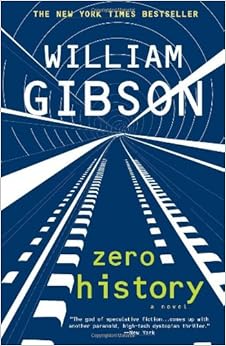 Finally finished the last book in Gibson's Blue Ant/Bigend trilogy. Liked this much better than Spook Country, even though the protagonist was again Hollis Henry, whom I do not particularly care for (she is flavorless and lovelorn, snooze).
In this work, a mysterious line of wondrously simple denim clothing called "Gabriel Hounds" catches Bigend's eye for their innovative use of secrecy in marketing, and he hires Hollis to identify the brand's creator. When Hollis objects she is hardly the best person for this job, suggesting instead someone who might understand the fashion world better, Bigend replies, "But that's exactly it. Because they 'understand all that' they won't find the edge. They won't find the new. And worse, they'll trample on it, inadvertently crush it, beneath a certain mediocrity inherent in professional competence." Bigend is an immensely compelling figure, who prides himself on his ability to always select the exact right person for a given job... makes me wish I could work for someone like him!
Hollis' partner in the search for the Hounds' creator is Bigend's rescued drug addict, hyper-alert and sensitive Russian translator Milgrim, who has been put to work researching military uniform contracts. Of course, working for Bigend means being swept up in his machinations, and this tale follows the ensuing drama.
Always a pleasure to read Gibson, and now I've read his entire works!
The Sprawl Trilogy:
- Neuromancer
- Count Zero
- Mona Lisa Overdrive
- Virtual Light
- Idoru
- All Tomorrow's Parties
Sunday, February 9, 2014
Anathem - Neal Stephenson
Today I finished my 6th book of 2014, Stephenson's Anathem. WOW!
 The book is set on the planet Arbre, quite similar to our own, but divided in the present time (and for the past several thousand years) into the Saecular and Mathic worlds. Inside the "maths", or cloisters, live the Avout, non-religious men (fraas) and women (suurs) who have devoted their lives to intense scholarship and medieval asceticism, almost wholly without advanced praxis (technology). They live secluded from the outside world, except for a 10-day holiday called Apert during which the gates are opened, when the "extras" are free to come into the math, and the Avout are free to leave and explore extramuros. Depending on whether an Avout is a Unitarian, Tenner, Hundreder, or Thousander, his or her order will have the chance to celebrate Apert only once a year, decade, century, or millenium. In the mean time, all knowledge of the Saecular world is strictly avoided.
The book opens as Fraa Erasmas, a Tenner, is about to celebrate his first Apert since joining his math, the Concent of Saunt Edhar, as a young boy. Over the course of this holiday, however, he and his fraas and suurs discover that something very serious and shocking has been happening extramuros. Dun dun dun!
Of course I won't give away more, but suffice to say, this book is pure Stephenson genius. A beautifully rich world filled with highly likable characters (especially Fraa Jad!) engaged in a gripping and meaningful quest.
Recommended if you enjoyed: The Name of the Rose, Reamde
Stephenson's Novels
The book is set on the planet Arbre, quite similar to our own, but divided in the present time (and for the past several thousand years) into the Saecular and Mathic worlds. Inside the "maths", or cloisters, live the Avout, non-religious men (fraas) and women (suurs) who have devoted their lives to intense scholarship and medieval asceticism, almost wholly without advanced praxis (technology). They live secluded from the outside world, except for a 10-day holiday called Apert during which the gates are opened, when the "extras" are free to come into the math, and the Avout are free to leave and explore extramuros. Depending on whether an Avout is a Unitarian, Tenner, Hundreder, or Thousander, his or her order will have the chance to celebrate Apert only once a year, decade, century, or millenium. In the mean time, all knowledge of the Saecular world is strictly avoided.The book opens as Fraa Erasmas, a Tenner, is about to celebrate his first Apert since joining his math, the Concent of Saunt Edhar, as a young boy. Over the course of this holiday, however, he and his fraas and suurs discover that something very serious and shocking has been happening extramuros. Dun dun dun!
Of course I won't give away more, but suffice to say, this book is pure Stephenson genius. A beautifully rich world filled with highly likable characters (especially Fraa Jad!) engaged in a gripping and meaningful quest.
Recommended if you enjoyed: The Name of the Rose, Reamde
Stephenson's Novels
- The Big U (1984)
- Zodiac (1988)
- Snow Crash (1992)
- Interface (1994)
- The Diamond Age: or A Young Lady's Illustrated Primer (1995)
- The Cobweb (1996)
- Cryptonomicon (1999)
- The Baroque Cycle
- Quicksilver (2003), volume I
- The Confusion (2004), volume II
- The System of the World (2004), volume III
- Anathem (2008)
- The Mongoliad (2010–2012)
- Reamde + Colin's review (2011)
Thursday, January 2, 2014
S.A.S. Survival Handbook

On a related note, check out the CDC's fun and educational illustrated narrative on emergency preparedness, zombie style.
Friday, August 2, 2013
REAMDE by Neal Stephenson
 Just finished reading Stephenson's 1000-something page novel, REAMDE, which was amazing. (Excellent overview by Colin here: http://blogenburyisreading.blogspot.com/2011/12/neal-stephenson-reamde.html?m=1).
Stephenson has the impressive ability to weave together a host of characters and circumstances which, in the hands of a lesser author, would feel they had been chosen by a random word generator: jihadists, MMORPG, computer virus, British spy, Russian mafia, ski resort, Wikipedia. Well, maybe they do have a theme: it sounds like a James Bond movie, but without the glamour, and set against the new realities of postmodernity: the digital age and the international War on Terror.
Stephenson is truly a great author: each section of the book is told from the perspective of one of a handful of key characters, and each has a distinctive and authentic tone. Although the book plays like an action movie and largely examines the meaning of life as experienced in the scopes of a rifle, the detailed attention to psychology and the richness of the world feel (almost) Tolstoyan. (Making the Acknowledgments page quite interesting, since he lists areas of expertise, such as guns, which are seamlessly integrated into the plot, yet evidently draw heavily upon the knowledge of others.)
Although set in the present (near future?) and so less earthshatteringly visionary than The Diamond Age, I preferred this to Snow Crash and definitely recommend.
Stephenson's Novels
- The Big U (1984)
- Zodiac (1988)
- Snow Crash (1992)
- Interface (1994)
- The Diamond Age: or A Young Lady's Illustrated Primer (1995)
- The Cobweb (1996)
- Cryptonomicon (1999)
- The Baroque Cycle
- Quicksilver (2003), volume I
- The Confusion (2004), volume II
- The System of the World (2004), volume III
- Anathem (2008)
- The Mongoliad (2010–2012)
- Reamde + Colin's review (2011)
Friday, July 12, 2013
Ernest Cline's Ready Player One

WOW! My bookclub's most recent pick was Ready Player One, and I read this thrilling 372-page sci-fi novel cover to cover over the last several hours. Talk about a page-turner! I won't give away the main quest driving the plot, but suffice to say, it is action-packed and awesome.
The experience of reading this book was very self-indulgent for a cyberpunk nerd like myself -- it is a book about otaku, for otaku, and it has the works: a post-apocalyptic wasteland where everyone with enough money for a visor and "haptic gloves" escapes the filth and squalor of our used-up Earth via a full-dive VR universe called OASIS; brilliant teen hackers; a soulless corporate entity in full villain mode; and, in an unusual twist on your typical sci-fi novel, endless real-world references to obscure sci-fi, video games, and everything 1980s.
The British newspaper The Observer says that the otaku is "the passionate obsessive, the information age's embodiment of the connoisseur, more concerned with the accumulation of data than of objects." In Ready Player One, and in many nerd subcultures IRL, a player's ability to amass vast knowledge of game-related trivia is a sought-after mark of authenticity, and a status symbol within the group.
In one early scene, our ridiculously erudite, but chronically poor and therefore low-level hero, Perzival, spars with the braggart I-r0k in a VR chat room, about what it takes to be a "gunter" (egg hunter, or elite gamer):
"Poseur."
"Poseur? Penis-ville is calling me a poseur? ...This chump is so broke that he has to bum rides to Greyhawk, just so he can kill kobolds for copper pieces! And he's calling me a poseur!"
..."That's right, I called you a poseur, poseur." I stood up and got in his grille. "You're an ignorant know-nothing twink. Just because you're fourteenth-level, it doesn't make you a gunter. You actually have to possess some knowledge."
As Perzival's friend Aech would say, "Word."
This novel is recommended for everyone, but especially if you like:
- Stephenson's Snow Crash
- Sword Art Online (anime TV series)
- Gibson's Idoru
Sunday, October 28, 2012
City of Light - Lauren Belfer

Monday, February 27, 2012
Ryu Mitsuse - 10 Billion Days & 100 Billion Nights

This book is utterly insane, and operates under the principle that sufficiently advanced technology is indistinguishable from magic, mystical experience, or a really incredible psychedelic voyage.
At one point, Jesus of Nazareth and Siddhartha Guatama the Buddha, who are cyborgs, fight a laser battle amidst the fortieth-century ruins of Tokyo. I feel like that should be recommendation enough. If dream narratives aren't your thing, though, you might find the book frustrating.
The story is a sort of metaphysical space-opera with Dickian gnostic overtones, featuring Plato, Jesus, Buddha, and the goddess Asura. The translation is excellent and highly poetic; the original Japanese must be pretty amazing.
Subscribe to:
Comments (Atom)