Showing posts with label medicine. Show all posts

Monday, November 23, 2015

The Laws of Medicine - Siddhartha Mukherjee

Siddhartha Mukherjee is very smart, very thoughtful, and a very talented writer, with an ear for the telling anecdote.  (We have previously reviewed his Pulitzer Prize-winning The Emperor of All Maladies).  The Laws of Medicine is a focused reflection on how medicine has changed over the past 80 years, viewed through the lens of Mukherjee's desire to identify "laws", specific to medicine, that govern its practice.

The book is serious and thought-provoking but also rather charming....and it's a fast read.  It's definitely a library book, not a worthwhile purchase - it's almost pocket-sized, it's thin, and it has some lovely textless illustrated pages to add space for personal reflection between one chapter and the next.  Purchasing it ($16.99) would be a good way to support the TED Talks (from which this book was adapted), but I was happier to delight in Mukherjee's reflections, on the library's dime!  To offer a little substance to this review, here's a nice thought, snatched from the book:
Priors. Outliers. Biases.  That all three laws of medicine involve limits and constraints on human knowledge is instructive.
I definitely recommend this highly.

Tuesday, August 11, 2015

Inside the O'Briens

Lisa Genova is a neuroscientist and author who has been creating books that illustrate different neurological disorders through novels that feature the effects of the diseases on her characters.  Still Alice, her account of Alzheimer's, was highly acclaimed.  Inside the O'Briens shows the devastating effects of Huntington's Disease (HD) on Joe O'Brien, a tough but very likable Boston cop, and his family.
Although many readers (including me) will begin to read this book as a case study of HD, Genova has a particularly nice ear for dialog and local lingo and she tells an excellent story.  Many parts of the book are funny or heartwarming and some, of course, are heart-rending.
Even if HD holds no special interest for you, one key plot issue (culminating in a gripping conclusion) is the 50-50 chance that a child of an HD patient has of inheriting the disease.  Because HD is late onset, generally appearing only when a person is 40-50, the uncertainty of whether and when you will begin experiencing neurological symptoms is itself unnerving, even before any disease onset - this is powerfully depicted. There has been a genetic test for HD since the 1990's, but many at-risk people choose to live without taking the test.  The all-or-nothing, 50-50 chance seems to throw into sharp contrast both the uncertainty of fate and the impossibility humans seem to have in evaluating how to make decisions in the absence of conclusive information.  Very worthwhile read.

Friday, August 8, 2014

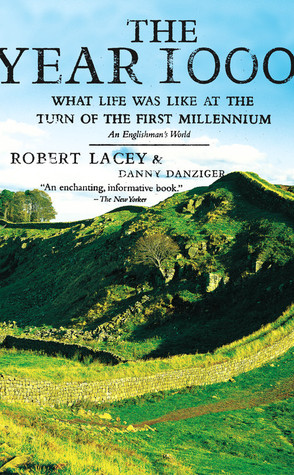
The Year 1000

This extremely charming book about life in the year 1000 is organized around the 12 months of the year, and the activities that were typical of that month. It is densely packed with fascinating information, and is extremely readable. Many fascinating facts in this book and I highly recommend it to everyone!

The first page of every chapter bears that month's illustration from the Julius Work Calendar, such as these:

Sunday, January 5, 2014

Plagues and Peoples - William McNeil

This book by William McNeil offers an interesting interpretation of the way that epidemic disease has shaped the course of world history from ancient times to the present day, a topic that the author asserts has been neglected in traditional historical accounts. The book is written in a charmingly old-fashioned style which is pleasant to read, although it is at times a bit tediously wordy and the citations are sparser than I would like.

Nevertheless, here is one passage from the Introduction that I think provides a good example of the interesting theories underpinning this book:
Disease and parasitism play a pervasive role in all life. A successful search for food on the part of one organism becomes for its host a nasty infection or disease. All animals depend on other living things for food, and human beings are no exception. Problems of finding food and the changing ways human communities have done so are familiar enough in economic histories. The problems of avoiding becoming food for some other organism are less familiar, largely because from very early times human beings have ceased to have much to fear from large-bodied animal predators like lions or wolves. Nevertheless, one can properly think of most human lives as caught in a precarious equilibrium between the microparasitism of disease organisms and the macroparasitism of large-bodied predators, chief among which have been other human beings.
Originally published in 1977, parts are noticeably antiquated, but it remains an interesting and thought-provoking work which has sparked my interest in learning much more about the bubonic plague and the medieval period. 

Thursday, January 2, 2014

S.A.S. Survival Handbook

Thank you very much, Mark, for this wonderful Christmas present! I had read about this some time ago as being the "definitive guide" to wilderness survival, a topic of great interest to me. This book is fantastic - based on a lifetime serving in the Special Air Service (SAS), an elite British army unit, Wiseman packs this invaluable book full of comprehensive, clear, practical information about building shelter, finding food and water, and staying safe and healthy in all emergency scenarios and situations. The diagrams are very clear, and his writing style is quaint. Very enjoyable to read, and who knows, one day it could save your life!!

On a related note, check out the CDC's fun and educational illustrated narrative on emergency preparedness, zombie style.

Thursday, October 24, 2013

The Emperor of All Maladies

My bookclub's most recent book (recommended to me by dad) is The Emperor of All Maladies, an unusual piece of nonfiction which reads like a novel, and which the author calls a "biography of cancer." This tale spans the entire known "life" of the disease(s) we call cancer, from the earliest ancient references (Herodotus recorded the strange tale of the Persian Queen Atossa's breast cancer) to the latest advances in medicine and technology. Mukherjee is a masterful storyteller (and a wise person), and weaves a riveting and at times heartbreaking tale of the hundreds of years of scientific inquiry (and ignorant butchery) which form the largest part of cancer's story. It is a frightening tale but ultimately a hopeful one, and I highly recommend this surprising page turner to all.

Dad's review here.

Wednesday, June 12, 2013

The Emperor of All Maladies

A 608 page book that describes the history of cancer research and treatment sounds like a dry-as-dust sedative.  But, this Pulitzer Prize-winning book by physician-scientist Siddhartha Mukherjee is anything but! Dr. Mukherjee subtitles his book "A Biography of Cancer," and this subtitle accurately conveys how Mukherjee characterizes the "personality" of cancer as it has been perceived over the ages.  The book also discusses changes in ideas of how cancer should be treated, especially focusing on instances when those ideas, though wholly incorrect, were persuasively, even dogmatically championed by accomplished and articulate physicians and researchers.  The scholarship is impressive, but first and foremost, this is an immensely readable and thoughtful consideration of a menacing, devastating, yet fascinating disease.  Very highly recommended!

Sunday, June 5, 2011

A Fierce Radiance

This book takes place in Manhattan during World War II and follows the development of penicillin with a love story thrown in. Although it is a novel, it is based on historical fact (with some poetic license). I was surprised to learn that blood poisoning was a real threat up until the 1940s - people could die of something as simple as a cat scratch. Fascinating to see how the race to make penicillin readily available to the troops led to the rise of drug companies frantic to patent their own special formulas. Much of the novel takes place at the Rockefeller Institute so especially recommended to Brack and Jesse.

Tuesday, January 26, 2010

How Doctors Think

by Jerome Groopman, Chief of Experimental Medicine at Beth Israel Deaconess Medical Center in Boston. A thoughtful guy! This book gives many anecdotes to illustrate some ideas about the kinds of errors physicians make when arriving at incorrect diagnoses. Things like settling quickly on an obvious (but incorrect) diagnosis for a patient who is extremely unpleasant, or the converse, a reluctance to order very uncomfortable tests for patients they like very much and feel sympathy for. And much more. Not earth shattering, by any means, but some very interesting stories. And, surprisingly, some take-home lessons about questions you can ask your own physician to make sure they do not miss any crucial possibilities. Recommended.