For the past several years, Mark and I have enjoyed watching the HBO series Game of Thrones. Mark had read all of Martin's books up to the time of the TV series premiere, but I never had. Everyone says how great the books are, so I finally decided to give the first book a try. I loved it so much I tore through all 800 pages and am already a third of the way through book 2!
Martin's prose is relatively simple and straightforward, but his world is vividly portrayed in all 5 senses and his realistic character depictions make the courtly intrigues and ancient mysteries come alive brilliantly. One of my favorite characters is Lord Tyrion, a little person and son of the powerful house of Lannister. In a world where warriors rule and a disabled man is worth less than a woman, Tyrion uses his wits and humor to remain relevant and preserve his dignity in a society that has derisively termed him "the Imp." Fond of drink and whores, Tyrion is nevertheless the source of many of the book's words of wisdom. He gives several valuable pieces of advice to Jon Snow, the bastard son of powerful Lord Stark, who holds a similarly low place in their world's hierarchy. One such quote is when Tyrion explains his love of reading by saying that "a mind needs books as a sword needs a whetstone, if it is to keep its edge.”
Martin famously kills off nearly every major character (and many minor ones), and it is a strong storyteller indeed who can hold the reader's interest in the events of the world, not just in specific people.
Very exciting and more food for thought than in your usual "light reading."
Showing posts with label medieval. Show all posts
Showing posts with label medieval. Show all posts
Monday, July 20, 2015

Friday, August 8, 2014
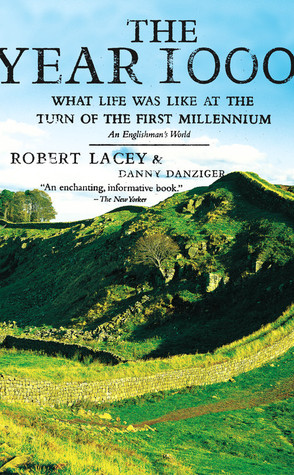
The Year 1000
The first page of every chapter bears that month's illustration from the Julius Work Calendar, such as these:

Saturday, May 17, 2014
The Medieval Underworld - Andrew McCall

Anyway, the content was engaging - the book opens with the context of the Middle Ages, the theory behind Church, State, and sin, then the nature of medieval punishment (cruel and unusual), following by a closer treatment of several strains of deviants in the Middle Ages:
- bandits, freebooters and outlaws
- richman, poorman, beggarman, thieves
- prostitutes
- homosexuals
- heretics
- sorcerers and witches
- Jews
Again, interesting, but perhaps not worth the effort.
Wednesday, April 9, 2014
Great Harry - Carrolly Erickson
 Another tremendous biography by Ms. Erickson. Like Bloody Mary, Great Harry is a vibrant, engaging portrait of life in 1500s England, both the intrigue and lavish splendor of the court, and the violence, ignorance, and squalor of the poor. Ms. Erickson is a master storyteller - King Henry VIII is convincing portrayed as a highly intelligent and ambitious (though flawed) ruler, who is here shown in all his facets and stages - charismatic, handsome, idealistic and beloved in his youth, irascible, peevish, and self-important in his old age, always majestic and awe-inspiring. Hundreds upon hundreds of contemporary quotes are seamlessly woven into this tale, giving it a very rich and authentic flavor of the period and of "Great Harry," as he was called by his adoring subjects in the early years of his reign. A brilliant work, and I can't wait to read more Erickson!
Sunday, January 19, 2014
The Witch-Hunt in Early Modern Europe - Brian P. Levack
 Levack's work is a overview of the legal, political, economic, religious, and epidemic circumstances which he argues enabled the great witch-hunts of early modern Europe. Although witches have been a lifelong interest for me, and I was eagerly anticipating reading this book, I found it kind of disappointing, to be honest.
The scope feels too broad - Levack seldom dives deeply into the particulars of any given hunt, preferring to treat the issue in very general terms. The book is surprisingly dry and even boring, which seems nearly impossible, treating as it does the lurid topics of torture, naked dancing, and burning at the stake, which in this book are described in the most clinical, repetitious passages. Levack also almost never includes direct quotes from contemporaries, which would have spiced it up considerably.
I did learn a few things, but the book could have been a third as long and 10 times more exciting. Especially on the heals of Erickson's riveting historical drama about Mary Tudor, this was pretty dull. Would not recommend.
Sunday, January 5, 2014
Plagues and Peoples - William McNeil
 This book by William McNeil offers an interesting interpretation of the way that epidemic disease has shaped the course of world history from ancient times to the present day, a topic that the author asserts has been neglected in traditional historical accounts. The book is written in a charmingly old-fashioned style which is pleasant to read, although it is at times a bit tediously wordy and the citations are sparser than I would like.
Nevertheless, here is one passage from the Introduction that I think provides a good example of the interesting theories underpinning this book:
Disease and parasitism play a pervasive role in all life. A successful search for food on the part of one organism becomes for its host a nasty infection or disease. All animals depend on other living things for food, and human beings are no exception. Problems of finding food and the changing ways human communities have done so are familiar enough in economic histories. The problems of avoiding becoming food for some other organism are less familiar, largely because from very early times human beings have ceased to have much to fear from large-bodied animal predators like lions or wolves. Nevertheless, one can properly think of most human lives as caught in a precarious equilibrium between the microparasitism of disease organisms and the macroparasitism of large-bodied predators, chief among which have been other human beings.
Originally published in 1977, parts are noticeably antiquated, but it remains an interesting and thought-provoking work which has sparked my interest in learning much more about the bubonic plague and the medieval period.
Subscribe to:
Comments (Atom)