Showing posts with label global climatic disruption. Show all posts

Thursday, May 14, 2015

Dawn - Octavia Butler

Octavia Butler's Dawn is a brilliant exploration of human nature under oppressive conditions, and of the psychology of surviving assimilation. I don't want to give away too much, but suffice to say that her highly original post-apocalyptic vision is powerful, visceral, and disturbing.

This was also the first book I'd read by Octavia Butler, a talented African American female sci-fi author (her Wikipedia page here).

Thursday, July 17, 2014

Nate Silver's The Signal and the Noise

Gibson's novels deal extensively with the science of prediction, which he depicts as a kind of occult phenomenon or 6th sense (cf Laney with his uncanny nodal perception, or the Coolhunter Cayce). As usual, in exploring this theme, Gibson is masterfully extrapolating from current issues, such as the rise of and obsession with Big Data. My reading of this book, then, was driven by curiosity of the actual state of prediction today, especially as compared to its potential as envisioned by Gibson. Sounds like we have a ways to go! It was a very fast and enjoyable read, written in a fluent and conversational style. Recommend!

Dad's review here.

Sunday, May 18, 2014

The Signal and the Noise

This very fascinating book by Nate Silver, of 538.com and NY Times fame, was recommended by Jesse and a geneticist friend, Anil Menon - and it's a winner!  The book is all about predictions - in this era of "big data", one might think that we would be able to make more and more accurate predictions, yet Silver shows that this is not the case.  He looks closely at several fields in which predictions are crucial - weather, earthquakes, climate change and others - and shows that predictions have become more accurate in some of these (weather), but not others (climate change and earthquakes) - and discusses why this is so.  The book sounds very wonky - Bayesian statistics are discussed at some length - but it is exceptionally readable and enjoyable.   Silver's writing seems like speech - it probably was dictated - and he has a whimsical sense of humor that catches you by surprise - he's laugh out loud funny.  He discusses Isaiah Berlin and hedgehogs and foxes (see Berlin's essay) to describe effective predictors (foxes) versus ineffective predictors (hedgehogs).  Really absorbing and informative.  Very highly recommended.  I plan to re-read it soon!

Sunday, July 7, 2013

Ernest Callenbach’s Ecotopia


A recent choice for my book club was Ecotopia. Written in 1975, Ecotopia depicts a vision of the United States in 1999, in which the Pacific Northwest has seceded from the union and been completely isolated from America for the past two decades. The motivation behind this split, led by the women-directed Survivalist Party, was the desire to entirely reform society on egalitarian and ecological grounds – achieving equality for all people, eliminating cars and other pollutants through strict regulation, and creating a “stable state,” sustainable society, which emphasizes recycling and a return to nature. In the (optimistically brief) period since its inception, the nation has largely achieved these goals, unbeknownst to America, which has continued on its wasteful decent into widespread pollution and overpopulation – alas, much like the America we know today.

The story of Ecotopia is from the perspective of William Weston, a journalist who becomes the first American emissary to visit the new country since its founding. Weston is a hard-nosed reporter, and the novel is divided into personal reflections written in his diary and his largely fact-based articles, which he posts back to America to be published. Fairly predictably, Weston’s initial prejudices are softened by the month+ he spends in the new country, and we see him open up to the nation’s “strange” and “barbaric” practices and “surprisingly” brilliant inventions.

Although at times a little heavy-handed, pat, and unrealistically utopian, I found the novel to be very well-imagined and articulated, and the tone believable. Moreover, I was happy to realize that Callenbach’s vision has in some ways been realized – Seattle recently instituted a ban on plastic bags, and all homes and apartments (and most businesses) are equipped with bins to divide “garbage” into recycling, compost, and (thus much reduced) waste. (Although I was horrified to see how inconsistently this is practiced in Ohio!)

It was depressing to finish the novel and remember that I cannot emigrate to Ecotopia, but even so I would definitely recommend this book.

Sunday, February 19, 2012

Paul Gilding - The Great Disruption


There is a war coming.

In this book, Gilding tries to articulate a way out of the mess we're in - he says, in essence, "if we're going to solve these problems, here's what it will look like."  He argues that the coming crisis will initiate a response from the first world directly analogous to that of the second world war, in which enormous swaths of first world economy were nationalized and repurposed to the war effort.  It is this wartime economy, with an emphasis on efficiency and frugality, that will allow us to orchestrate a crisis management response to the collapse that we are now far too late to head off with more gradual efforts.

While much of the material covered in the book is not new to me, Gilding's experience as first an environmental activist with Greenpeace, and later as a environmental consultant who has worked with people like the CEO of DuPont, provides a perspective that is more of an insider's view.

I think the most important point that I drew from this book was his argument that we cannot fight a war on two fronts.  The first front is the radical and transformative restructuring of our political and economic systems that will allow the creation of a sustainable and steady-state (as opposed to growth-focused) economy.  The second is the direct response to the chaos and violence that will make the conflict of the twentieth century look like a gentlemanly session of fisticuffs.  Since the vested interests of the current establishment will, like any hegemony, fight to protect its power, we need to find a way to in the short term harness the old capitalist system to fight the Carbon War, in a concerted effort that will in turn bring about the systemic transformation that we need so desperately.

While I don't know if I share Gilding's optimism, his analogy to the war-time effort of WWII is thought provoking (he notes that military spending went from 3 percent of GDP at the beginning of the war to 39 percent at the end, in a time when the GDP as a whole increased by 75 percent.)  If we can accomplish something similar, along with a total paradigm shift in the consciousness of the first world which will divert our collective activity away from mindless consumption, there may still be hope.

Friday, August 21, 2009

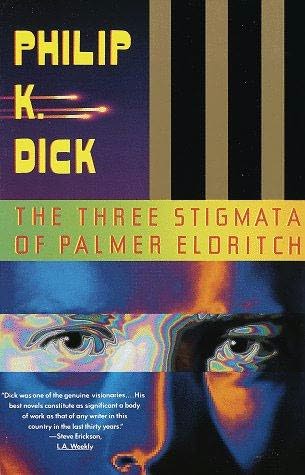
The Three Stigmata of Palmer Eldritch

"The Three Stigmata of Palmer Eldritch" (1965) was the last Philip K. Dick novel I read this summer, and I liked it the most.

I will paraphrase excerpts from the wikipedia page's "Plot introduction":

The setting is some time in the 21st century. Global climatic disruption has rendered Earth inhabitable and to cope with this humans have colonized throughout the solar system. No one wants to be a colonist since it's hard and boring so the UN has to draft people to become colonists. Colonists entertain themselves by playing with "Perky Pat" dolls and accessories manufactured by P.P. Layouts. The real attraction of Perky Pat is using the layouts with Can-D, an illegal hallucinogen that allows the user to "translate" into Perky Pat (if the user is female) or her boyfriend Walt (if male), allowing colonists to experience an idealized version of life on Earth in a collective unconscious hallucination. P.P. Layouts employs several "precogs" to determine if new Perky Pat accessories will be popular. Barney Mayerson, a precog, is the protagonist of this novel.

The plot gets a bit bizarre towards the end of the book, and a few parts are unconvincing, but on the whole I really enjoyed this book.