Showing posts with label poverty. Show all posts

Tuesday, October 18, 2016

Behind the Beautiful Forevers

This exceptional book by Katherine Boo reads like an absorbing, fascinating novel yet is, almost unbelievably, nonfiction.  Boo, a Pulitzer Prize-winning reporter and writer for the New Yorker, lived in Mumbai and delved into the lives of the residents of Annawadi, a small slum beside a lake of sewage, adjacent to a very busy international airport serving Mumbai.
"Everything around us is roses" is how Abdul's younger brother, Mirchi, put it.  "And we're the shit in between."
In an afterward, Boo describes her research, interviewing and filming residents with the help of translators and student interns, for four years, then piecing together this extraordinarily vivid and clear-eyed account of key events in the life of Annawadi, including suicides, a murder, a tragic accident involving horses painted like zebras, and always the crushing power of poverty, inequality and pervasive corruption.
As Abdul and his family had already learned, the police station was not a place where victimhood was redressed and public safety held dear.  It was a hectic bazaar, like many other institutions in Mumbai, and investigating Kalu's death was not a profit generating enterprise."
Boo's aim is to understand how globalization and world economics shape the lives of those at the lower end of the economic scale and her insights are penetrating and empathetic.  This is a beautiful book, though heartbreakingly sad.

Monday, April 18, 2016

Red Rising - Pierce Brown

My bookclub's April pick is Pierce Brown's Red Rising (see our full calendar here). When I first picked up this book, I was turned off by the clunky, dialect-heavy feel of the dystopian Mars mining colony - it reminded me a bit of the feral children's irritating ramblings in Mad Max Beyond Thunderdome about "tomorrow-morrow land."

"I's looking behind us now, into history back."
However, the book's scope explodes beyond this point, and I became very engrossed in its exploration of the themes of social control, exploitation, and revolution.

Personally, I thought the movie Hunger Games was insipid, but I would recommend this book to HG fans, and any other survival enthusiasts.

Monday, March 23, 2015

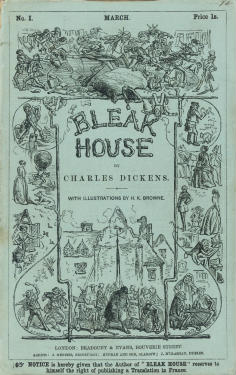
Bleak House - Charles Dickens

I find Dickens' novels to be delicious and satisfying like a nice Stilton, and Bleak House is no exception. The tale is told from the perspective of Esther, a schoolmarmish and self-effacing young woman who lives to nurture others. Characteristically, the novel weaves Esther's own story into a complex tapestry of interconnected narratives and broader themes.

Esther is raised by a severe old woman and haunted by a vague suggestion that she was born into shame (a mystery which is gradually explored over the course of the novel). After the old woman dies, Esther is rescued by a wealthy patron, John Jarndyce, who pays for her education and finishing and then sets her up as caretaker of his estate, Bleak House. In addition to managing the keys and accounts, Esther dedicates herself to the care of John's beautiful niece, Ada, and acts as a chaperone and confidant to Ada and her carefree beau, cousin Richard.

The novel's principal theme is revealed through the story of Ada and Richard - the wards of Jarndyce - as the destructive power of the sprawling and ineffective Chancery justice  system, which was ultimately reformed in part due to Dickens' powerful critique.

A poetic and very human look at the beauty and tragedy of the domestic sphere across multiple societal classes. Dickens captures the crude wisdom of impoverished women despite the ignorance, violence, and squalor of their existence, and through Esther's prim but compassionate eye, satirizes the conceits of those blustering do-gooders who would help the poor by giving them books they cannot read. He is also as adept at capturing the foibles and tragedies of the nobility as he is at portraying the life of the very poor. All in all, a very vibrant picture of the human condition.

Friday, May 16, 2014

All Tomorrow's Parties - William Gibson

I have been consuming Gibson in a strange and disjointed fashion over the past 3 years, picking up random books in his trilogies and reading them out of order. Maybe because I never stop thinking about Gibson's universe (!), this has not reduced my enjoyment of them in the slightest.

ATP follows Laney in the final stages of his drug-induced transformation, in which his uncanny nodal apprehension is perfected even as his body completely degenerates. Laney has sensed that a pivotal change is poised to occur in the universe, with the node centered around the enigmatic celebrity Harwood and idoru Rei Toei, and the new nanotechnology "fax machines" entering all Lucky Dragon convenience stores. As usual, a synopsis is unsatisfying for Gibson's stories, which sound absurd when summarized in this fashion, yet are immensely, masterfully believable.

I truly believe that Gibson has his finger on the pulse of our own history, much like Laney, and this is why his "future" is so powerfully present.

Highly, highly recommend.

Gibson's 3 Trilogies:

The Sprawl Trilogy:
The Bridge Trilogy:
The Bigend Books:

Wednesday, April 16, 2014

The Grapes of Wrath - Steinbeck

For whatever reason, I was never required to read this book in high school, so I read it now for the first time as an adult. It's really a masterful work, very emotionally powerful and heartbreaking. The grotesque plight of the disenfranchised Oklahoma tenant farmers is told through the eyes of the Joad family. The story recounts their struggles as they are forced to leave their land and seek work in California, where they experience the cruelty of poverty and the futility of hard work and hope in the face of an oppressive system.  I am not surprised the book was so controversial in its day, the politics are very progressive and pro-labor. The book can be graphically disturbing but it is  an important story that remains very relevant today.

Sunday, January 26, 2014

The Prince and the Pauper

This is one of Twain's "softer" books - although there is some social criticism and a few sad episodes, by and large this is a delightful story with many humorous incidents.  And the overall theme of the book is a paean to mercy - sympathy for one's fellow man and a willingness to help.  The device of virtual twins, one from the highest and one from the lowest station of life underscores that, as the Phil Ochs folksong says, "there but for fortune go you or I".  And Twain is a masterful storyteller with a powerful ability to build a mood and then demolish it suddenly with a piercing incident (no spoiler quote to follow!)  Very highly recommended.

Sunday, January 5, 2014

Plagues and Peoples - William McNeil

This book by William McNeil offers an interesting interpretation of the way that epidemic disease has shaped the course of world history from ancient times to the present day, a topic that the author asserts has been neglected in traditional historical accounts. The book is written in a charmingly old-fashioned style which is pleasant to read, although it is at times a bit tediously wordy and the citations are sparser than I would like.

Nevertheless, here is one passage from the Introduction that I think provides a good example of the interesting theories underpinning this book:
Disease and parasitism play a pervasive role in all life. A successful search for food on the part of one organism becomes for its host a nasty infection or disease. All animals depend on other living things for food, and human beings are no exception. Problems of finding food and the changing ways human communities have done so are familiar enough in economic histories. The problems of avoiding becoming food for some other organism are less familiar, largely because from very early times human beings have ceased to have much to fear from large-bodied animal predators like lions or wolves. Nevertheless, one can properly think of most human lives as caught in a precarious equilibrium between the microparasitism of disease organisms and the macroparasitism of large-bodied predators, chief among which have been other human beings.
Originally published in 1977, parts are noticeably antiquated, but it remains an interesting and thought-provoking work which has sparked my interest in learning much more about the bubonic plague and the medieval period. 

Friday, July 12, 2013

Ernest Cline's Ready Player One


WOW! My bookclub's most recent pick was Ready Player One, and I read this thrilling 372-page sci-fi novel cover to cover over the last several hours. Talk about a page-turner! I won't give away the main quest driving the plot, but suffice to say, it is action-packed and awesome.

The experience of reading this book was very self-indulgent for a cyberpunk nerd like myself -- it is a book about otaku, for otaku, and it has the works: a post-apocalyptic wasteland where everyone with enough money for a visor and "haptic gloves" escapes the filth and squalor of our used-up Earth via a full-dive VR universe called OASIS; brilliant teen hackers; a soulless corporate entity in full villain mode; and, in an unusual twist on your typical sci-fi novel, endless real-world references to obscure sci-fi, video games, and everything 1980s.

The British newspaper The Observer says that the otaku is "the passionate obsessive, the information age's embodiment of the connoisseur, more concerned with the accumulation of data than of objects." In Ready Player One, and in many nerd subcultures IRL, a player's ability to amass vast knowledge of game-related trivia is a sought-after mark of authenticity, and a status symbol within the group.

In one early scene, our ridiculously erudite, but chronically poor and therefore low-level hero, Perzival, spars with the braggart I-r0k in a VR chat room, about what it takes to be a "gunter" (egg hunter, or elite gamer):

"Poseur."
"Poseur? Penis-ville is calling me a poseur? ...This chump is so broke that he has to bum rides to Greyhawk, just so he can kill kobolds for copper pieces! And he's calling me a poseur!"
..."That's right, I called you a poseur, poseur." I stood up and got in his grille. "You're an ignorant know-nothing twink. Just because you're fourteenth-level, it doesn't make you a gunter. You actually have to possess some knowledge."

As Perzival's friend Aech would say, "Word."


This novel is recommended for everyone, but especially if you like:
- Stephenson's Snow Crash
- Sword Art Online (anime TV series)
- Gibson's Idoru

Saturday, July 18, 2009

Ironweed

Dad recommended Ironweed, by William Kennedy, to me a while ago, and I finally got around to reading it.

I really enjoyed reading it, although it was very grim. I especially loved the fact that the main character, a violent bum, is literally haunted by the ghosts of his past... spooky and intriguing. The voice of the novel is engaging, and the variety of narrative styles is unique. An interesting picture of poverty and alcoholism in 1938.

I would recommend it!