This short (111 pages), very readable book was excerpted and augmented from Spillover, Quammen's earlier book about zoonoses - diseases that jump from an animal to man - and possible reasons why they are increasing in frequency. The decision to create a more focused book on Ebola was stimulated, of course, by the devastating Ebola epidemic that began in Guinea in late 2013. This book appeared before that epidemic had run its course and was intended to help people around the world understand the nature and course of this disease.
Ebola shows a classic zoonotic pattern of occurrence - emerging suddenly and killing tens or hundreds of people, then as quickly vanishing without a trace, only to re-emerge a few years later. During the quiescent or latent period, the causative agent resides within a natural host or "reservoir" species - in which it may multiply freely, while causing little disruption or disease. The devastating eruptions occur when some rare event causes the agent to infects an unusual host, such as man, leading quickly to death. If the virus or other agent can be passed from human to human, the disease may spread quickly, but in isolated communities, it often reaches a dead-end, because of a lack of new victims to affect. In this case, the outbreak ceases until another "spillover" or extraordinary infection event occurs. Frequently, it can be very difficult to identify the reservoir species.
Bats are reservoir species for many zoonotic diseases, including that caused by Marburg virus, which is closely related to Ebola. Good, though not conclusive, evidence suggests bats are also the reservoir for Ebola. Quammen's book considers, at some length, why bats may be a favored reservoir for many viral diseases - all quite interesting speculations. Another important issue considered in the book is why zoonotic outbreaks have become more common; Quammen relates the widely held view among zoonotic researchers that it is because of the increasing disruption of wilderness by the encroachment of human settlements and activities. These encroachments bring humans into more direct and more frequent contact with many species that have long been spatially segregated. As this trend continues and intensifies, we may expect zoonotic outbreaks to become more frequent, increasing the likelihood that some of these agents will adapt to human to human transmission, resulting in deadlier epidemics and, perhaps, The Next Big One - a world-wide pandemic such as bubonic plague in the middle ages or the Great Influenza of 1918.
Quammen is a terrific science writer - he digs deeply and understands his subject fully, he presents the science via a lively narrative focused on the stories of individuals, and his anecdotes are frequently punctuated by a sharp, sometimes mordant wit.
Showing posts with label Africa. Show all posts
Friday, December 25, 2015
Saturday, March 28, 2015
Mandela: My prisoner, my friend
This very personal and unpretentious memoir by Christo Brand helps fill in many dimensions of Mandela's life during imprisonment and also the varying faces of apartheid. Brand grew up in South Africa in unusual circumstances - though of Afrikaans descent, his parents were very open-minded and, within the limits of South African society and rules, were open to relations with all people. Accordingly, when he became a warder in the South African Prison system at age 18 (to avoid military service), he was a combination of naive obedience to the system coupled with an open-minded outlook toward people of all races.
When assigned to the maximum security prison on Robben Island, he was surprised to find that he was to oversee not the hardened criminals he expected, but "even worse", murderous terrorists, as the government had depicted them - especially including Nelson Mandela, who was 60 and had already served many years. Brand soon found that these were serious, decent and kind people, and over time, he began helping them in small ways that seemed to him to be only human, yet could easily have resulted in his dismissal.
One feature of imprisonment for the "Rivonians" (so-called because of the trial that resulted in their life sentences, held at Rivonia) that I had not known about and that weighed on them very heavily was that they were forbidden from seeing or even hearing the voices of children at any time, especially their own children. Thus, when Brand once secretly made a startling exception to the rules and allowed Mandela to briefly hold his granddaughter, it was particularly meaningful and helped cement their relationship. Not surprisingly, the book reveals Mandela to be amazingly patient, disciplined and kind to all - though also quite impressively resolute when he felt it necessary. An easy, heart-warming read - very highly recommended.
When assigned to the maximum security prison on Robben Island, he was surprised to find that he was to oversee not the hardened criminals he expected, but "even worse", murderous terrorists, as the government had depicted them - especially including Nelson Mandela, who was 60 and had already served many years. Brand soon found that these were serious, decent and kind people, and over time, he began helping them in small ways that seemed to him to be only human, yet could easily have resulted in his dismissal.
One feature of imprisonment for the "Rivonians" (so-called because of the trial that resulted in their life sentences, held at Rivonia) that I had not known about and that weighed on them very heavily was that they were forbidden from seeing or even hearing the voices of children at any time, especially their own children. Thus, when Brand once secretly made a startling exception to the rules and allowed Mandela to briefly hold his granddaughter, it was particularly meaningful and helped cement their relationship. Not surprisingly, the book reveals Mandela to be amazingly patient, disciplined and kind to all - though also quite impressively resolute when he felt it necessary. An easy, heart-warming read - very highly recommended.
Sunday, March 17, 2013
Heart of Darkness
This classic from Joseph Conrad is actually a really, really short read. So, if you've ever wanted to dip your toe into the novels you should have read in high school but never got around to, this one's a good one to start you off.
The story is rather straightforward, so much so that one might argue very little happens-- the true beauty of the novel, however, is in the atmosphere that Conrad creates throughout the book, bringing to life the struggles of the African people, and the darkness that is within everyone.
I thought this book was fantastic, and definitely worth the read. If you're willing to brave a couple of nightmares, pick this sucker up from your local library.
The story is rather straightforward, so much so that one might argue very little happens-- the true beauty of the novel, however, is in the atmosphere that Conrad creates throughout the book, bringing to life the struggles of the African people, and the darkness that is within everyone.
I thought this book was fantastic, and definitely worth the read. If you're willing to brave a couple of nightmares, pick this sucker up from your local library.
Labels:
adventure,
Africa,
classic,
dark,
fiction,
Joseph Conrad,
seafaring,
social commentary
Thursday, October 18, 2012
King Peggy
This was truly a delightful book! It is the true story of how Peggielene Bartels, a Ghanaian native, moved to America to work in the Ghanaian Embassy as a secretary, eventually became a US citizen and then, completely out of the blue, got a phone call from a relative in Ghana, saying that she had been chosen as the village's new King! (Her uncle had been King before, but Peggy thought this had to be a joke, because there are virtually no female Kings in Africa!). She finds out that the news is on the level, but she soon realizes that the village elders have chosen her in large part because she is a woman, is much younger than them, and lives far away - virtually guaranteeing that they will be able to dominate her. Guess she moved away from Africa before they ever got a chance to get to know her!! Peggy is a strong-minded, caring person, who develops big plans for her impoverished village - and she cuts off the bribes and corruption that have prevented much progress, eventually doing wonderful things for the village. She also has a wicked sense of humor - and the book is touching and exceptionally funny. A light, but wonderful, read!
Labels:
Africa,
autobiography,
Dad,
Ghana,
humor,
King,
nonfiction,
politics
Sunday, February 19, 2012
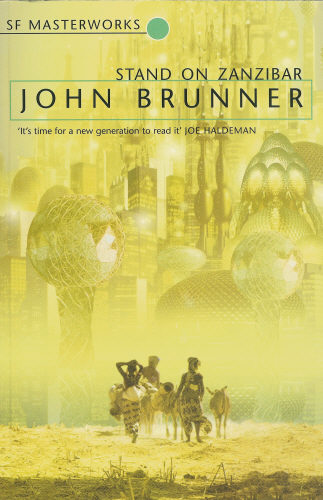
John Brunner - Stand on Zanzibar
Another classic science fiction novel that I never knew existed. Written in 1968, Stand on Zanzibar is set in a crowded, decolonized early 21st century. The world is filled with mass-market psychedelics and eugenic legislation, overstimulated and disney-fied in a way that hits pretty close to home. The world's crowded cities are terrorized by "muckers," or people driven to the point of berzerk killing sprees. Brunner's vision is on the level of a Philip K. Dick in terms of sheer affectual prescience.
The novel contains several narrative threads, interspersed with commercials and other snippets from the infosphere, as well as vignettes that act as character sketches of various dysfunctional relationships (usually centered around attempts to circumvent eugenics laws). Other sections are polemics, written in the voice of Chad Mulligan, who can perhaps best be described as stand up comedian channeling Vonnegut.
The two main plot lines involve a propaganda campaign by a Southeast Asian archipelago claiming that they will genetically modify their next generation to breed a perfect species, and a series of negotiations between a large US corporation and a small African ex-colony which is mysteriously free of violence, and whose people have had a reputation for witchcraft stretching back into prehistory.
The novel is scathing and quite funny. I find most satire to be a bit cringe-inducing, but Brunner pulls off his tone with an aplomb that reminds me most of David Foster Wallace.
Labels:
Africa,
Colin,
drug culture,
dystopia,
fiction,
humor,
John Brunner,
post-apocalyptic,
propadana,
satire,
sci-fi,
social commentary
Subscribe to:
Comments (Atom)