Showing posts with label astrobiology. Show all posts

Wednesday, January 13, 2021

To Be Taught if Fortunate - Becky Chambers


With the pandemic, I have barely been reading, so it's been a long time since I've contributed to our book blog! But I'm hoping to get back on track in 2021. My first read of 2021 is this novel by Becky Chambers, for my bookclub. I love space exploration sci-fi, and this was fresh and evocative light reading. Spunky like The Martian, thoughtful like (but not nearly as dark as) The Sparrow (also by a woman, Mary Doria Russell).

Besides Ursula K. LeGuin, Octavia Butler, and Madeline L'engle, I don't know that I've read many female science fiction authors, which is too bad, since it's one of my favorite genres. I don't know that I would say the author's gender was really relevant to this book, though I did find it interesting that in one passage the main character (who is also a woman) muses that 
"We astronauts are taught to compartmentalize the realities of flight. [And the fact that everyone you know will be dead when you return.] ...You wonder if you're a bad daughter, a bad friend, a selfish asshole placing her own intellectual wankery above the living, breathing people who poured everything they could ever give into her, and were rewarded with the sight of her walking away forever." 
I don't think I've heard this sentiment much in the male-centered space exploration stuff I've read, and it struck me the extra pressures women explorers face, since we are usually expected to be caregivers for elder family, etc. -- more guilt and conflict there. So I found that interesting.

Anyway, all in all, a good book for the new year.

Wednesday, August 24, 2016

Aurora - Kim Stanley Robinson

Aurora is KSR's latest novel, published in summer 2015, and the only other book of his that I have read, other than the genius Mars trilogy. Aurora is just as delightful, and satisfyingly familiar in tone, with its hyper-detailed yet highly readable descriptions of technology, and the incisive and compelling character depictions, which elevate the book from tech porn to high literature.

Aurora is the story of a generation of families born on a spaceship in the middle of a 159+ year colonizing trip to Tau Ceti, led at this point in their journey by brilliant yet troubled scientist Devi, who keeps their aging vessel in working order through hundreds of daily repairs. Unlike Mars, with its numerous protagonists, this novel focuses primarily on Devi and her daughter, Freya. In a unique and engaging narrative twist, the tale's chronicler is the ship itself, an AI called simply "ship."

The action begins in Freya's youth and young adulthood, in the final years of the journey to Tau Ceti. A deeply interesting and moving tale, which I highly recommend to all sci-fi enthusiasts!

Saturday, January 17, 2015

Red Planet - Robert Heinlein

Really enjoyed Heinlein's short novel about two boys, Jim and Frank, and their exploits at a boarding school on Mars. The plot unfolds amidst a political conflict between the freedom-loving people of Mars and their greedy and callous Earth overlords, and centers around Jim's relationship with the Martian "bouncer" Willis, a small, furry, tentacled creature with remarkable powers of imitation.

Written in 1949, the novel is reminiscent of a Hardy Boys style adventure, but the ideas are refreshingly modern (with the exception of the frequent sexism, which tends to mar the quaint tone). Still, a charming book with an interesting conception of alien life.

Also, Willis was so cute!
Some artist's conception of Willis

Saturday, August 2, 2014

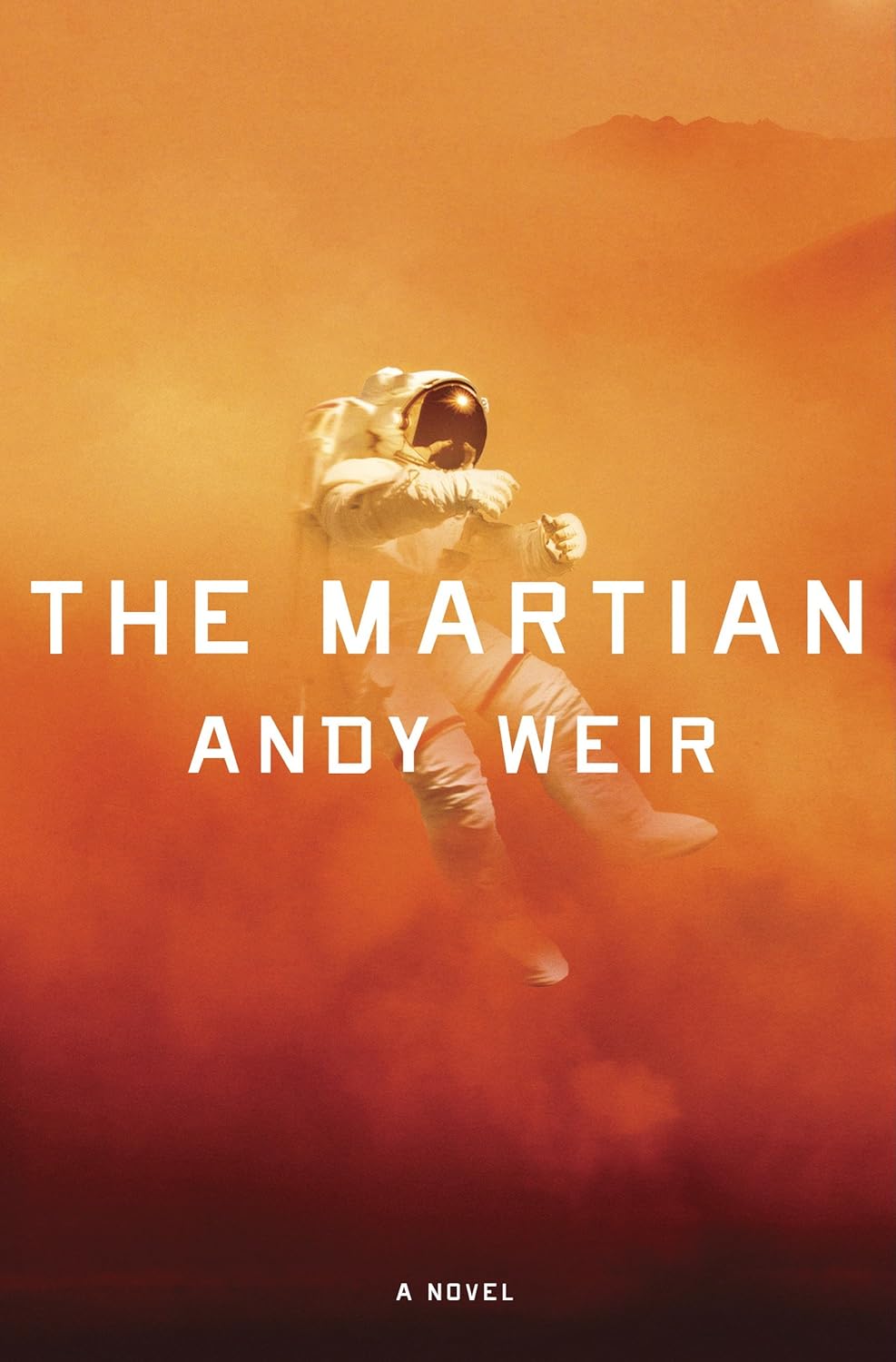
The Martian - Andy Weir

"Robinson Crusoe in space" is how our bookclub organizer described The Martian, and this is a pretty apt description. Our intrepid astronaut hero Mark Watney is left stranded on Mars when his crew takes him for dead following a terrible accident. Using his botany and mechanical engineering skills, Mark must survive and find a way to let Earth know that he's still alive!

This fast-paced action thriller is written in a highly loose and conversational style, with entries styled as Mark's log. Recommended for fans of Kim Stanley Robinson, though this is much less literary and more of a beach read. Still fun and thought-provoking!

Also, here's a (kind of) relevant clip from Total Recall:

Sunday, February 9, 2014

Anathem - Neal Stephenson

Today I finished my 6th book of 2014, Stephenson's Anathem. WOW!

The book is set on the planet Arbre, quite similar to our own, but divided in the present time (and for the past several thousand years) into the Saecular and Mathic worlds. Inside the "maths", or cloisters, live the Avout, non-religious men (fraas) and women (suurs) who have devoted their lives to intense scholarship and medieval asceticism, almost wholly without advanced praxis (technology). They live secluded from the outside world, except for a 10-day holiday called Apert during which the gates are opened, when the "extras" are free to come into the math, and the Avout are free to leave and explore extramuros. Depending on whether an Avout is a Unitarian, Tenner, Hundreder, or Thousander, his or her order will have the chance to celebrate Apert only once a year, decade, century, or millenium. In the mean time, all knowledge of the Saecular world is strictly avoided.

The book opens as Fraa Erasmas, a Tenner, is about to celebrate his first Apert since joining his math, the Concent of Saunt Edhar, as a young boy. Over the course of this holiday, however, he and his fraas and suurs discover that something very serious and shocking has been happening extramuros. Dun dun dun!

Of course I won't give away more, but suffice to say, this book is pure Stephenson genius. A beautifully rich world filled with highly likable characters (especially Fraa Jad!) engaged in a gripping and meaningful quest.

Recommended if you enjoyed: The Name of the Rose, Reamde

Stephenson's Novels

Monday, November 1, 2010

Kim Stanley Robinson's Mars Trilogy


Wow! Many thanks to Colin for recommending this fascinating, compelling science fiction novel (the first of a trilogy) describing the colonization of Mars.
Many significant Earth-bound themes are thrown into sharp relief, accentuated by the open possibilities for establishing a new (?) world order on Mars. Some of these issues are represented by key members of the First Hundred to settle on the planet: Idealism (John Boone) versus political manipulation (Frank Chalmers), eco-preservation (Ann Clayborne) versus aggressive terraforming (Sax Russell), and revolutionary democratic forms of government (Arkady Bogdanov) vs. control by transnational corporations (Phylis Boyle). The characters are interesting individuals and Mars is depicted in astonishing and deeply-researched detail as hostile, extraordinarily strange, and awe-inspiringly beautiful.

Saturday, May 22, 2010

An Introduction to Astrobiology

I am doing some readings about aliens this summer and this was one of the books on my list. It is basically an undergraduate level textbook with some fairly nontechnical chapters on the genesis of life, cell biology, the essential chemical reactions of life, extremophile terrestrial species, planetary geology, exoplanet astronomy, and SETI. It does a very good job of explaining what we know and how we know it. The book is about five years out of date (most relevant for the astronomy section, as exoplanet discoveries are starting to pour in) but gave me a good basis for further reading on the subject.

Saturday, November 8, 2008

Sparrow


When I was a kid I really liked the sci-fi classics: Asimov, Herbert, Bradbury. I don't read much of it now, though I did love Orson Scott Card's Ender's Game. But Ryan and Eunice listed Mary Doria Russell's The Sparrow as a favorite on their website, so I thought I'd give it a try.

It's the story of a the discovery of alien life and an expedition to the nearby planet. It is a Jesuit party and it goes horribly awry. The stories of the discovery and the post-mortem investigation are told simultaneously, building toward the same climax. It is an effective storytelling device and the hero is a compelling figure. Ultimately, though, I was disappointed in the "reveal."

So, all in all, I'd say a pretty good quick read - maybe a 7 out of 10.

Dad's review here
Lauren's review here