Showing posts with label politics. Show all posts

Sunday, July 31, 2022

A Memory Called Empire - Arkady Martine

A Memory Called Empire was phenomenal. My favorite genre of sci-fi is cyberpunk, and although this was not that, and was more a traditional Star Trek- or Ursula K. LeGuin-style exploration of cultures intersecting in outer space, this did have my favorite cyberpunk trope, of stacks and sleeves (or wetware and hardware, or whatever you want to call it -- importing one's consciousness into a new vessel). This novel uses a form of this trope I particularly enjoy, a la Jadzia Dax, where the individual's consciousness merges with that of their predecessor, forming a new hybrid individual. In Memory, this technology is called an 'imago line,' which citizens on Lsel Station use to covertly preserve the knowledge, personality, and memories of generations.


In this work, Mahit is the new Lsel Ambassador to the Empire, appointed after her predecessor, Yskandr, dies under suspicious circumstances. Mahit is fitted with Yskandr's imago, which should give her the benefit of his expertise, but it's missing 15 years of his experiences, and then mysteriously stops functioning at all, leaving her entirely alone and unsupported on an alien planet. Mahit must rely upon her own instincts (and some unlikely allies) to navigate the politics of the imperial court, investigate Yskandr's demise, and preserve the independence of Lsel Station -- all against a backdrop of increasing civil unrest in the imperial City.

A brilliant, exciting, authorial debut, written by an author with a passion for poetry and linguistics, which deepen and enrich this political space opera. Highly recommend!!

Saturday, January 17, 2015

Red Planet - Robert Heinlein

Really enjoyed Heinlein's short novel about two boys, Jim and Frank, and their exploits at a boarding school on Mars. The plot unfolds amidst a political conflict between the freedom-loving people of Mars and their greedy and callous Earth overlords, and centers around Jim's relationship with the Martian "bouncer" Willis, a small, furry, tentacled creature with remarkable powers of imitation.

Written in 1949, the novel is reminiscent of a Hardy Boys style adventure, but the ideas are refreshingly modern (with the exception of the frequent sexism, which tends to mar the quaint tone). Still, a charming book with an interesting conception of alien life.

Also, Willis was so cute!
Some artist's conception of Willis

Sunday, January 26, 2014

An Edible History of Humanity - Tom Standage

An Edible History of Humanity was sort of entertaining, as it contains lots of colorful anecdotes, but much of it felt like a less substantive (and very derivative) version of Pollan's Omnivore's Dilemna (cf the discussion of corn). Moreover, I came away feeling like behind his pseudo-intellectualism, Standage is either really ignorant, or sort of a schmuck. His political beliefs, when they show through, are disturbing.

For example, Standage describes several instances of famines in which the native community starved, while exporting their food for consumption by wealthy foreigners.* However, evidently without realizing the irony in his position, Standage remains shockingly, unabashedly colonialist - he explains the danger of the current popularity of "local food" by stating that, "an exclusive focus on local foods would harm the prospects of farmers in developing countries who grow high-value crops for export to foreign markets. To argue that they should concentrate on growing staple foods for themselves, rather than more valuable crops for wealthy farmers, is tantamount to denying them the opportunity for economic development." I was dumbfounded when I read this... Below I have excerpted only 2 of several passages where Standage plainly describes the misery that results when poor farmers grow crops for wealthy foreigners, but this does not seem to have shaken his ideology.

He also extensively lauds the virtues of nitrogen farming while devoting exactly 1 paragraph to its dangers, trivializes the organic movement, and is a bit over-the-top in his rah-rah Capitalist, anti-Communist jingoism ("Is it a coincidence that the worst famine in history occurred in a Communist state?"). He's the business editor at the Economist, so maybe that explains it?

Anyway, I wish he would take some time out from copying Pollan's rhetoric to read a little Chomsky.

Sigh!

* On p.135, he states that "by the early 1840s, imports from Ireland were supplying one sixth of England's food. This food was produced by men who worked on the best, most easily cultivated land and were typically given small patches of inferior land on which they grew potatoes to support themselves and their families. The English could only keep eating bread, in short, because the Irish were eating potatoes." He later describes, on p.188, how under Mao in China, "the main cause of the famine was not inadequate food production so much as the farmers' lack of entitlement to it. The food they produced went to feed people in the cities, Party officials, and foreigners."

Thursday, January 2, 2014

Understanding Power - Noam Chomsky

My book group's most recent selection (at my suggestion) was Chomsky's "Understanding Power." My friend Dan had urged me to read this book many times and I kept putting it off, thinking it would be boring and difficult. Nothing could be farther from the truth! This gripping book, although shocking and disturbing at times, was extremely interesting and readable. It is an edited transcript of Chomsky's various talks, and his style is clear and persuasive. I found this book to be profoundly eye-opening and unsettling regarding American politics and media censorship, and while I felt very disillusioned, it was important for me to have a better understanding of power and oppression in our nation. A must-read for everyone, I think!
Footnotes to the text are available here.

Friday, September 6, 2013

Fathers and Children

Lauren has already reviewed this book by Turgenev , often published under the title Fathers and Sons, providing a nice summary of its depiction of two generations of Russians, the idealists of the 1840's (the Fathers) and the nihilists of the 1860's (the Children).

Turgenev's portrait of the self-proclaimed nihilist Bazarov provoked huge controversy: opponents of the utilitarian nihilists reviled Turgenev, denouncing Bazarov as a villain.  Most nihilists dismissed the portrait as a laughable caricature, though a few actually praised him as a "new man" of the type who would rejuvenate Russia.
 "Your sort, you gentry," Bazarov tells Arkady, when the two friends come to the parting of the ways, "can never get beyond refined submission or refined indignation, and that's a mere trifle.  You won't fight.....but we mean to fight.....we want to smash other people!"
Interestingly, one of the few people in Russia who seemed to accurately understand Turgenev's portrayal was Dostoevsky, who saw Bazarov as a tragic character, doomed to unhappiness by the contradiction between his sterile and brutal intellectual beliefs and his human needs and longings. Dostoevsky's praise and understanding helped forge a strong but brief friendship with Turgenev, which, however, was quickly dashed to pieces by their widely divergent views on religion and whether Russia's future lay in adopting western ideas (Turgenev) or seeking guidance from the true Russian character, which, in Dostoevsky's view, derived from a deep faith in Christ.

I really enjoyed the book, which is lyrically written, with great sensitivity to human love and loneliness. Though Bazarov is infuriating in his brutality, he is captivating in his passions and deep emotions.


Thursday, October 18, 2012

King Peggy

This was truly a delightful book! It is the true story of how Peggielene Bartels, a Ghanaian native, moved to America to work in the Ghanaian Embassy as a secretary, eventually became a US citizen and then, completely out of the blue, got a phone call from a relative in Ghana, saying that she had been chosen as the village's new King! (Her uncle had been King before, but Peggy thought this had to be a joke, because there are virtually no female Kings in Africa!). She finds out that the news is on the level, but she soon realizes that the village elders have chosen her in large part because she is a woman, is much younger than them, and lives far away - virtually guaranteeing that they will be able to dominate her. Guess she moved away from Africa before they ever got a chance to get to know her!! Peggy is a strong-minded, caring person, who develops big plans for her impoverished village - and she cuts off the bribes and corruption that have prevented much progress, eventually doing wonderful things for the village. She also has a wicked sense of humor - and the book is touching and exceptionally funny. A light, but wonderful, read!

Saturday, August 18, 2012

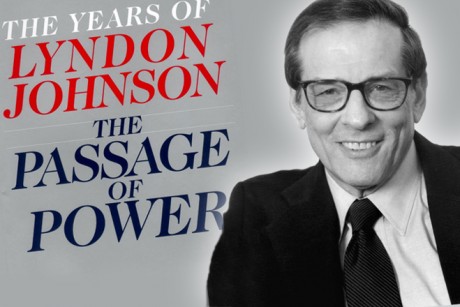
The Years of Lyndon Johnson: The Passage of Power

The fourth volume in the ongoing, detailed, yet completely absorbing biography of Lyndon Johnson by Robert Caro was published recently. Caro is a titan of biography: his research is exhaustive, based on hundreds of interviews, examination of all relevant documents, and even substantial time living in places where Johnson spent formative periods. Caro famously spent more years writing Johnson volume III, than Johnson spent living it! Yet reading his prose is effortless - logically organized and lively, it's more like a yarn than a history.

Caro originally conceived this biography as three books - now four are out, with numbers five or, even, six in the works. I used to say that I hoped Caro (now 77) would live long enough to finish the series. Now I say that I hope I live long enough to finish reading the series!

Caro's invariable subject is power. His first book, The Power Broker, about Robert Moses, was a detailed study of the most powerful man in New York State for several decades. And power is the explicit subject of the Johnson series. The third volume, Master of the Senate, spent ~150 pages describing the history of the US Senate, convincingly demonstrating how the dictates of the Constitution, the historical traditions of the Senate, and the powerful and monolithic Southern Bloc of Senators made it impossible for any single man to wield power in that body - all to set the stage for the astonishing consolidation, almost creation, of power by the junior Senator from Texas. Johnson himself is quoted saying,
I do understand power, whatever else may be said about me. I know where to look for it, and how to use it."
The Passage of Power describes a new chapter in Johnson's search for power, describing how he failed to capture the Democratic Presidential nomination for the 1960 election and then decided to accept the Vice-Presidential nomination, strongly against the advice of his best friends and advisors, who argued forcefully that the Vice Presidency is a ludicrous, powerless office. Johnson believed he could alter that situation, telling one friend, "Power is where power goes." But he was wrong. He had misread and badly underestimated Jack Kennedy, who sidelined him completely. Johnson was regarded by the Kennedy inner circle ("the Harvards", as he called them) as a rube ("Uncle Cornpone" or "Rufus") and was personally snubbed and administratively excluded. In the absence of any meaningful role, with no opportunity to groom himself to replace Kennedy at the conclusion of his term, Johnson literally wasted away, physically and mentally.

The gripping part of this volume is the shocking assassination of Kennedy and the immediate transformation in Johnson; he came alive, overcoming enormous obstacles, to seize the reins of power and wield them with astonishing effectiveness. For example, the description of how he managed to steer a civil rights act through Congress is exceptionally impressive. Caro lauds Johnson's achievement in the highest terms:
The 1965 Act would be passed after another titanic struggle, in which, with men and women (and children, many children) being beaten in Selma on their way to the Edmund Pettus Bridge, singing "We Shall Overcome" as they marched into tear gas and billy clubs and bullwhips, Lyndon Johnson went before Congress and said, "We Shall Overcome," thereby adopting the cicil rights rallying cry as his own. (When Martin Luther King, watching the speech on television in Selma, heard Johnson say that, he began to cry - the first time his assistants had ever seen him cry). ..... To bring black Americans more fully into the political system, he had to break the power of the South in the Senate - and he broke it. It was Abraham Lincoln who "struck off the chains of black Americans," I have written, "but it was Lyndon Johnson who led them into voting booths, closed democracy's sacred curtain behind them, placed their hands upon the lever that gave them a hold on their owndestiny, made them, at last and forever, a true part of American political life." How true a part? Forty-three years later, a mere blink in history's eye, a black American, Barack Obama, was sitting behind the desk in the Oval Office.
For me, this book provided new insight into Jack and Robert Kennedy, the incomparable speechwriter and Kennedy accolyte Ted Sorenson, and, through the masterful protrayal of the strengths and weaknesses of LBJ, new insights into the character of men.

Sunday, February 19, 2012

Paul Gilding - The Great Disruption


There is a war coming.

In this book, Gilding tries to articulate a way out of the mess we're in - he says, in essence, "if we're going to solve these problems, here's what it will look like."  He argues that the coming crisis will initiate a response from the first world directly analogous to that of the second world war, in which enormous swaths of first world economy were nationalized and repurposed to the war effort.  It is this wartime economy, with an emphasis on efficiency and frugality, that will allow us to orchestrate a crisis management response to the collapse that we are now far too late to head off with more gradual efforts.

While much of the material covered in the book is not new to me, Gilding's experience as first an environmental activist with Greenpeace, and later as a environmental consultant who has worked with people like the CEO of DuPont, provides a perspective that is more of an insider's view.

I think the most important point that I drew from this book was his argument that we cannot fight a war on two fronts.  The first front is the radical and transformative restructuring of our political and economic systems that will allow the creation of a sustainable and steady-state (as opposed to growth-focused) economy.  The second is the direct response to the chaos and violence that will make the conflict of the twentieth century look like a gentlemanly session of fisticuffs.  Since the vested interests of the current establishment will, like any hegemony, fight to protect its power, we need to find a way to in the short term harness the old capitalist system to fight the Carbon War, in a concerted effort that will in turn bring about the systemic transformation that we need so desperately.

While I don't know if I share Gilding's optimism, his analogy to the war-time effort of WWII is thought provoking (he notes that military spending went from 3 percent of GDP at the beginning of the war to 39 percent at the end, in a time when the GDP as a whole increased by 75 percent.)  If we can accomplish something similar, along with a total paradigm shift in the consciousness of the first world which will divert our collective activity away from mindless consumption, there may still be hope.

Thursday, February 9, 2012

The Limits of Power: The End of American Exceptionalism

So I was researching into presidential candidates, and in the debate, I found that "American Exceptionalism" was mentioned multiple times. While I found basic definitions online, I found this book mentioned a few times, and thought that it might help teach me exactly what everyone was so hyped up about.

So, "American Exceptionalism" is the concept that America is a special nation, as first mentioned by de Tocqueville after a visit here. The term has transformed, until now, it refers to how America believes that it can justify its actions simply by dint of its "exceptionalism", and ignore the consequences as less exceptional nations cannot.

The book's premise is that America was founded upon principles of life, liberty and pursuit of happiness, and as admirable as this is, our pursuit of them in the modern day has stretched too far in three spheres: political, economic, and militaristic. The book goes through the three areas, giving the history of how we arrived at the current conditions in said area, and how we are pushing the limits of power.

The book, I thought, was very good in that it was very well-researched and made a great many points, but my difficulty with it is that I can't tell its actual purpose. The author lambasts the entirety of the U.S., and so alienates anyone he might be persuading. If the book is just to inform, it's quite interesting, but in that case, why the acerbic tone? As such, I think the book fails to accomplish whatever purpose it was intended for, but it was still a very interesting read. I recommend it to those interested in U.S. politics.

P.S. This guy has a love relationship with Reinhold Niebuhr, a well-known theologian whom I had to read last semester for my religion class.

Tuesday, January 31, 2012

David Harvey - The Enigma of Capital


David Harvey, who is, along with Fredric Jameson, one of my favorite academics, here presents his analysis of the recent financial crisis and offers a theory that attempts to explain the crisis-prone nature of capitalism in terms of the inner contradictions of the system.  At the center of his argument is the "surplus absorption problem," in which the surplus generated by capital today must be reinvested into new lines of production in order to maintain an increasingly unrealistic 3 percent annual compound growth.

While the argument is complex enough that I don't want to try and represent it here, the book is surprisingly accessible and the ideas in it are presented relatively simply.  Some familiarity with the vocabulary of academic Marxism is helpful to understand Harvey's argument, but it is much easier going than Jameson, for example.

I would highly recommend this book to anyone who wants to understand the present financial crisis and why we desperately need to be shrinking our economy, not growing it.

Monday, February 28, 2011

David Harvey - Spaces of Hope

This is one of the books I am reading for my thesis. In it, Harvey presents a convincing case for and way of adapting Marx's ideas to the conditions of capitalism in postmodernity, particularly in the context of globalization and the death of the Modernist utopian project in the aftermath of WWII.

Particularly interesting is Harvey's application of his "historical-geographical materialism" in his case study of Baltimore in the second half of the twentieth century, as he examines the ways that capital manipulates the construction of urban space in order to maintain its exploitative control over the working class.

In this book Harvey brilliantly addresses the worries of postmodernity and the various postmodernisms while maintaining a commitment to the utopian dream and political praxis, offering both a framework to understand the mutual interactions of geography and capital and to offer resistance to the bourgeois myth that "there is no alternative" to consumer capitalism, democracy, and the tyranny of the free market.

I read two chapters of this book for a class in my sophomore year, and it has been highly influential in the development of my own political sympathies. Harvey's writing is clear and accessible (for the most part, although some background in literary theory and intellectual history of the twentieth century is useful) and completely devoid of the obscurantism that plagues a lot of academic writing. Fascinating and highly enjoyable.

Monday, January 3, 2011

Fathers and Sons


I realized I never made this post, even though I read the work last Christmas, so here goes: my thoughts on Turgenev's (1862) Fathers and Sons (Отцы и дети is actually Fathers and Children, although it's true that I don't recall any daughters in the novel).

This book is truly genius. I think of it often. The two generations under discussion are the Fathers (1840s) and Sons (1860s). The book describes (primarily male) family and friend relationships and the way that these interactions evolved during a time of major social change: the emancipation of the serfs occurred in 1861 and freed millions of people from serfdom, causing great upheaval in landed/aristocratic families and in society. The Fathers and Sons represent conflicting ideologies which are very interesting to consider, because their opposition foreshadows the 1917 revolution.

One of the two primary Sons in the book is Arkady Nikolaevich Kirsanov. He has recently graduated from St. Petersburg University where he became friends with a man named Bazarov. The Sons' values are boldly and at times offensively embodied by the larger-than-life Bazarov, a loud-mouthed, frog-dissecting, arrogant nihilist. These values include: egalitarianism, nihilism, and rejection of sentimentality and of bourgeois values.

The book begins with Arkady taking his friend Bazarov home to meet his father, the sensitive land-owner Nikolai Petrovich Kirsanov. Although Nikolai is one of the Fathers, he is liberal for his generation, and as an educated and thoughtful man is trying to make sense of and in some ways assimilate the liberal values of the youth while holding onto his appreciation of literature, the arts and the beauty of nature.

The conflicts in this book are fascinatingly timeless and really bear thought. Although I was not bowled over when I first read the book a year ago, it has been on my mind very frequently since and I have come to appreciate it very much.

Monday, November 1, 2010

Kim Stanley Robinson's Mars Trilogy


Wow! Many thanks to Colin for recommending this fascinating, compelling science fiction novel (the first of a trilogy) describing the colonization of Mars.
Many significant Earth-bound themes are thrown into sharp relief, accentuated by the open possibilities for establishing a new (?) world order on Mars. Some of these issues are represented by key members of the First Hundred to settle on the planet: Idealism (John Boone) versus political manipulation (Frank Chalmers), eco-preservation (Ann Clayborne) versus aggressive terraforming (Sax Russell), and revolutionary democratic forms of government (Arkady Bogdanov) vs. control by transnational corporations (Phylis Boyle). The characters are interesting individuals and Mars is depicted in astonishing and deeply-researched detail as hostile, extraordinarily strange, and awe-inspiringly beautiful.

Monday, May 31, 2010

The World Jones Made

Recently read The World Jones Made by Philip K. Dick. This novel is set in 2002 on a post-apocalyptic earth that has been nearly destroyed by radiation and is filled with bizarre and disturbing mutants. The populace is ruled by a Federal World Government, aka Fedgov, and has been bullied into adopting Relativism, a philosophy that has led to the legalization of hard drugs and public acts of perversion. The plot revolves around the messianic fervor aroused by the titular character, Jones, and explores the issues of liberty and free will.

Tuesday, August 11, 2009

Moscow Diary

Finished reading Benjamin's Moscow Diary. Very interesting and pleasurable to read. It is the chronicle of Benjamin's visit to Moscow and his frustrated desire for Asja Lacis, his internal struggle over whether or not to join the Communist party, and his attempts to get by in a difficult Soviet society despite speaking almost no Russian. It is also filled with colorful and beautiful descriptions of the city, its churches, museums, culture and inhabitants.

In one passage Benjamin records his friend Reich's observation that

"in great writing the proportion between the total number of sentences and those sentences whose formulation was especially striking or pregnant was about one to thirty - whereas it was more like one to two in my [Benjamin's] case."

This density of style is apparent in Benjamin's works, but I had not thought of it as a flaw in his writing...the style just requires more time spent decoding. However, I can see that it could discourage some from reading him. However, Moscow Diary is direct and fresh, as well as insightful and interesting, making it a good choice for someone who is interested in trying Benjamin but wants an easier read. I highly recommend.


Further reading: In my Russian lit class, The Soviet Experience, we read an essay Benjamin had written that was based on his Moscow diary. I don't remember the name of the essay, but we read an analysis of it by my prof Zhenya called "The Withering of Private Life: Walter Benjamin in Moscow." I recommend both.

Saturday, November 1, 2008

Homage to Catalonia


While visiting my son Jesse, Eileen, and new grandson Henry in New York, I picked a book of Eileen's from their bookshelf to read: Homage to Catalonia by George Orwell. I liked it immediately and requested it from my local library - have been reading it on and off for the last few days and am now about one-half done.

Like everyone else, I was required to read Animal Farm and 1984 in high school or jr. high - can't remember which - and although I liked these OK, it was Down and Out in Paris and London that really made me appreciate Orwell's clear-eyed views of society, his highly empathetic but realistic picture of the underprivileged, and his simple but powerful style of writing.

Homage to Catalonia, Orwell's account of his few months fighting for the Republican side in the Spanish Civil War, was written in the same voice as Down and Out and immediately engaged me. Orwell had gone to Spain to cover the war as a journalist, but was quickly galvanized by the revolutionary spirit of the Republican side and enlisted with the POUM (Party of Marxist Unification), being sent to the front in Catalonia after the briefest and most inadequate of training periods. The weapons they received were antiquated and largely useless and he saw little action (though evidently he is severely wounded as described later in the book).

Orwell truly desired to fight for the revolutionaries, who wished to create a classless society - at one point he says "When I joined the Militia I had promised myself to kill one Fascist - after all, if each of us killed one they would soon be extinct". The revolutionary factions were aligned with the Communists, but Orwell came to believe that the Communists, though fighting hard to defeat Franco and the Facists, were surprisingly, bitterly opposed to the revolution - in Orwell's view, this was because the Communists were desperate to placate and obtain support from the pro-Democratic supporters in England and France who would be essential allies for the Soviets to resist invasion by Nazi Germany.

These differences caused enormous bickering and divisions between the "allies", especially as the Communists accused the POUM of deliberately impeding the war effort and, in effect, of being traitors. Orwell's summation of these events is devastating:

"This, then is what they were saying about us: we were Trotskyists, Fascists, traitors, murderers, cowards, spies, and so forth. I admit it was not pleasant, especially when one thought of some of the people who were responsible for it. It is not a nice thing to see a Spanish boy of fifteen carried down the line on a stretcher, with a dazed white face looking out from among the blankets, and to think of the sleek persons in London and Paris who are writing pamphlets to prove that this boy is a Fascist in disguise."
There are many more instances in which Orwell concludes a clear, factual account of events or summary of views with a simple but stunning anecdote.

The introduction to this edition is written by the social critic Lionel Trilling, who contrasts Orwell's book with the genre of "personal confession of involvement and then of disillusionment with Communism". He says
"Orwell's ascertaining of certain political facts was not the occasion for a change of heart, nor for a crisis of soul. What he learned from his experiences in Spain of course pained him very much, and it led him to change his course of conduct. But it did not destroy him, it did not, as people say, cut the ground from under him. It did not shatter his faith in what he previously believed, nor weaken his political impulse, nor even change its direction. It produced not a moment of doubt or self-recrimination."

I find Orwell so attractive because his belief in equality and his empathy for those in misfortune are so strong, clear-eyed, and durable.

November 8 Update
Just finished the book - very serious and powerful, but with light touches and ultimately optimistic, despite Orwell's dismal experience and the reality of betrayal and infighting among the pro-government factions.
The safest thing at present was to look as bourgeois as possible. We frequented the fashionable residential quarter of the town, where our faces were not known, went to expensive restaurants and were very English with the waiters. For the first time in my life I took to writing on the walls. The passage-ways of several smart restaurants had "Visca P.O.U.M." scrawled on them, as large as I could write it. All the while, though I was technically in hiding, I could not feel myself in danger. The whole thing seemed too absurd. I had the ineradicable English belief that 'they' cannot arrest you unless you have broken the law. It is a most dangerous belief to have during a political pogrom.

The last several lines of the book are very powerful, but I will not write anything here to spoil them. Instead, I will finish with one observation of Orwell's so contrary to my own views that I was quite amused. He comments thus, on this now landmark Gaudi cathedral in Barcelona:

For the first time since I had been in Barcelona I went to have a look at the cathredal - a modern cathedral, and one of the most hideous buildings in the world. It has four crenellated spires exactly the shape of hock bottles. Unlike most of the churches in Barcelona it was not damaged during the revolution - it was spared because of its 'artistic value,' people said. I think the Anarchists showed bad taste in not blowing it up when they had the chance...
One can only imagine what Orwell would have thought of Gehry's Bilbao Museum!