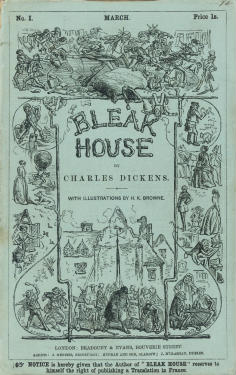
I find Dickens' novels to be delicious and satisfying like a nice Stilton, and Bleak House is no exception. The tale is told from the perspective of Esther, a schoolmarmish and self-effacing young woman who lives to nurture others. Characteristically, the novel weaves Esther's own story into a complex tapestry of interconnected narratives and broader themes.
Esther is raised by a severe old woman and haunted by a vague suggestion that she was born into shame (a mystery which is gradually explored over the course of the novel). After the old woman dies, Esther is rescued by a wealthy patron, John Jarndyce, who pays for her education and finishing and then sets her up as caretaker of his estate, Bleak House. In addition to managing the keys and accounts, Esther dedicates herself to the care of John's beautiful niece, Ada, and acts as a chaperone and confidant to Ada and her carefree beau, cousin Richard.
The novel's principal theme is revealed through the story of Ada and Richard - the wards of Jarndyce - as the destructive power of the sprawling and ineffective Chancery justice system, which was ultimately reformed in part due to Dickens' powerful critique.
A poetic and very human look at the beauty and tragedy of the domestic sphere across multiple societal classes. Dickens captures the crude wisdom of impoverished women despite the ignorance, violence, and squalor of their existence, and through Esther's prim but compassionate eye, satirizes the conceits of those blustering do-gooders who would help the poor by giving them books they cannot read. He is also as adept at capturing the foibles and tragedies of the nobility as he is at portraying the life of the very poor. All in all, a very vibrant picture of the human condition.
Showing posts with label legal system. Show all posts
Monday, March 23, 2015
Saturday, May 17, 2014
The Medieval Underworld - Andrew McCall
This book was interesting, but very painful to read because McCall tortures all of his sentences. In McCall's hands, for example, the previous sentence might read: "The sentences of this book, being tortured by McCall, were very painful to read, yet interesting did I find the book."Or some such nonsense.
Anyway, the content was engaging - the book opens with the context of the Middle Ages, the theory behind Church, State, and sin, then the nature of medieval punishment (cruel and unusual), following by a closer treatment of several strains of deviants in the Middle Ages:
- bandits, freebooters and outlaws
- richman, poorman, beggarman, thieves
- prostitutes
- homosexuals
- heretics
- sorcerers and witches
- Jews
Again, interesting, but perhaps not worth the effort.
Labels:
crime,
criminal justice,
deviance,
essays,
evolution of culture,
heresy,
history,
Judaism,
legal system,
LGBTQ,
LMB,
medieval,
middle ages,
nonfiction,
outlaw,
prostitutes,
religion,
witch-hunt,
witches
Wednesday, April 9, 2014
Great Harry - Carrolly Erickson
Another tremendous biography by Ms. Erickson. Like Bloody Mary, Great Harry is a vibrant, engaging portrait of life in 1500s England, both the intrigue and lavish splendor of the court, and the violence, ignorance, and squalor of the poor. Ms. Erickson is a master storyteller - King Henry VIII is convincing portrayed as a highly intelligent and ambitious (though flawed) ruler, who is here shown in all his facets and stages - charismatic, handsome, idealistic and beloved in his youth, irascible, peevish, and self-important in his old age, always majestic and awe-inspiring. Hundreds upon hundreds of contemporary quotes are seamlessly woven into this tale, giving it a very rich and authentic flavor of the period and of "Great Harry," as he was called by his adoring subjects in the early years of his reign. A brilliant work, and I can't wait to read more Erickson!
Labels:
1500s,
1600s,
Anne Boleyn,
aristocracy,
biography,
Catholicism,
England,
Henry VIII,
history,
Knights,
law,
legal system,
LMB,
Mary Tudor,
medieval,
middle ages,
nonfiction,
power,
royalty,
war
Sunday, January 19, 2014
The Witch-Hunt in Early Modern Europe - Brian P. Levack
Levack's work is a overview of the legal, political, economic, religious, and epidemic circumstances which he argues enabled the great witch-hunts of early modern Europe. Although witches have been a lifelong interest for me, and I was eagerly anticipating reading this book, I found it kind of disappointing, to be honest.The scope feels too broad - Levack seldom dives deeply into the particulars of any given hunt, preferring to treat the issue in very general terms. The book is surprisingly dry and even boring, which seems nearly impossible, treating as it does the lurid topics of torture, naked dancing, and burning at the stake, which in this book are described in the most clinical, repetitious passages. Levack also almost never includes direct quotes from contemporaries, which would have spiced it up considerably.
I did learn a few things, but the book could have been a third as long and 10 times more exciting. Especially on the heals of Erickson's riveting historical drama about Mary Tudor, this was pretty dull. Would not recommend.
Labels:
1500s,
1600s,
1700s,
conspiracy,
coven,
criminal justice,
hallucinogen,
heresy,
history,
law,
legal system,
LMB,
magic,
medieval,
middle ages,
nonfiction,
religion,
Satan,
witch-hunt,
witches
Friday, December 31, 2010
The Diamond Age or, a Young Lady's Illustrated Primer
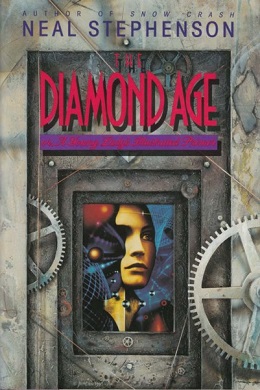
Recently read Neal Stephenson's The Diamond Age, a novel set in a futuristic society (maybe ~100 years from now) in China. Whether this book presents a dystopian or utopian vision is unclear, maybe it shows both, although the dystopian aspects (callous brutality, pervasive misogyny) are more salient.
Background (no spoilers):
In this society, nanotechnology has become the dominant means of production. (Many buildings are built out of man-made diamond because it is hard and durable, hence the title). Stephenson's novel is Marxist in that he posits a world in which the social structure arises from the means of production. Matter Compilers, or MCs, create food, clothes, etc. using molecular blueprints downloaded from a central government server. This top-down means of production makes poor people dependent on the government for their existence.
Most people are divided into phyles (aka claves) which are essentially tribes which live together in different parts of the city. One prominent phyle is that of the "Vickys" - neo-Victorians who have consciously adopted Victorian dress, mannerisms and social codes, believing that this is preferable to the amoral degeneracy of prior centuries (i.e. our time). The poor are the exception to this structure; they have no phyles, and lead lives that are nasty, brutish and short.
Nanotechnology has also become a means of ugly warfare and supports a bizarre justice system which combines Confucian principles with nanotech-based methods of execution. Rogue nanotech experts develop their own micromachines in defiance of the government's prohibition, and use them to spy, track, and kill.
My take on it:
I really, really enjoyed the first half of this book. Stephenson's vision is brilliant: complex, detailed, strikingly creative and novel, and powerful. It is also very pleasurable to read. However, I found the second half of the book chaotic and the ending unrealistic and anticlimactic. I was also troubled by the book's at times graphic misogyny, which does not seem to serve any purpose beyond reinforcing the brutality of the world. However, I highly recommend it because it is truly novel and gripping and introduces many fascinating ideas.
Stephenson's Novels
Stephenson's Novels
- The Big U (1984)
- Zodiac (1988)
- Snow Crash (1992)
- Interface (1994)
- The Diamond Age: or A Young Lady's Illustrated Primer (1995)
- The Cobweb (1996)
- Cryptonomicon (1999)
- The Baroque Cycle
- Quicksilver (2003), volume I
- The Confusion (2004), volume II
- The System of the World (2004), volume III
- Anathem (2008)
- The Mongoliad (2010–2012)
- Reamde + Colin's review (2011)
Labels:
China,
crime,
criminal justice,
dystopia,
fiction,
futuristic,
law,
legal system,
LMB,
Marx,
nanotechnology,
Neal Stephenson,
sci-fi,
science,
social commentary,
utopia
Rumpole of the Bailey

I recently finished reading Sir John Mortimer's Rumpole of the Bailey. The witty and poetry-quoting protagonist of this book is Rumpole, a 68-year-old barrister who is a defense attorney for England's petty criminals. The novel is broken down into short stories about different cases that he has been involved in. This book is totally hilarious. The language is also quite pleasing - the book is full of nicely turned phrases. It reminds me a bit of Mr. Sammler's Planet, but is comic rather than existential. I highly recommend it!
Labels:
comedy,
crime,
criminal justice,
humor,
law,
legal system,
LMB,
Sir John Mortimer
Subscribe to:
Comments (Atom)