Showing posts with label aristocracy. Show all posts
Showing posts with label aristocracy. Show all posts
Saturday, February 17, 2018
Vile Bodies - Evelyn Waugh
Vile Bodies is a delightfully written satire about the desperately frivolous goings-on of the youth in 1920s England. I have not read a gossipy novel I enjoyed so much since I read Thackeray’s Vanity Fair, or before that, the Scarlett Pimpernel. A loosely-knit band of friends veers from drunken party to drunken brunch, careening wildly toward death, disgrace, or marriage, fueled largely by money conned or borrowed from friends or relatives. A book about nothing, that still manages to excite interest and sympathy for its dissolute “heroes.”

Friday, February 5, 2016
The Picture of Dorian Gray (1890) - Oscar Wilde

"How sad it is!" murmured Dorian Gray with his eyes still fixed upon his own portrait. "How sad it is! I shall grow old, and horrible, and dreadful. But this picture will remain always young. It will never be older than this particular day of June.... If it were only the other way! If it were I who was to be always young, and the picture that was to grow old! For that- for that- I would give everything! Yes, there is nothing in the whole world I would not give! I would give my soul for that!"
Although the plot is very simple, Wilde's prose is magnificent, and this short (213-page) novel is utterly captivating. It is also interesting how delicately Dorian's sins are portrayed - everything alluded to rather than shown, perhaps due to the publication in 1890, when the work was decried as obscene - amazing how standards for the depiction of sex and violence have changed in the past century.
Perhaps the most enjoyable part of the novel is Lord Henry's indulgence in cynical epigrams, such as, "the only way to get rid of a temptation is to yield to it." Although his wordplay is delicious, Lord Henry's amoral fascination with beauty, and his artistic interest in the destruction of Dorian's life, is frightening - he would have done well to learn from his contemporary, Tolstoy, who said “It is amazing how complete is the delusion that beauty is goodness.”
Monday, July 20, 2015
Game of Thrones: A Song of Ice and Fire - George R.R. Martin
For the past several years, Mark and I have enjoyed watching the HBO series Game of Thrones. Mark had read all of Martin's books up to the time of the TV series premiere, but I never had. Everyone says how great the books are, so I finally decided to give the first book a try. I loved it so much I tore through all 800 pages and am already a third of the way through book 2!
Martin's prose is relatively simple and straightforward, but his world is vividly portrayed in all 5 senses and his realistic character depictions make the courtly intrigues and ancient mysteries come alive brilliantly. One of my favorite characters is Lord Tyrion, a little person and son of the powerful house of Lannister. In a world where warriors rule and a disabled man is worth less than a woman, Tyrion uses his wits and humor to remain relevant and preserve his dignity in a society that has derisively termed him "the Imp." Fond of drink and whores, Tyrion is nevertheless the source of many of the book's words of wisdom. He gives several valuable pieces of advice to Jon Snow, the bastard son of powerful Lord Stark, who holds a similarly low place in their world's hierarchy. One such quote is when Tyrion explains his love of reading by saying that "a mind needs books as a sword needs a whetstone, if it is to keep its edge.”
Martin famously kills off nearly every major character (and many minor ones), and it is a strong storyteller indeed who can hold the reader's interest in the events of the world, not just in specific people.
Very exciting and more food for thought than in your usual "light reading."
Martin's prose is relatively simple and straightforward, but his world is vividly portrayed in all 5 senses and his realistic character depictions make the courtly intrigues and ancient mysteries come alive brilliantly. One of my favorite characters is Lord Tyrion, a little person and son of the powerful house of Lannister. In a world where warriors rule and a disabled man is worth less than a woman, Tyrion uses his wits and humor to remain relevant and preserve his dignity in a society that has derisively termed him "the Imp." Fond of drink and whores, Tyrion is nevertheless the source of many of the book's words of wisdom. He gives several valuable pieces of advice to Jon Snow, the bastard son of powerful Lord Stark, who holds a similarly low place in their world's hierarchy. One such quote is when Tyrion explains his love of reading by saying that "a mind needs books as a sword needs a whetstone, if it is to keep its edge.”
Martin famously kills off nearly every major character (and many minor ones), and it is a strong storyteller indeed who can hold the reader's interest in the events of the world, not just in specific people.
Very exciting and more food for thought than in your usual "light reading."
Monday, March 23, 2015
Bleak House - Charles Dickens
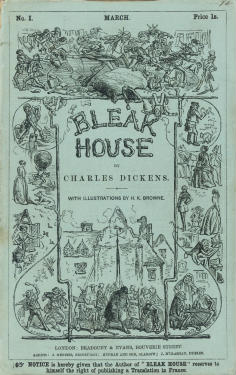
Esther is raised by a severe old woman and haunted by a vague suggestion that she was born into shame (a mystery which is gradually explored over the course of the novel). After the old woman dies, Esther is rescued by a wealthy patron, John Jarndyce, who pays for her education and finishing and then sets her up as caretaker of his estate, Bleak House. In addition to managing the keys and accounts, Esther dedicates herself to the care of John's beautiful niece, Ada, and acts as a chaperone and confidant to Ada and her carefree beau, cousin Richard.
The novel's principal theme is revealed through the story of Ada and Richard - the wards of Jarndyce - as the destructive power of the sprawling and ineffective Chancery justice system, which was ultimately reformed in part due to Dickens' powerful critique.
A poetic and very human look at the beauty and tragedy of the domestic sphere across multiple societal classes. Dickens captures the crude wisdom of impoverished women despite the ignorance, violence, and squalor of their existence, and through Esther's prim but compassionate eye, satirizes the conceits of those blustering do-gooders who would help the poor by giving them books they cannot read. He is also as adept at capturing the foibles and tragedies of the nobility as he is at portraying the life of the very poor. All in all, a very vibrant picture of the human condition.
Tuesday, January 13, 2015
Devil in the White City - Erik Larson
My bookclub's most recent book is Larson's Devil in the White City, a thrilling historical drama about the construction of the 1892 World's Fair and the serial killer who preyed upon its visitors, H.H. Holmes.

Holmes is only one among several intriguing players in the tale, including ambitious lead architect Burnham and cantankerous but brilliant landscape architect Olmsted.
The work is very engaging and colorful and powerfully recreates the atmosphere of bustling, squalid Chicago at the turn of the century, and the otherworldly transformation it underwent to become the White City during the Fair. It was also fun to realize how many inventions we consider commonplace had their origins in this fair. I would recommend this book to everyone.
Holmes is only one among several intriguing players in the tale, including ambitious lead architect Burnham and cantankerous but brilliant landscape architect Olmsted.
The work is very engaging and colorful and powerfully recreates the atmosphere of bustling, squalid Chicago at the turn of the century, and the otherworldly transformation it underwent to become the White City during the Fair. It was also fun to realize how many inventions we consider commonplace had their origins in this fair. I would recommend this book to everyone.
 |
| The White City |
Tangentially related, Nikolai Tesla won the contract to provide electricity at the World's Fair, so here is a hilarious video.
Saturday, August 2, 2014
Quicksilver (The Baroque Cycle, #1) - Neal Stephenson
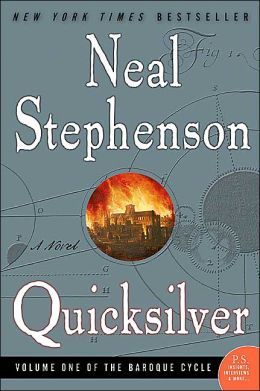
“And yet viewing several depictions of even an imaginary city, is enlightening in a way," Leibniz said. "Each painter can view the city from only one standpoint at a time, so he will move about the place, and paint it from a hilltop on one side, then a tower on the other, then from a grand intersection in the middle--all in the same canvas. When we look at the canvas, then, we glimpse in a small way how God understands the universe--for he sees it from every point of view at once. By populating the world with so many different minds, each with its own point of view, God gives us a suggestion of what it means to be omniscient.”An interesting book. I've set down The Confusion, which has a different cast of characters and didn't grab me as much, but I may return to it.
Stephenson's Novels
- The Big U (1984)
- Zodiac (1988)
- Snow Crash (1992)
- Interface (1994)
- The Diamond Age: or A Young Lady's Illustrated Primer (1995)
- The Cobweb (1996)
- Cryptonomicon (1999)
- The Baroque Cycle
- Quicksilver (2003), volume I
- The Confusion (2004), volume II
- The System of the World (2004), volume III
- Anathem (2008)
- The Mongoliad (2010–2012)
- Reamde + Colin's review (2011)
Wednesday, April 9, 2014
Great Harry - Carrolly Erickson
 Another tremendous biography by Ms. Erickson. Like Bloody Mary, Great Harry is a vibrant, engaging portrait of life in 1500s England, both the intrigue and lavish splendor of the court, and the violence, ignorance, and squalor of the poor. Ms. Erickson is a master storyteller - King Henry VIII is convincing portrayed as a highly intelligent and ambitious (though flawed) ruler, who is here shown in all his facets and stages - charismatic, handsome, idealistic and beloved in his youth, irascible, peevish, and self-important in his old age, always majestic and awe-inspiring. Hundreds upon hundreds of contemporary quotes are seamlessly woven into this tale, giving it a very rich and authentic flavor of the period and of "Great Harry," as he was called by his adoring subjects in the early years of his reign. A brilliant work, and I can't wait to read more Erickson!
Friday, February 21, 2014
The London Monster: A Sanguinary Tale - Jan Bondeson
 Bondeson's tale is a stranger-than-fiction account of the "Monster," a savage serial stabber in 1790s London, who preyed upon unaccompanied young women by with a "tremulous eagerness," accompanying his attacks with shockingly foul and indecent language. Although the Monster (or perhaps, Monsters) employed a variety of sinister stratagems of assault, including stabbing unsuspecting maidens in the face using a knife hidden inside a bouquet of artificial nosegays, and tearing at women's exposed arms with some sort of metal claw, his preferred method of attack was to slash at his victims' thighs and buttocks, inspiring fearful aristocratic women to wear copper petticoats, and lower class women to hide frying pans under their skirts.
All told, the Monster attacked somewhere between 15-30 women, causing mass hysteria and vigilante mob action, before a local pervert and malcontent, artificial flower-maker Rhynwick Williams, was brought to trial and ultimately convicted (although both then and now, doubts remain about his guilt), essentially ending the slew of attacks and putting an end to the witch-hunt.
The book is largely an exploration of the panic caused by these stabbings, as well as the popularity of the subject in the media (the book contains ribald poetry, bawdy newspaper cartoons, and descriptions of various Monster plays from the period), as well as the bizarre circumstances of the two trials.
Pretty odd, but interesting!
Thursday, January 9, 2014
Bloody Mary: The Life of Mary Tudor

Carolly Erickson's Bloody Mary is a history that reads like an action adventure. This book was thoroughly engaging and immensely interesting.
Adored and publicly admired by her father as a young child, Mary's peaceful home life was destroyed when her father, always flirtatious, suddenly decided to pursue his love affair with Anne Boleyn beyond the bedroom, and with cold indifference and evident scorn cast aside his former wife, daughter, and religion. Mary was stripped of the title "Princess" and of all her fine clothes and possessions, tormented by Anne and her courtiers, denied medical treatment when sick, and kept for years as a veritable prisoner in a run-down and drafty old house.
Although Mary rose above seemingly insurmountable obstacles to become Queen, and was an impressive scholar who spoke excellent Latin and ruled with wisdom and moderation, and even compassion and clemency (by the standards of the day), she was never accorded the respect she deserved while she was alive, due to the "imbecility of her sex," and was later condemned in the public memory as a bloody tyrant.
This book illustrates the flavor of life during the period very colorfully, and portrays Queen Mary with perhaps greater subtlety and nuance than has been accorded her in the past.
Highly recommend!
Friday, September 6, 2013
Fathers and Children

Turgenev's portrait of the self-proclaimed nihilist Bazarov provoked huge controversy: opponents of the utilitarian nihilists reviled Turgenev, denouncing Bazarov as a villain. Most nihilists dismissed the portrait as a laughable caricature, though a few actually praised him as a "new man" of the type who would rejuvenate Russia.
"Your sort, you gentry," Bazarov tells Arkady, when the two friends come to the parting of the ways, "can never get beyond refined submission or refined indignation, and that's a mere trifle. You won't fight.....but we mean to fight.....we want to smash other people!"Interestingly, one of the few people in Russia who seemed to accurately understand Turgenev's portrayal was Dostoevsky, who saw Bazarov as a tragic character, doomed to unhappiness by the contradiction between his sterile and brutal intellectual beliefs and his human needs and longings. Dostoevsky's praise and understanding helped forge a strong but brief friendship with Turgenev, which, however, was quickly dashed to pieces by their widely divergent views on religion and whether Russia's future lay in adopting western ideas (Turgenev) or seeking guidance from the true Russian character, which, in Dostoevsky's view, derived from a deep faith in Christ.
I really enjoyed the book, which is lyrically written, with great sensitivity to human love and loneliness. Though Bazarov is infuriating in his brutality, he is captivating in his passions and deep emotions.
Monday, August 5, 2013
Vanity Fair - Thackeray

Anyway, this gossipy novel follows the beautiful schemer Becky Sharp as she climbs from her lowly beginnings as a poor opera dancer's daughter to the height of English aristocratic wealth and influence. A gorgeous portrait of English and continental life during the Napoleanic war, which sounds utterly blissful (although of course filled with ridiculous intrigue).
Thackeray is a master of the language, and this lighthearted but keen examination of vanity is a delight to read.
Recommended if you liked The Scarlet Pimpernel, reviewed here: http://blogenburyisreading.blogspot.com/2012/01/scarlet-pimpernel-by-baroness-emmuska.html?m=0
Dad's VF review: http://blogenburyisreading.blogspot.com/2009/06/vanity-fair.html
Monday, January 2, 2012
The Scarlet Pimpernel by Baroness Emmuska Orczy

The Scarlet Pimpernel is a swashbuckling adventure set in 1792 during the French Revolution. As hundreds of French aristocrats lose their heads to the guillotine, a band of intrepid English gentleman makes it their sport to boldly rescue these victims and hustle them to safety in England. The mysterious leader of this gang is the wily Scarlet Pimpernel, who signs his notes with a little drawing that same "humble wayside flower."
The main character is a beautiful Frenchwoman, Marguerite Blakeney, "the cleverest woman in Europe," who languishes in her marriage to a dandified fop, Sir Percy Blakeney. The story charts her disillusionment with her husband and involvement in the revolutionary and counterrevolutionary schemes that surround the Scarlet Pimpernel and his 19 loyal devotees.
The language is beautiful, the plot is exciting, and it has a satisfactorily happy ending, which apparently had not yet gone out of fashion in 1905 when the Baroness was writing. Highly, highly recommend.
*Note: I know Dad read this fairly recently but couldn't find the link - if you wrote about this, Dad, please include the link to your review here and I will comment on yours. Otherwise, feel free to add your thoughts here!*
Monday, January 3, 2011
Fathers and Sons

I realized I never made this post, even though I read the work last Christmas, so here goes: my thoughts on Turgenev's (1862) Fathers and Sons (Отцы и дети is actually Fathers and Children, although it's true that I don't recall any daughters in the novel).
This book is truly genius. I think of it often. The two generations under discussion are the Fathers (1840s) and Sons (1860s). The book describes (primarily male) family and friend relationships and the way that these interactions evolved during a time of major social change: the emancipation of the serfs occurred in 1861 and freed millions of people from serfdom, causing great upheaval in landed/aristocratic families and in society. The Fathers and Sons represent conflicting ideologies which are very interesting to consider, because their opposition foreshadows the 1917 revolution.
One of the two primary Sons in the book is Arkady Nikolaevich Kirsanov. He has recently graduated from St. Petersburg University where he became friends with a man named Bazarov. The Sons' values are boldly and at times offensively embodied by the larger-than-life Bazarov, a loud-mouthed, frog-dissecting, arrogant nihilist. These values include: egalitarianism, nihilism, and rejection of sentimentality and of bourgeois values.
The book begins with Arkady taking his friend Bazarov home to meet his father, the sensitive land-owner Nikolai Petrovich Kirsanov. Although Nikolai is one of the Fathers, he is liberal for his generation, and as an educated and thoughtful man is trying to make sense of and in some ways assimilate the liberal values of the youth while holding onto his appreciation of literature, the arts and the beauty of nature.
The conflicts in this book are fascinatingly timeless and really bear thought. Although I was not bowled over when I first read the book a year ago, it has been on my mind very frequently since and I have come to appreciate it very much.
Tuesday, June 9, 2009
Vanity Fair
There is a great quantity of eating and drinking, making love and jilting, laughing and the contrary, smoking, cheating, fighting, dancing, and fiddling: there are bullies pushing about, bucks ogling the women, knaves picking pockets, policemen on the look-out, quacks, (other quacks, plague take them!) bawling in front of their booths, and yokels looking up at the tinselled dancers and poor old rouged tumblers, while the light-fingered folk are operating upon their pockets behind. Yes, this is VANITY FAIR: not a moral place certainly; nor a merry one, though very noisy.A lively and delicious read - rather like a practical and entertaining version of Machiavelli!
Subscribe to:
Comments (Atom)