Showing posts with label Colin. Show all posts

Monday, February 27, 2012

Ryu Mitsuse - 10 Billion Days & 100 Billion Nights


This book is utterly insane, and operates under the principle that sufficiently advanced technology is indistinguishable from magic, mystical experience, or a really incredible psychedelic voyage.

At one point, Jesus of Nazareth and Siddhartha Guatama the Buddha, who are cyborgs, fight a laser battle amidst the fortieth-century ruins of Tokyo.  I feel like that should be recommendation enough.  If dream narratives aren't your thing, though, you might find the book frustrating.

The story is a sort of metaphysical space-opera with Dickian gnostic overtones, featuring Plato, Jesus, Buddha, and the goddess Asura.  The translation is excellent and highly poetic; the original Japanese must be pretty amazing.  

Monday, February 20, 2012

Stephen Hawking's A Brief History of Time


Since I have recently been pursuing the fundamental philosophical question "why is there something instead of nothing" from one end of the philosophical tradition, Daoist metaphysics in particular, I decided to switch gears for a bit and see what professor Hawking had to say about the issue.

A Brief History of Time is an eminently accessible guided tour, not through time itself, but through the Western tradition's understanding of the nature of the universe.  Hawking walks the reader through the major paradigm shifts in intellectual history, beginning with the Copernican revolution, and explains in each case why the previous theory had to be abandoned and why the new one was chosen.  The first section of the book should be familiar to most readers from high school.  The second half was all things I had heard of before, and understood to some extent, but quantum mechanics et al. are always worth thinking about again.

Hawking presents the history of cosmology as the gradual reconciliation and elaboration of partial theories, with the current problem in physics understood as the production of a theory that will unify quantum mechanics and general relativity; in other words, reconcile our theories about what happens at very small scales and very large ones, respectively.  Reading this book makes me nostalgic for the alternate life in which I pursued mathematics and understood in something more than a qualitative way what was at stake in all of this, but Hawking generously includes the rest of us in the conversation with his clear presentation.

The best part of the book, by far, is Hawking's stories about the bets he has made with various physicists on points of theoretical contention.

"I... believe there are grounds for cautious optimism that we may now be near the end of the search for the ultimate laws of nature."

Sunday, February 19, 2012

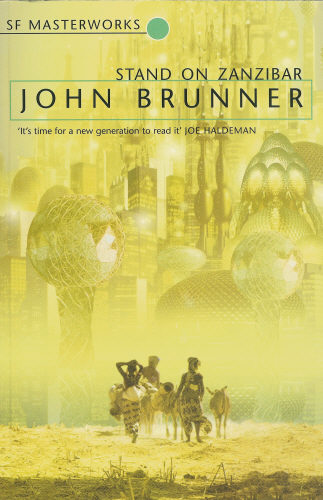
John Brunner - Stand on Zanzibar


Another classic science fiction novel that I never knew existed.  Written in 1968, Stand on Zanzibar is set in a crowded, decolonized early 21st century.  The world is filled with mass-market psychedelics and eugenic legislation, overstimulated and disney-fied in a way that hits pretty close to home.  The world's crowded cities are terrorized by "muckers," or people driven to the point of berzerk killing sprees.  Brunner's vision is on the level of a Philip K. Dick in terms of sheer affectual prescience.

The novel contains several narrative threads, interspersed with commercials and other snippets from the infosphere, as well as vignettes that act as character sketches of various dysfunctional relationships (usually centered around attempts to circumvent eugenics laws).  Other sections are polemics, written in the voice of Chad Mulligan, who can perhaps best be described as stand up comedian channeling Vonnegut.

The two main plot lines involve a propaganda campaign by a Southeast Asian archipelago claiming that they will genetically modify their next generation to breed a perfect species, and a series of negotiations between a large US corporation and a small African ex-colony which is mysteriously free of violence, and whose people have had a reputation for witchcraft stretching back into prehistory.

The novel is scathing and quite funny.  I find most satire to be a bit cringe-inducing, but Brunner pulls off his tone with an aplomb that reminds me most of David Foster Wallace.

Paul Gilding - The Great Disruption


There is a war coming.

In this book, Gilding tries to articulate a way out of the mess we're in - he says, in essence, "if we're going to solve these problems, here's what it will look like."  He argues that the coming crisis will initiate a response from the first world directly analogous to that of the second world war, in which enormous swaths of first world economy were nationalized and repurposed to the war effort.  It is this wartime economy, with an emphasis on efficiency and frugality, that will allow us to orchestrate a crisis management response to the collapse that we are now far too late to head off with more gradual efforts.

While much of the material covered in the book is not new to me, Gilding's experience as first an environmental activist with Greenpeace, and later as a environmental consultant who has worked with people like the CEO of DuPont, provides a perspective that is more of an insider's view.

I think the most important point that I drew from this book was his argument that we cannot fight a war on two fronts.  The first front is the radical and transformative restructuring of our political and economic systems that will allow the creation of a sustainable and steady-state (as opposed to growth-focused) economy.  The second is the direct response to the chaos and violence that will make the conflict of the twentieth century look like a gentlemanly session of fisticuffs.  Since the vested interests of the current establishment will, like any hegemony, fight to protect its power, we need to find a way to in the short term harness the old capitalist system to fight the Carbon War, in a concerted effort that will in turn bring about the systemic transformation that we need so desperately.

While I don't know if I share Gilding's optimism, his analogy to the war-time effort of WWII is thought provoking (he notes that military spending went from 3 percent of GDP at the beginning of the war to 39 percent at the end, in a time when the GDP as a whole increased by 75 percent.)  If we can accomplish something similar, along with a total paradigm shift in the consciousness of the first world which will divert our collective activity away from mindless consumption, there may still be hope.

Friday, February 17, 2012

Thomas Cleary - The Essential Confucius


This is the best book I have ever read.

Cleary's translation is extremely readable - his ordering is somewhat unorthodox but I don't understand what the details of that are.

As for the text itself, nothing has ever struck me so deeply.  I have read the Analects before, but I did not fully appreciate it.  I think everyone should study this book carefully and live their life by it.  I am not going to say anything else about it because it is very short and the master speaks for himself.

Tuesday, February 14, 2012

Ken Wilber - Sex, Ecology, Spirituality


Reading this book was an interesting experience.

My dad is a pretty devoted Wilberian.  It would perhaps not be far from the mark to say that "wilberism" was the religion that I grew up in.  For this reason, the strangest thing about reading this book was realizing how profoundly I had been influenced by Wilber's system.

The other strange thing was the contrast between how much I liked the first half and how much I disliked the second.  I'll return to this in a second, although the details of our disagreement are too technical for a blog post.

(I do however find Wilber's aesthetics to be a bit questionable.  He gets into bestselling cult-leader territory, and he has horrible taste in art.  He uses too many words with capital letters, and is more in bed with the New Agers than he would like to admit.)

The basic project of this book, which was published in 1996 as a response to the rather dogmatic deconstructionism that was (and still is) the current theoretical orthodoxy in academia.

Wilber here attempts to devise a synthesis of rationality (coded: western) and mysticism (coded: eastern).  The elegant theoretical structure with which he describes the internal dynamics of intellectual history is impressive, and, as I said, my own thought is as indebted to Wilber as it is to my other touchstones like Jameson or Harvey.  His elaboration of this structure takes up the first half of the book.  Wilber's thought here is presented with a clarity that is admirable; It is perfectly accessible to a lay person and for somebody with a background in theory it is quite easy.

An attempted sketch of Wilber's arguments (and I am in substantial agreement with all of these positions - but I would draw my picture a little bit differently):

The metaphysical structure of the entire universe is the holon, which is a whole that is also a part of some higher structure.  For example, oxygen atoms are wholes, but they are parts of water molecules.  I am a whole, but I am a part of my society.  Everything is like this.  In fact, the entire universe is an enormous "holarchy" composed of progressively higher levels of organization.

All holons can only be fully understood through a consideration of their manifestations in four "Quadrants:" upper left, lower left, upper right, and lower right.  Essentially, these are four different viewpoints on the same phenomena.  The universe is thus a great holarchy which is unfolding simultaneously through the four quadrants.  The right hand side is the objective side, while the left hand side is the subjective side; the top is singular, the bottom is plural.  Furthermore, the quadrants can be mapped onto the grammatical pronouns in the following way; upper left is I, lower left is We, upper right is It, and lower right is Its.

So if we want to understand, for example, consciousness, we need to understand it from all of these perspectives.  The upper left is the individual subjective, or psychological development.  The lower left is culture, or the collective subjective.  The upper right is the individual objective, the development of the brain.  The lower right is the collective objective, the systems of political and social organization.

Holons evolve through these quadrants in a process that is essentially a Hegelian dialectic.  Wilber stresses the phrase "transcend and include," which means that each higher holon contains all of the structure of its parts, plus more.

As the major purpose of this book is to understand the evolution of culture, or the development of our collective worldview, this idea of transcendence and inclusion means that, in order to be healthy, a new worldview must embrace the truths of the worldview it has replaced.  As Freud discovered, repression leads to pathology.  Therefore, if a new worldview (e.g. the Rational of the Enlightenment) represses rather than includes it predecessor (the Mythic of the feudal period) then it becomes pathological.  This, Wilber argues, is the origin of the deconstructive turn in postmodernity.

Essentially, Wilber thinks that all of western philosophy since Plato has been an attempt to reduce on half of the quadrants to the other.  That is, to show that everything objective was only subjective, or to show that everything subjective was only objective.  The current pathology he terms "flatland" which is the reduction of the right hand quadrants to the left hand quadrants - basically to show that all subjective consciousness is "nothing but" the activity of neurons, etc.  His solution to this is that Western science and Eastern spirituality need to team up, and then everything will be great.

This is the first half of his book, and he's mostly totally right.  The second half is a polemic against a poorly argued straw man he calls "subtle reductionism."  As the blog is getting a bit long I won't go into the details, but the short version is that I myself am a "subtle reductionist," and I think Wilber does not fully appreciate most sophisticated version of this position.  I think that he does not understand the full philosophical implications of emergence, complexity, and evolutionary dynamics, and I think his mistakes here make the second half of the book moot.

TL;DR:
So, I guess, I would highly recommend the first seven chapters of this book.  In it, he presents the most complete and elegant comprehensive philosophical theory I have encountered.  After that, he makes a crippling mistake and takes a tangent off into orbit.

PS Sorry, Brack, I only read these very serious books these days.  But there is an absurdist science fiction novel on the way (secretly though Very Serious) and also the Analects of Confucius, which is exquisite.

Tuesday, January 31, 2012

David Harvey - The Enigma of Capital


David Harvey, who is, along with Fredric Jameson, one of my favorite academics, here presents his analysis of the recent financial crisis and offers a theory that attempts to explain the crisis-prone nature of capitalism in terms of the inner contradictions of the system.  At the center of his argument is the "surplus absorption problem," in which the surplus generated by capital today must be reinvested into new lines of production in order to maintain an increasingly unrealistic 3 percent annual compound growth.

While the argument is complex enough that I don't want to try and represent it here, the book is surprisingly accessible and the ideas in it are presented relatively simply.  Some familiarity with the vocabulary of academic Marxism is helpful to understand Harvey's argument, but it is much easier going than Jameson, for example.

I would highly recommend this book to anyone who wants to understand the present financial crisis and why we desperately need to be shrinking our economy, not growing it.

Wednesday, December 28, 2011

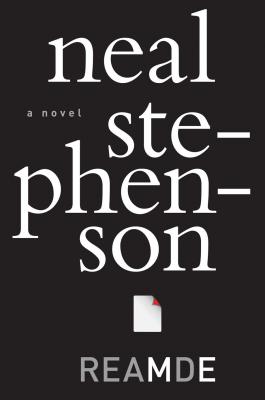
Neal Stephenson - Reamde

In Stephenson's oeuvre, Reamde, despite its 1056 pages, is light reading. This is not necessarily a bad thing. The man is a master of plot construction, not in terms of technical complexity but rather in terms of sheer engagement: he gets those pages turned. The novel's most striking feature is its action sequences, in which Stephenson shows off his impressive gunfight-choreography chops.

The novel's cyberpunk elements center around the computer game T'Rain (the fictional successor to the online hegemony of World of Warcraft), whose most salient characteristic its elaborate economy, based on a virtual-gold standard whose integrity is ensured by an elaborate geological simulation which determines the location of deposits of ore within the game world. The game is designed to exploit, rather than be exploited by, the existence of "gold-farmers," or kids in China who perform repetitive in-game actions (or grinding) in order to harvest virtual items and currency that they can then sell to rich Westerners - a real phenomenon in games like WoW. Stephenson's picture of how this all works is really quite ingenious, and somehow constitutes both a more sophisticated version and elaborate parody of early cyberpunk depictions of the function of virtual spaces in the global economy, like Stephenson's own depiction of the "Metaverse" in Snow Crash.


A series of elaborate coincidences embroil the creator of this game, the draft-dodging black sheep of a gun-toting Idaho clan, and his adopted Eritrean refugee niece in a globe-trotting hostage plot involving Islamic terrorists and Russian organized crime; all of which is much too complicated to even begin to explain here. Suffice to say that the entire thing is incredibly entertaining, and the characters are extremely well-written: I thought that the terrorist Abdullah Jones, a suave Black American convert, was a particularly intriguing figure.

In Reamde, Stephenson dials down the whole "novel of ideas" business and writes a fairly straightforward thriller that delivers exactly what it promises and in fine style. The Stephensonian themes are all here, but muted and lighthearted in a way that I think is actually a very good artistic move, especially following the somewhat more ponderous (but very good) Anathem. If nothing else, the book makes me wistful for a world in which the rest of the bestseller list was even a fraction of Reamde's quality.

I would recommend the book, but read the essential Stephenson first: Snow Crash, The Diamond Age, Cryptonomicon.

Stephenson's Novels

China Mieville - The City & The City

Mieville has always had a thing for patchwork cities. I first encountered the author years ago with the strange and wonderful Perdido Street Station, which I highly recommend. That novel was a masterpiece of imagination, set in a politically fractured steampunk metropolis. Its two sequels were entertaining but lackluster, and Mievelle fell off of my radar.

The City & The City, which shared the 2010 Hugo with Bacigalupi's vastly inferior The Windup Girl, is a detective novel set in the absurd divided city of Beszel and Ul Qoma, located somewhere in a post-Soviet Eastern Europe. I don't want to say too much about the nature of the relationship between the two cities, as the gradual unfolding of this relationship in the early part of the novel produces a somewhat maddening sense of disorientation that I found to be fairly masterful on the part of Mieville. For this same reason, I would recommend that one avoid reading too much about the book before diving into it.

The setting itself is something of a literary-theoretical thought experiment taken to an absurd extreme; this is self-conscious, as Foucault and Baudrillard are referenced by a character in the text (although I think the conceit is more due to Deleuze). Which is to say: this book is ambitious, in a way that (especially with the noir trappings) reminds me of nothing more than Paul Auster's New York Trilogy, to which this book is clearly indebted. And Mieville, somehow, pulls it off, producing a novel that's both a technical masterpiece and lot of fun.

edit: As a sidenote, you can understand the thematic structure of this novel in terms of Greimas' semiotic square, which is a bit like a two-dimensional dialectic and a really powerful analytic tool in general.

Monday, June 27, 2011

Three Californias


Three Californias is a trilogy by Kim Stanley Robinson written prior to the Mars cycle. Each of the three novels, The Gold Coast, the Wild Shore, and the Pacific Edge, posits a radically different future taking place in Orange County. I've just finished the Wild Shore, read the Gold Coast over spring break, and will be picking up the final one soon. The Gold Coast takes place in a total-sprawl landscape of designer drugs and party lifestyle, the Wild Shore takes place in a post-nuclear America quarantined by Japanese ships off the coast, and I'm not entirely sure what the other one is about.

While these novels don't quite stand up to the magnum opus that is Red Mars, and are not as dense in ideas and sheer brilliance, they are definitely worth checking out even if only as a prelude to his later work.

Monday, February 28, 2011

David Harvey - Spaces of Hope

This is one of the books I am reading for my thesis. In it, Harvey presents a convincing case for and way of adapting Marx's ideas to the conditions of capitalism in postmodernity, particularly in the context of globalization and the death of the Modernist utopian project in the aftermath of WWII.

Particularly interesting is Harvey's application of his "historical-geographical materialism" in his case study of Baltimore in the second half of the twentieth century, as he examines the ways that capital manipulates the construction of urban space in order to maintain its exploitative control over the working class.

In this book Harvey brilliantly addresses the worries of postmodernity and the various postmodernisms while maintaining a commitment to the utopian dream and political praxis, offering both a framework to understand the mutual interactions of geography and capital and to offer resistance to the bourgeois myth that "there is no alternative" to consumer capitalism, democracy, and the tyranny of the free market.

I read two chapters of this book for a class in my sophomore year, and it has been highly influential in the development of my own political sympathies. Harvey's writing is clear and accessible (for the most part, although some background in literary theory and intellectual history of the twentieth century is useful) and completely devoid of the obscurantism that plagues a lot of academic writing. Fascinating and highly enjoyable.

Saturday, May 29, 2010

A Canticle for Leibowitz


A Canticle for Leibowitz is Walter Miller's classic science fiction novel about post-apocalyptic Catholic monks in the desert of Utah, preserving what scraps of ancient writing they have managed to gather together through a post-nuclear dark ages in which all scientific knowledge is seen as evil. The novel is composed of three sections, roughly analogous to the dark ages, the renaissance, and a new technological age. The Catholic church provides what little cultural stability exists in the period, and the story follows the history of the abbey of the Albertian Order of Leibowitz, founded by a scientist after the war who became a martyr in his attempts to save books from being burned by the barbaric remnants of human civilization.

This is one of the masterpieces of American science fiction. I'm glad to have finally filled this particular hole in my knowledge of the genre, and I really can't recommend this book highly enough.

Saturday, May 22, 2010

Where is Everybody?

This book presents a set of 50 possible solutions to the Fermi Paradox ("where is everybody," i.e. if the universe is so big why haven't we met any other technological civilizations?). The solutions come in three main categories: they're already here, they exist but haven't communicated, and they don't exist. The book is not at all rigorous but serves as a broad-ranging introduction that includes more speculative material than the textbook below. My only quibble with this book concerns his chapters on evolutionary biology, where I don't feel he's fully acquainted with the complexity of the issue, but in fairness there isn't space to even begin to address those questions here. Overall this was a entertaining and good broad overview to a wide selection of factors to consider on the subject, from the physics of interstellar travel to von-Neumann probes and Dyson spheres, although a lot of the science is glossed over and I found a couple of his mathematical models a bit suspicious (or at least poorly defended).

Rocannon's World

Rocannon's World is Ursula K. LeGuin's first novel, published in 1966 as a lengthening of the story "Dowry of the Angyar," which appeared in Astounding in 1964 and comprises the prologue to the novel as "Semley's Necklace". It's currently out of print, but I found it in a used book store in Seattle and there are some used on the internet as well. It is basically an epic fantasy set in a world of relativistic interstellar travel, in which an anthropologist studying quote highly intelligent life forms (a hilfer) from the galactic league of worlds is stranded on Fomalhaut II, an alien world with a heroic early age culture (think Homer) that involves living in castles and riding giant flying cats (see cover). Our boy Rocannon has to journey across the planet with a motley band of locals (think Tolkien), seeing the sights and getting into various problematic situations along the way. It's not her most mature work, but in particular the way in which she incorporates relativistic travel into the epic register is pretty impressive. Plus, giant flying cats are sweet.

An Introduction to Astrobiology

I am doing some readings about aliens this summer and this was one of the books on my list. It is basically an undergraduate level textbook with some fairly nontechnical chapters on the genesis of life, cell biology, the essential chemical reactions of life, extremophile terrestrial species, planetary geology, exoplanet astronomy, and SETI. It does a very good job of explaining what we know and how we know it. The book is about five years out of date (most relevant for the astronomy section, as exoplanet discoveries are starting to pour in) but gave me a good basis for further reading on the subject.