Showing posts with label futuristic. Show all posts
Showing posts with label futuristic. Show all posts
Wednesday, April 26, 2017
Cordelia's Honor - Lois McMaster Bujold
I absolutely loved our bookclub's most recent pick, Cordelia's Honor. It is the story of Captain Cordelia Naismith, a scientist/explorer in the mold of Star Trek's Captain Janeway - kind, strong, resourceful, compassionate, and with a powerful moral compass. Cordelia is enjoying a routine survey mission to an unclaimed planet when she and her crew are attacked by a squad of Barrayans, a militant race with a revered warrior caste, the Vor. She is taken prisoner by their honorable commander, Aral Vorkosigan, and the two unexpectedly fall in love. Eventually, Cordelia returns with him to Barrayar as Lady Vorkosigan, where the two are swept up in intergalactic politics and domestic revolution. Powerfully written, with interesting reflections on war, love, gender dynamics, and the stigma of disability. Not your typical romance novel.

Wednesday, August 24, 2016
Aurora - Kim Stanley Robinson
Aurora is KSR's latest novel, published in summer 2015, and the only other book of his that I have read, other than the genius Mars trilogy. Aurora is just as delightful, and satisfyingly familiar in tone, with its hyper-detailed yet highly readable descriptions of technology, and the incisive and compelling character depictions, which elevate the book from tech porn to high literature.
Aurora is the story of a generation of families born on a spaceship in the middle of a 159+ year colonizing trip to Tau Ceti, led at this point in their journey by brilliant yet troubled scientist Devi, who keeps their aging vessel in working order through hundreds of daily repairs. Unlike Mars, with its numerous protagonists, this novel focuses primarily on Devi and her daughter, Freya. In a unique and engaging narrative twist, the tale's chronicler is the ship itself, an AI called simply "ship."
The action begins in Freya's youth and young adulthood, in the final years of the journey to Tau Ceti. A deeply interesting and moving tale, which I highly recommend to all sci-fi enthusiasts!
Aurora is the story of a generation of families born on a spaceship in the middle of a 159+ year colonizing trip to Tau Ceti, led at this point in their journey by brilliant yet troubled scientist Devi, who keeps their aging vessel in working order through hundreds of daily repairs. Unlike Mars, with its numerous protagonists, this novel focuses primarily on Devi and her daughter, Freya. In a unique and engaging narrative twist, the tale's chronicler is the ship itself, an AI called simply "ship."
The action begins in Freya's youth and young adulthood, in the final years of the journey to Tau Ceti. A deeply interesting and moving tale, which I highly recommend to all sci-fi enthusiasts!
Monday, April 18, 2016
Red Rising - Pierce Brown

 |
| "I's looking behind us now, into history back." |
Personally, I thought the movie Hunger Games was insipid, but I would recommend this book to HG fans, and any other survival enthusiasts.
Old Man's War - John Scalzi

Altered Carbon - Richard K. Morgan

I read Rudy Rucker's Software not long ago, so Morgan's elaboration of the consciousness-divorced-from-physicality concept was a nice "sequel." I was especially intrigued by his portrayal of the ugly consequences of wealth inequality, in a world where the technology of immortality is largely limited to the economic elite. (Kim Stanley Robinson's Mars trilogy also fruitfully explores this issue.)
I will definitely be checking out the other Takeshi Kovacs novels!
Wednesday, July 8, 2015
The Peripheral - William Gibson
The Peripheral is Gibson's most recent novel, and it did not disappoint. The tale opens in a a world that appears to be our near future, the logical extension of our society's tendency to favor technological advancement amidst crumbling physical infrastructure. The increasingly unstable economy is marked by intensified monopolization, and the average person can only get wealthy by "funny" means - "building" (producing and selling drugs), or "fabbing" (3D printing) prohibited items. Our morally-conscious protagonists - a wounded special ops veteran named Burton and his spunky sister, Flynne - choose instead to eke out a living by playing security forces in a video game for a mysterious employer. It is during one of these gaming sessions that Flynne becomes sole witness to a gruesome murder, an event that ignites a series of radical changes in their lives and world. The novel is ultimately set in two futures, whose inhabitants are able to influence each other by means of shared "peripheral" technology. Fascinating stuff, as always!
Saturday, January 17, 2015
Red Planet - Robert Heinlein

Written in 1949, the novel is reminiscent of a Hardy Boys style adventure, but the ideas are refreshingly modern (with the exception of the frequent sexism, which tends to mar the quaint tone). Still, a charming book with an interesting conception of alien life.
Also, Willis was so cute!
 |
| Some artist's conception of Willis |
Saturday, August 2, 2014
The Martian - Andy Weir
 "Robinson Crusoe in space" is how our bookclub organizer described The Martian, and this is a pretty apt description. Our intrepid astronaut hero Mark Watney is left stranded on Mars when his crew takes him for dead following a terrible accident. Using his botany and mechanical engineering skills, Mark must survive and find a way to let Earth know that he's still alive!
This fast-paced action thriller is written in a highly loose and conversational style, with entries styled as Mark's log. Recommended for fans of Kim Stanley Robinson, though this is much less literary and more of a beach read. Still fun and thought-provoking!
Also, here's a (kind of) relevant clip from Total Recall:

Thursday, July 17, 2014
Spook Country - William Gibson
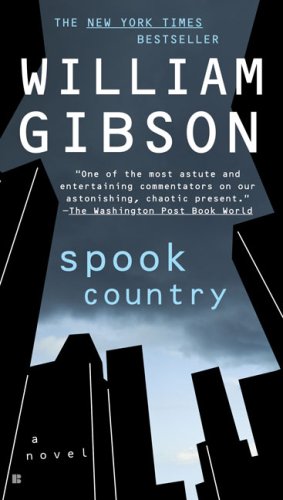
Gibson's 3 Trilogies:
The Sprawl Trilogy:
- Neuromancer
- Count Zero
- Mona Lisa Overdrive
- Virtual Light
- Idoru
- All Tomorrow's Parties
Friday, May 30, 2014
Pattern Recognition - William Gibson
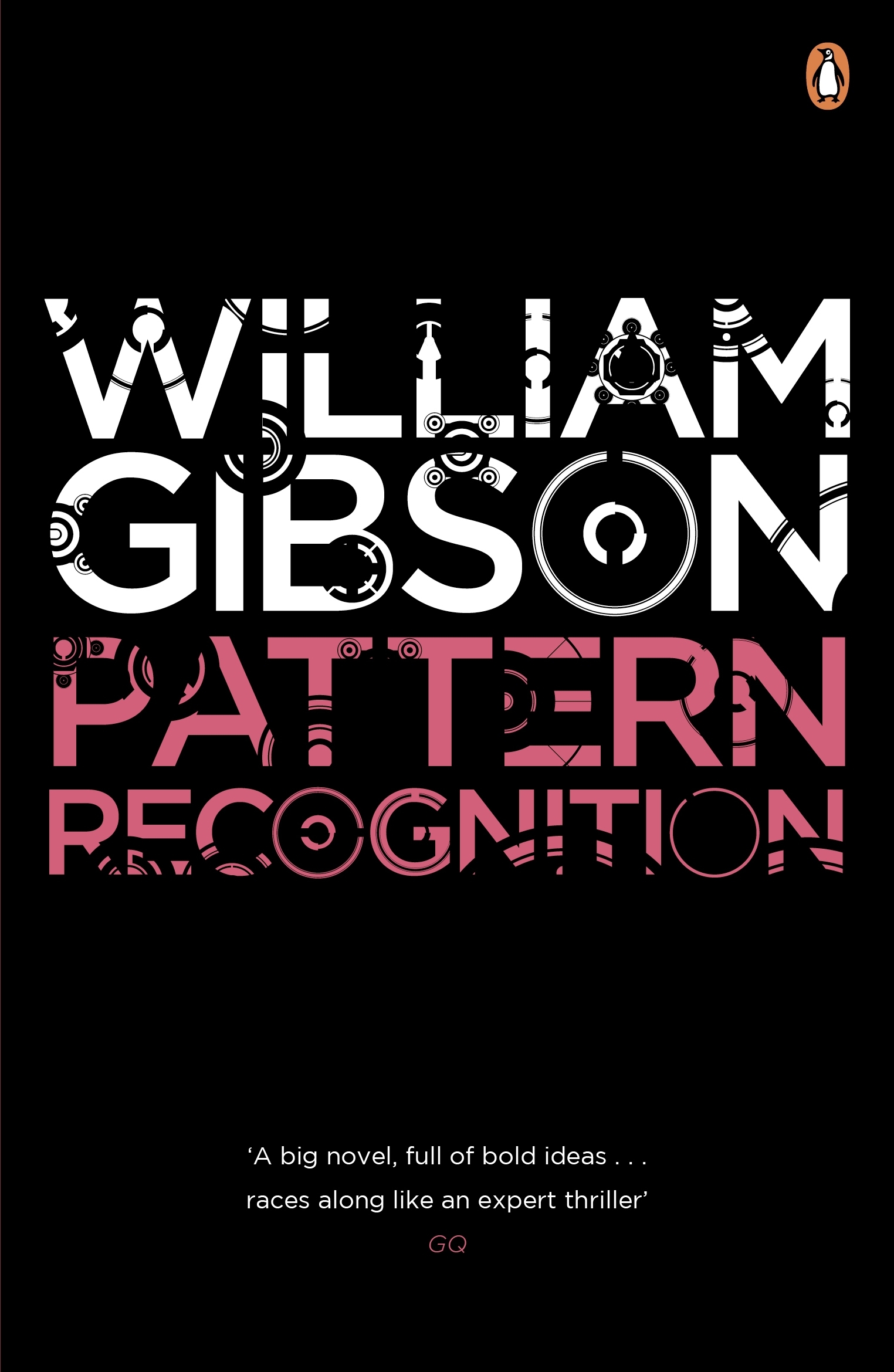 Another brilliant book by Gibson, and the first in the Blue Ant/Hubertus Bigend trilogy. The likable but neurotic protgagonist, Cayce (pronounced "Case"), is a coolhunter - a precog who uses her sensitivity to brands and logos to serve as a consultant to major franchises, helping them make branding choices based on what she senses will become trendy or not. In her spare time, Cayce and her online otaku friends obsess over "the footage" - segments of breathtaking, unearthly films scattered across the net, discovered a fragment at a time. Cayce's life changes when an exceptionally powerful employer hires her for a special consulting job, and draws her into a web of intrigue, Soviet mafia, and mystery...
I also really identified with Cayce, and many of her reflections resonated with me, such as, "Does she feel liminal, now, or simply directionless?"
Gibson's 3 Trilogies:
The Sprawl Trilogy:
- Neuromancer
- Count Zero
- Mona Lisa Overdrive
- Virtual Light
- Idoru
- All Tomorrow's Parties
Tuesday, May 27, 2014
Zodiac - Neal Stephenson
 Finished reading Stephenson's (1988) Zodiac this weekend. It was weird, to say the least, and definitely seemed less mature than other works of his that I've read (not surprising, it's his 2nd book, written before Snow Crash). It's the tale of S.T., a nonviolent ecoterrorist who brings polluting companies to justice by zipping around on his Zodiac (high-powered motored raft) plugging up waste pipes in the Boston Harbor and exposing the offenders to media ridicule. A quick and easy read, not one I'd necessarily recommend.
Book Challenge 2014 stats: 15/65 (23%), 11 books behind schedule. (Although I've now read 2 more books thus far in 2014 than I did in all of 2013!)
Stephenson's Novels
- The Big U (1984)
- Zodiac (1988)
- Snow Crash (1992)
- Interface (1994)
- The Diamond Age: or A Young Lady's Illustrated Primer (1995)
- The Cobweb (1996)
- Cryptonomicon (1999)
- The Baroque Cycle
- Quicksilver (2003), volume I
- The Confusion (2004), volume II
- The System of the World (2004), volume III
- Anathem (2008)
- The Mongoliad (2010–2012)
- Reamde + Colin's review (2011)
Friday, May 16, 2014
All Tomorrow's Parties - William Gibson
 I have been consuming Gibson in a strange and disjointed fashion over the past 3 years, picking up random books in his trilogies and reading them out of order. Maybe because I never stop thinking about Gibson's universe (!), this has not reduced my enjoyment of them in the slightest.
ATP follows Laney in the final stages of his drug-induced transformation, in which his uncanny nodal apprehension is perfected even as his body completely degenerates. Laney has sensed that a pivotal change is poised to occur in the universe, with the node centered around the enigmatic celebrity Harwood and idoru Rei Toei, and the new nanotechnology "fax machines" entering all Lucky Dragon convenience stores. As usual, a synopsis is unsatisfying for Gibson's stories, which sound absurd when summarized in this fashion, yet are immensely, masterfully believable.
I truly believe that Gibson has his finger on the pulse of our own history, much like Laney, and this is why his "future" is so powerfully present.
Highly, highly recommend.
Gibson's 3 Trilogies:
The Sprawl Trilogy:
- Neuromancer
- Count Zero
- Mona Lisa Overdrive
- Virtual Light
- Idoru
- All Tomorrow's Parties
Sunday, February 9, 2014
Anathem - Neal Stephenson
Today I finished my 6th book of 2014, Stephenson's Anathem. WOW!
 The book is set on the planet Arbre, quite similar to our own, but divided in the present time (and for the past several thousand years) into the Saecular and Mathic worlds. Inside the "maths", or cloisters, live the Avout, non-religious men (fraas) and women (suurs) who have devoted their lives to intense scholarship and medieval asceticism, almost wholly without advanced praxis (technology). They live secluded from the outside world, except for a 10-day holiday called Apert during which the gates are opened, when the "extras" are free to come into the math, and the Avout are free to leave and explore extramuros. Depending on whether an Avout is a Unitarian, Tenner, Hundreder, or Thousander, his or her order will have the chance to celebrate Apert only once a year, decade, century, or millenium. In the mean time, all knowledge of the Saecular world is strictly avoided.
The book opens as Fraa Erasmas, a Tenner, is about to celebrate his first Apert since joining his math, the Concent of Saunt Edhar, as a young boy. Over the course of this holiday, however, he and his fraas and suurs discover that something very serious and shocking has been happening extramuros. Dun dun dun!
Of course I won't give away more, but suffice to say, this book is pure Stephenson genius. A beautifully rich world filled with highly likable characters (especially Fraa Jad!) engaged in a gripping and meaningful quest.
Recommended if you enjoyed: The Name of the Rose, Reamde
Stephenson's Novels
The book is set on the planet Arbre, quite similar to our own, but divided in the present time (and for the past several thousand years) into the Saecular and Mathic worlds. Inside the "maths", or cloisters, live the Avout, non-religious men (fraas) and women (suurs) who have devoted their lives to intense scholarship and medieval asceticism, almost wholly without advanced praxis (technology). They live secluded from the outside world, except for a 10-day holiday called Apert during which the gates are opened, when the "extras" are free to come into the math, and the Avout are free to leave and explore extramuros. Depending on whether an Avout is a Unitarian, Tenner, Hundreder, or Thousander, his or her order will have the chance to celebrate Apert only once a year, decade, century, or millenium. In the mean time, all knowledge of the Saecular world is strictly avoided.The book opens as Fraa Erasmas, a Tenner, is about to celebrate his first Apert since joining his math, the Concent of Saunt Edhar, as a young boy. Over the course of this holiday, however, he and his fraas and suurs discover that something very serious and shocking has been happening extramuros. Dun dun dun!
Of course I won't give away more, but suffice to say, this book is pure Stephenson genius. A beautifully rich world filled with highly likable characters (especially Fraa Jad!) engaged in a gripping and meaningful quest.
Recommended if you enjoyed: The Name of the Rose, Reamde
Stephenson's Novels
- The Big U (1984)
- Zodiac (1988)
- Snow Crash (1992)
- Interface (1994)
- The Diamond Age: or A Young Lady's Illustrated Primer (1995)
- The Cobweb (1996)
- Cryptonomicon (1999)
- The Baroque Cycle
- Quicksilver (2003), volume I
- The Confusion (2004), volume II
- The System of the World (2004), volume III
- Anathem (2008)
- The Mongoliad (2010–2012)
- Reamde + Colin's review (2011)
Friday, July 12, 2013
Ernest Cline's Ready Player One

WOW! My bookclub's most recent pick was Ready Player One, and I read this thrilling 372-page sci-fi novel cover to cover over the last several hours. Talk about a page-turner! I won't give away the main quest driving the plot, but suffice to say, it is action-packed and awesome.
The experience of reading this book was very self-indulgent for a cyberpunk nerd like myself -- it is a book about otaku, for otaku, and it has the works: a post-apocalyptic wasteland where everyone with enough money for a visor and "haptic gloves" escapes the filth and squalor of our used-up Earth via a full-dive VR universe called OASIS; brilliant teen hackers; a soulless corporate entity in full villain mode; and, in an unusual twist on your typical sci-fi novel, endless real-world references to obscure sci-fi, video games, and everything 1980s.
The British newspaper The Observer says that the otaku is "the passionate obsessive, the information age's embodiment of the connoisseur, more concerned with the accumulation of data than of objects." In Ready Player One, and in many nerd subcultures IRL, a player's ability to amass vast knowledge of game-related trivia is a sought-after mark of authenticity, and a status symbol within the group.
In one early scene, our ridiculously erudite, but chronically poor and therefore low-level hero, Perzival, spars with the braggart I-r0k in a VR chat room, about what it takes to be a "gunter" (egg hunter, or elite gamer):
"Poseur."
"Poseur? Penis-ville is calling me a poseur? ...This chump is so broke that he has to bum rides to Greyhawk, just so he can kill kobolds for copper pieces! And he's calling me a poseur!"
..."That's right, I called you a poseur, poseur." I stood up and got in his grille. "You're an ignorant know-nothing twink. Just because you're fourteenth-level, it doesn't make you a gunter. You actually have to possess some knowledge."
As Perzival's friend Aech would say, "Word."
This novel is recommended for everyone, but especially if you like:
- Stephenson's Snow Crash
- Sword Art Online (anime TV series)
- Gibson's Idoru
Sunday, July 7, 2013
Ernest Callenbach’s Ecotopia

A recent choice for my book club was Ecotopia. Written in 1975, Ecotopia depicts a vision of the United States in 1999, in which the Pacific Northwest has seceded from the union and been completely isolated from America for the past two decades. The motivation behind this split, led by the women-directed Survivalist Party, was the desire to entirely reform society on egalitarian and ecological grounds – achieving equality for all people, eliminating cars and other pollutants through strict regulation, and creating a “stable state,” sustainable society, which emphasizes recycling and a return to nature. In the (optimistically brief) period since its inception, the nation has largely achieved these goals, unbeknownst to America, which has continued on its wasteful decent into widespread pollution and overpopulation – alas, much like the America we know today.
The story of Ecotopia is from the perspective of William Weston, a journalist who becomes
the first American emissary to visit the new country since its founding. Weston is
a hard-nosed reporter, and the novel is divided into personal reflections
written in his diary and his largely fact-based articles, which he posts back
to America to be published. Fairly predictably, Weston’s initial prejudices are
softened by the month+ he spends in the new country, and we see him open up to
the nation’s “strange” and “barbaric” practices and “surprisingly” brilliant
inventions.
Although at times a little
heavy-handed, pat, and unrealistically utopian, I found the novel to be very well-imagined and articulated, and the tone believable. Moreover, I was happy to
realize that Callenbach’s vision has in some ways been realized – Seattle recently
instituted a ban on plastic bags, and all homes and apartments (and most
businesses) are equipped with bins to divide “garbage” into recycling, compost,
and (thus much reduced) waste. (Although I was horrified to see how
inconsistently this is practiced in Ohio!)
It was depressing to finish the
novel and remember that I cannot emigrate to Ecotopia, but even so I would
definitely recommend this book.
Tuesday, July 2, 2013
The 5th Wave
Janet Maslin recently wrote a piece for the New York Times about quality beach reads, and The 5th Wave is the first I've tackled from her list. It is a post-apocalyptic young adult novel about an alien invasion - War of the Worlds plus The Hunger Games plus The Stand. A great page turner - or wait for the movie, as it's already been optioned by Somy.
Wednesday, June 5, 2013
Galileo's Dream

Monday, February 27, 2012
Ryu Mitsuse - 10 Billion Days & 100 Billion Nights

This book is utterly insane, and operates under the principle that sufficiently advanced technology is indistinguishable from magic, mystical experience, or a really incredible psychedelic voyage.
At one point, Jesus of Nazareth and Siddhartha Guatama the Buddha, who are cyborgs, fight a laser battle amidst the fortieth-century ruins of Tokyo. I feel like that should be recommendation enough. If dream narratives aren't your thing, though, you might find the book frustrating.
The story is a sort of metaphysical space-opera with Dickian gnostic overtones, featuring Plato, Jesus, Buddha, and the goddess Asura. The translation is excellent and highly poetic; the original Japanese must be pretty amazing.
Neal Stephenson's Snow Crash
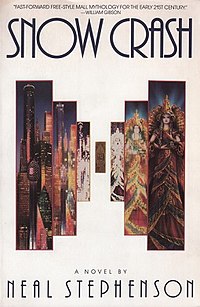
Stephenson has rapidly become one of my very favorite, if not all time favorite, authors. Snow Crash is so incredible - Stephenson's vision of the future is a rarity in its clarity, depth, and originality. The overpopulated earth has become a trashy wasteland, and the technological/economic elite have essentially moved to a digital existence, most often "goggled in" to the virtual reality of the Metaverse, where your avatar can move around and conduct business in the same way as on earth. Hackers, especially the samurai-sword wielding protagonist (named Hiro Protagonist), have the upper hand in a landscape they can control. However, the intersection between man and machine, embodied particularly in the hackers' binary-acccomodating neural pathways, has led to the dangerous potential for computer viruses to infect the user's mind. This unique vision has even more resonance given Google's recent announcement that they are developing glasses which will project a virtual reality and other information over the real world. This novel's astounding scope encompasses the exploration of memes, Glossolalia, drugs, viruses, and religion, which are depicted as being basically synonymous. A wonderful page-turner!
Wednesday, December 28, 2011
Neal Stephenson - Reamde
In Stephenson's oeuvre, Reamde, despite its 1056 pages, is light reading. This is not necessarily a bad thing. The man is a master of plot construction, not in terms of technical complexity but rather in terms of sheer engagement: he gets those pages turned. The novel's most striking feature is its action sequences, in which Stephenson shows off his impressive gunfight-choreography chops.
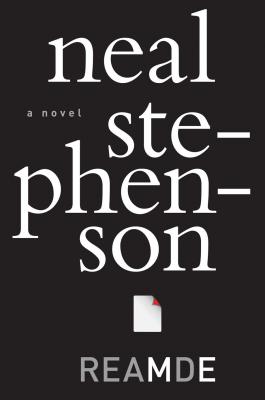 The novel's cyberpunk elements center around the computer game T'Rain (the fictional successor to the online hegemony of World of Warcraft), whose most salient characteristic its elaborate economy, based on a virtual-gold standard whose integrity is ensured by an elaborate geological simulation which determines the location of deposits of ore within the game world. The game is designed to exploit, rather than be exploited by, the existence of "gold-farmers," or kids in China who perform repetitive in-game actions (or grinding) in order to harvest virtual items and currency that they can then sell to rich Westerners - a real phenomenon in games like WoW. Stephenson's picture of how this all works is really quite ingenious, and somehow constitutes both a more sophisticated version and elaborate parody of early cyberpunk depictions of the function of virtual spaces in the global economy, like Stephenson's own depiction of the "Metaverse" in Snow Crash.
A series of elaborate coincidences embroil the creator of this game, the draft-dodging black sheep of a gun-toting Idaho clan, and his adopted Eritrean refugee niece in a globe-trotting hostage plot involving Islamic terrorists and Russian organized crime; all of which is much too complicated to even begin to explain here. Suffice to say that the entire thing is incredibly entertaining, and the characters are extremely well-written: I thought that the terrorist Abdullah Jones, a suave Black American convert, was a particularly intriguing figure.
In Reamde, Stephenson dials down the whole "novel of ideas" business and writes a fairly straightforward thriller that delivers exactly what it promises and in fine style. The Stephensonian themes are all here, but muted and lighthearted in a way that I think is actually a very good artistic move, especially following the somewhat more ponderous (but very good) Anathem. If nothing else, the book makes me wistful for a world in which the rest of the bestseller list was even a fraction of Reamde's quality.
I would recommend the book, but read the essential Stephenson first: Snow Crash, The Diamond Age, Cryptonomicon.
Stephenson's Novels
- The Big U (1984)
- Zodiac (1988)
- Snow Crash (1992)
- Interface (1994)
- The Diamond Age: or A Young Lady's Illustrated Primer (1995)
- The Cobweb (1996)
- Cryptonomicon (1999)
- The Baroque Cycle
- Quicksilver (2003), volume I
- The Confusion (2004), volume II
- The System of the World (2004), volume III
- Anathem (2008)
- The Mongoliad (2010–2012)
- Reamde + Colin's review (2011)
Subscribe to:
Comments (Atom)