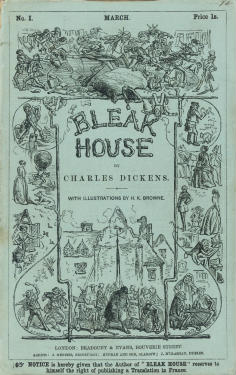
I find Dickens' novels to be delicious and satisfying like a nice Stilton, and Bleak House is no exception. The tale is told from the perspective of Esther, a schoolmarmish and self-effacing young woman who lives to nurture others. Characteristically, the novel weaves Esther's own story into a complex tapestry of interconnected narratives and broader themes.
Esther is raised by a severe old woman and haunted by a vague suggestion that she was born into shame (a mystery which is gradually explored over the course of the novel). After the old woman dies, Esther is rescued by a wealthy patron, John Jarndyce, who pays for her education and finishing and then sets her up as caretaker of his estate, Bleak House. In addition to managing the keys and accounts, Esther dedicates herself to the care of John's beautiful niece, Ada, and acts as a chaperone and confidant to Ada and her carefree beau, cousin Richard.
The novel's principal theme is revealed through the story of Ada and Richard - the wards of Jarndyce - as the destructive power of the sprawling and ineffective Chancery justice system, which was ultimately reformed in part due to Dickens' powerful critique.
A poetic and very human look at the beauty and tragedy of the domestic sphere across multiple societal classes. Dickens captures the crude wisdom of impoverished women despite the ignorance, violence, and squalor of their existence, and through Esther's prim but compassionate eye, satirizes the conceits of those blustering do-gooders who would help the poor by giving them books they cannot read. He is also as adept at capturing the foibles and tragedies of the nobility as he is at portraying the life of the very poor. All in all, a very vibrant picture of the human condition.
Showing posts with label drama. Show all posts
Monday, March 23, 2015
Tuesday, January 13, 2015
Devil in the White City - Erik Larson
My bookclub's most recent book is Larson's Devil in the White City, a thrilling historical drama about the construction of the 1892 World's Fair and the serial killer who preyed upon its visitors, H.H. Holmes.

Holmes is only one among several intriguing players in the tale, including ambitious lead architect Burnham and cantankerous but brilliant landscape architect Olmsted.
The work is very engaging and colorful and powerfully recreates the atmosphere of bustling, squalid Chicago at the turn of the century, and the otherworldly transformation it underwent to become the White City during the Fair. It was also fun to realize how many inventions we consider commonplace had their origins in this fair. I would recommend this book to everyone.

Holmes is only one among several intriguing players in the tale, including ambitious lead architect Burnham and cantankerous but brilliant landscape architect Olmsted.
The work is very engaging and colorful and powerfully recreates the atmosphere of bustling, squalid Chicago at the turn of the century, and the otherworldly transformation it underwent to become the White City during the Fair. It was also fun to realize how many inventions we consider commonplace had their origins in this fair. I would recommend this book to everyone.
![]() |
| The White City |
Tangentially related, Nikolai Tesla won the contract to provide electricity at the World's Fair, so here is a hilarious video.
Labels:
architecture,
aristocracy,
bookclub,
Chicago,
crime,
criminal justice,
drama,
history,
industr,
LMB,
mid-1800s,
murder,
nonfiction,
serial killer,
thriller
Friday, February 21, 2014
The London Monster: A Sanguinary Tale - Jan Bondeson
Bondeson's tale is a stranger-than-fiction account of the "Monster," a savage serial stabber in 1790s London, who preyed upon unaccompanied young women by with a "tremulous eagerness," accompanying his attacks with shockingly foul and indecent language. Although the Monster (or perhaps, Monsters) employed a variety of sinister stratagems of assault, including stabbing unsuspecting maidens in the face using a knife hidden inside a bouquet of artificial nosegays, and tearing at women's exposed arms with some sort of metal claw, his preferred method of attack was to slash at his victims' thighs and buttocks, inspiring fearful aristocratic women to wear copper petticoats, and lower class women to hide frying pans under their skirts.All told, the Monster attacked somewhere between 15-30 women, causing mass hysteria and vigilante mob action, before a local pervert and malcontent, artificial flower-maker Rhynwick Williams, was brought to trial and ultimately convicted (although both then and now, doubts remain about his guilt), essentially ending the slew of attacks and putting an end to the witch-hunt.
The book is largely an exploration of the panic caused by these stabbings, as well as the popularity of the subject in the media (the book contains ribald poetry, bawdy newspaper cartoons, and descriptions of various Monster plays from the period), as well as the bizarre circumstances of the two trials.
Pretty odd, but interesting!
Labels:
1700s,
aristocracy,
crime,
criminal justice,
drama,
England,
history,
light reading,
LMB,
mystery,
nonfiction,
obsession,
paranoia,
police,
terrorism,
whodunit,
witch-hunt
Monday, August 5, 2013
Vanity Fair - Thackeray
I told my doc I was reading Vanity Fair, and she asked if a new one had come out. Well... Not since 1848!
Anyway, this gossipy novel follows the beautiful schemer Becky Sharp as she climbs from her lowly beginnings as a poor opera dancer's daughter to the height of English aristocratic wealth and influence. A gorgeous portrait of English and continental life during the Napoleanic war, which sounds utterly blissful (although of course filled with ridiculous intrigue).
Thackeray is a master of the language, and this lighthearted but keen examination of vanity is a delight to read.
Recommended if you liked The Scarlet Pimpernel, reviewed here: http://blogenburyisreading.blogspot.com/2012/01/scarlet-pimpernel-by-baroness-emmuska.html?m=0
Dad's VF review: http://blogenburyisreading.blogspot.com/2009/06/vanity-fair.html
Anyway, this gossipy novel follows the beautiful schemer Becky Sharp as she climbs from her lowly beginnings as a poor opera dancer's daughter to the height of English aristocratic wealth and influence. A gorgeous portrait of English and continental life during the Napoleanic war, which sounds utterly blissful (although of course filled with ridiculous intrigue).
Thackeray is a master of the language, and this lighthearted but keen examination of vanity is a delight to read.
Recommended if you liked The Scarlet Pimpernel, reviewed here: http://blogenburyisreading.blogspot.com/2012/01/scarlet-pimpernel-by-baroness-emmuska.html?m=0
Dad's VF review: http://blogenburyisreading.blogspot.com/2009/06/vanity-fair.html
Labels:
1700s,
aristocracy,
classic,
comedy,
drama,
fiction,
French revolution,
history,
humor,
LMB,
romance,
social commentary,
Thackeray,
war
Wednesday, February 27, 2013
Breakfast at Tiffany's: A Short Novel and Three Stories
Breakfast at Tiffany's, featuring Capote's most memorable character, Holly Golightly, is a breezy and captivating story with a perfect concoction of wit, dramatic confrontations, breathless innocence, and lost youth. Lovely writing - I plan never to spoil it by seeing the movie! The short stories in this volume were also quite wonderful....very evocative, often funny, and very touching.
Labels:
Dad,
drama,
humor,
light reading,
short stories,
Truman Capote
Saturday, October 20, 2012
State of Wonder - Ann Patchett
This captivating story describes the quest of a pharmaceutical researcher, Dr. Marina Singh, to determine how her long-time colleague and friend, Dr. Anders Eckman, died. He had been sent by the CEO of their company to the Amazon to find the brilliant but renegade researcher Dr. Annick Swenson, who has shrouded her efforts to develop a new drug in complete secrecy. After three months with little communication from Eckman, the CEO receives a terse and sterile note from Dr. Swenson saying simply that Eckman died of a fever. Dr. Singh initially accepts the assignment to find out what happened out of her friendship for Dr. Eckman, sympathy for his wife, and loyalty to the CEO. But there are relationships within relationships - Singh is actually the secret lover of the CEO, Eckman's wife had been worried about whether Singh was having an affair with Eckman, and the imperious Dr. Swenson was formerly the exacting supervisor of Dr. Singh during her medical residency. These connections, and new ones that develop, especially with a deaf native boy, Easter, are the main substance of the book, and the driving force of its narrative. But Patchett also astonishes with vivid, startling episodes. Wonderful reading.
Saturday, February 4, 2012
The Stars Look Down
This novel, by Scottish physician and author AJ Cronin, is a powerful and emotional account of the plight of coal miners in Wales, interweaved with moving stories of struggles between people with different values.
The story begins cruelly with the miners returning to work after a lengthy and unsuccessful strike that has caused substantial hardship, to the point of desperate hunger. Robert Fenwick led the strike to obtain changes he felt essential for the miners' safety, but is now scorned by the miners and his own wife. Inevitably, the disaster he foresaw does occur: the miners break through a barrier into an underground reservoir, flooding the mine. Over 80 miners are quickly drowned, while Robert, with controlled intelligence and courage, leads his son Hughie and 10 others to safety into an old portion of the mine. They become trapped, however, by tons of collapsed tunnel and must wait for rescue. As days pass, first lit by candlelight and eventually in darkness, the miners die one by one. The account of the deaths by drowning, though short, is vivid and chilling; the drawn out description of the deaths of the trapped miners is harrowing.
Over the next decades, the story reveals the effects of this disaster on Robert's idealistic son Davey, on Arthur, the tortured son of the domineering and rapacious mine owner, and on Joe Gowlan, who flees the mines to become a successful and powerful war-profiteer. SPOILERS: Davey fights for miners' rights by striving to promote nationalization of the mines. Eventually elected to Parliament, Davey becomes a prominent miners' advocate, but the crushing realities of politics as usual and the influence of well-heeled capitalists defeat his efforts. After his father is debilitated by a stroke, Arthur uses the mine's astonishing war profits to initiate massive improvements. Crushingly, his outlays, coupled with economic downturn, lead him to the brink of bankruptcy, while his perceived weakness and the disregard for miners shown by politicians and other mine owners, make him an object of scorn rather than appreciation among the miners. The despicable Gowlan succeeds in business beyond his wildest dreams, makes massive amounts of money during the war, and eventually defeats Davey's attempt to be re-elected to Parliament.
Written in 1935, the book expresses a view of capitalism that resonates with present conditions:
The story begins cruelly with the miners returning to work after a lengthy and unsuccessful strike that has caused substantial hardship, to the point of desperate hunger. Robert Fenwick led the strike to obtain changes he felt essential for the miners' safety, but is now scorned by the miners and his own wife. Inevitably, the disaster he foresaw does occur: the miners break through a barrier into an underground reservoir, flooding the mine. Over 80 miners are quickly drowned, while Robert, with controlled intelligence and courage, leads his son Hughie and 10 others to safety into an old portion of the mine. They become trapped, however, by tons of collapsed tunnel and must wait for rescue. As days pass, first lit by candlelight and eventually in darkness, the miners die one by one. The account of the deaths by drowning, though short, is vivid and chilling; the drawn out description of the deaths of the trapped miners is harrowing.
Over the next decades, the story reveals the effects of this disaster on Robert's idealistic son Davey, on Arthur, the tortured son of the domineering and rapacious mine owner, and on Joe Gowlan, who flees the mines to become a successful and powerful war-profiteer. SPOILERS: Davey fights for miners' rights by striving to promote nationalization of the mines. Eventually elected to Parliament, Davey becomes a prominent miners' advocate, but the crushing realities of politics as usual and the influence of well-heeled capitalists defeat his efforts. After his father is debilitated by a stroke, Arthur uses the mine's astonishing war profits to initiate massive improvements. Crushingly, his outlays, coupled with economic downturn, lead him to the brink of bankruptcy, while his perceived weakness and the disregard for miners shown by politicians and other mine owners, make him an object of scorn rather than appreciation among the miners. The despicable Gowlan succeeds in business beyond his wildest dreams, makes massive amounts of money during the war, and eventually defeats Davey's attempt to be re-elected to Parliament.
Written in 1935, the book expresses a view of capitalism that resonates with present conditions:
At last, through their constitutional hidebound apathy, people were beginning to question the soundness of a political and economic system which left want, misery and unemployment unrelieved. New and bold ideas went into circulation. Men no longer retreated in terror from the suggestion that capitalism, as a system of life, had failed.At book's end, both Davey and Arthur are back in the mines, working under Gowlan. Jeez, this sounds depressing! The fundamental inequalities and unfairness of British society depicted here are leavened, however, by the rich interpersonal relationships, which provide many heart-warming and heart-rending incidents. Moreover, Davey convincingly achieves individual fulfillment, even as his professional ambitions are thwarted, and the book ends on an optimistic note. Very highly recommended!
Labels:
capitalism,
coal mining,
depressing,
drama,
fiction,
social commentary
Monday, January 2, 2012
La's Orchestra Saves the World
Alexander McCall Smith is the "Bestselling Author of THE NO. 1 LADIES' DETECTIVE AGENCY" and many other books. This book's jacket describes La's Orchestra as "heartwarming" and I suspect all of his books would fit this adjective...while this would usually be a red flag for me, this book was recommended by Linda's sister Karen, who likes to have fun but is serious and levelheaded! And, as advertised, the book was really good. Set in the 1930's, the book focuses on La (short for Lavender), who is serious and thoughtful. Rather surprisingly, she marries young, but is soon widowed. She moves to the English countryside in a kind of defiant rebellion against her London life and, when war breaks out, establishes an amateur orchestra.
While there were moments of "heartwarming", it was more a sober book, dealing with the limited options for women at that time, how the British coped with war, and how one person touches others. Sober but ultimately fairly optimistic. I read that Smith is an amateur bassoonist and "Not content with merely founding the Really Terrible Orchestra in Edinburgh (which brings really great fun to its audiences), McCall Smith has established an opera house and opera training center in Botswana". A very interesting man, evidently with limitless energy, as in his "real" life, he is a professor of medical law at Edinburgh. Quite a worthwhile read, I thought.
Labels:
1930s,
Alexander McCall Smith,
Dad,
drama,
England,
heartwarming,
history,
music,
war
Tuesday, August 2, 2011
Freedom by Jonathan Franzen
This excellent book more frequently made me uncomfortable than anything I have read in a long time. The Berglund family and their relatives and friends are interesting and troubled - and their weaknesses and vanities are placed under the klieg lights of Franzen's simple but powerful prose. I identified at least a little with all the characters but one, so I felt uncomfortable in turn when the faults and troubles of these characters were highlighted. I identified least with the disaffected and cynical rocker Richard Katz, so I guess that's why I liked him the most - I didn't squirm when he was under the light! But there were many laugh out loud moments also.
In a way, the book seems like a well-crafted puzzle - though the narrative was composed largely of grim events afflicting not-so-likable people, these people all eventually and convincingly achieved some peace and the ending was moving and uplifting. Very interesting. Highly recommended.
Labels:
Dad,
drama,
dysfunctional family,
fiction,
Jonathan Franzen,
searing,
uncomfortable
Saturday, June 5, 2010
The Girl With the Dragon Tattoo

Fabulous beach-read, can't-put-it-down mystery/thriller. Instantly absorbing, interesting characters, and convincing dialog. Not totally lightweight, as suggested by the original Swedish title, "Men Who Hate Women". I think everybody would like this.
Labels:
Dad,
drama,
light reading,
Lisbeth Salander,
Mikael Blomkvist,
mystery,
Stieg Larsson,
thriller
Tuesday, November 17, 2009
Measure for Measure
In my Shakespeare class we recently read the "problem comedy" Measure for Measure. The action of Measure for Measure commences with the Duke’s reflection that due to lax law enforcement in the city of Vienna, “liberty plucks justice by the nose/…and quite athwart/ Goes all decorum” (I. iii. 29-31). Believing himself to blame, the Duke decides that he cannot be the one to discipline the citizens, and thus decides to temporarily leave Vienna and appoint the austere Lord Angelo as deputy in his place, to restore order to the city through strict punishment. In fact, the Duke only pretends to leave the city, but remains behind disguised as a Friar. Angelo’s first act is to sentence a young man, Claudio, to death for fornication. When Claudio’s sister, a young postulant nun named Isabella, comes to Angelo to plead for his release, Angelo becomes passionately enraptured by her. I won’t give away more, but suffice to say, this play is full of surprises, including a “bed trick” and a “head trick.” The play is dark and disturbing but excellent, and I had the pleasure of watching it performed by the Reed theatre. I highly recommend it.
Labels:
comedy,
dark,
drama,
LMB,
play,
problem comedy,
religion,
sexuality,
Shakespeare,
vienna
Tuesday, June 9, 2009
Vanity Fair
There is a great quantity of eating and drinking, making love and jilting, laughing and the contrary, smoking, cheating, fighting, dancing, and fiddling: there are bullies pushing about, bucks ogling the women, knaves picking pockets, policemen on the look-out, quacks, (other quacks, plague take them!) bawling in front of their booths, and yokels looking up at the tinselled dancers and poor old rouged tumblers, while the light-fingered folk are operating upon their pockets behind. Yes, this is VANITY FAIR: not a moral place certainly; nor a merry one, though very noisy.A lively and delicious read - rather like a practical and entertaining version of Machiavelli!
Labels:
1700s,
aristocracy,
classic,
comedy,
Dad,
drama,
fiction,
French revolution,
history,
humor,
romance,
social commentary,
Thackeray,
war
Sunday, November 23, 2008
Asimov's "The End of Eternity"
After commenting to my father of how I enjoyed another book whose plot relied on time paradoxes, he recommended to me this book by Sci-Fi author Issac Asimov. In the past, I'd briefly tried one of Asimov's books, but I hadn't been hooked and eventually I gave up reading it. This time was fairly similar, but reading through the slow start was worth the wait.
The protagonist in this book is Harlan, who is known as an "Eternal". An Eternal is a dweller of Eternity, which is essentially a base from which experienced "Technicians" can time-travel. Not only can these Technicians time-travel, but they also can, after much planning, change things in the real world.
The book actually begins when Harlan is already half-way through his adventure and is blackmailing another Eternal into completing a "Life-Plot" for him. A Life-Plot is a map of what is likely to happen to a person when reality is changed. Strangely enough, we find out that this Life-Plot is for a woman, Noys Lambent, and Harlan delivers his fatal lines:
"If there was a flaw in Eternity, it involved women... he felt it personally only that day he had first met Noys... For the first time, the specific and express thought came to him. And though he pushed it away in horror, he knew that, having once come, it would return. The thought was simply this: That he would ruin Eternity, if he had to. The worst of it was that he knew he had power to do it."
The rest of the book progresses smoothly, but becomes significantly more intense in the last 100 pages, when we learn why the book is entitled "The End of Eternity".
Overall, I very much enjoyed this book. It was a slow start since I knew next to nothing about the story, and the vast number of Sci-Fi terms that were impressed upon me were confusing rather than engaging. It was not until the third chapter or so that I caught on to most of the scientific background, and it was not until more than halfway through that I understood all of it. The story, however, is fantastic. Even though Asimov takes a long time to set up all the pieces of his story, the playout at the end is fantastic, and the number of twists and unexpected turns that the book takes was very gripping.
Although I myself enjoyed this book, I don't know if everyone else would like it. I enjoyed the book because of its complexity, because this made it so much harder to predict that little quirks that came up throughout the book. Some, however, would likely find all the jargon more distracting that enhancing, and would perhaps not like to read this book as much. If, however, you're looking for a real mind-bending mystery/Sci-Fi/drama, then you should really consider reading this book.
The protagonist in this book is Harlan, who is known as an "Eternal". An Eternal is a dweller of Eternity, which is essentially a base from which experienced "Technicians" can time-travel. Not only can these Technicians time-travel, but they also can, after much planning, change things in the real world.
The book actually begins when Harlan is already half-way through his adventure and is blackmailing another Eternal into completing a "Life-Plot" for him. A Life-Plot is a map of what is likely to happen to a person when reality is changed. Strangely enough, we find out that this Life-Plot is for a woman, Noys Lambent, and Harlan delivers his fatal lines:
"If there was a flaw in Eternity, it involved women... he felt it personally only that day he had first met Noys... For the first time, the specific and express thought came to him. And though he pushed it away in horror, he knew that, having once come, it would return. The thought was simply this: That he would ruin Eternity, if he had to. The worst of it was that he knew he had power to do it."
The rest of the book progresses smoothly, but becomes significantly more intense in the last 100 pages, when we learn why the book is entitled "The End of Eternity".
Overall, I very much enjoyed this book. It was a slow start since I knew next to nothing about the story, and the vast number of Sci-Fi terms that were impressed upon me were confusing rather than engaging. It was not until the third chapter or so that I caught on to most of the scientific background, and it was not until more than halfway through that I understood all of it. The story, however, is fantastic. Even though Asimov takes a long time to set up all the pieces of his story, the playout at the end is fantastic, and the number of twists and unexpected turns that the book takes was very gripping.
Although I myself enjoyed this book, I don't know if everyone else would like it. I enjoyed the book because of its complexity, because this made it so much harder to predict that little quirks that came up throughout the book. Some, however, would likely find all the jargon more distracting that enhancing, and would perhaps not like to read this book as much. If, however, you're looking for a real mind-bending mystery/Sci-Fi/drama, then you should really consider reading this book.
Subscribe to:
Comments (Atom)


