Logicomix is a fascinating and unusual graphic novel by Apostolos Doxiadis and Christos Papadimitriou, with art by Aleco s Papadatos and Annie Di Donna. The subtitle, An Epic Search for Truth, signals the story's thread: an account of the development of logical thought, from the late 1890's up through the 1950's, using Bertrand Russell as narrator and his life story as the frame. Russell came from a privileged and illustrious family - his grandfather was a Prime Minister of England - but also a secretive one, with skeins of madness and promiscuity.
Thus, Russell's earliest passions were to discover hidden truths, with certainty, which drove his interest in logic. He spent roughly a decade collaborating with Alfred North Whitehead in developing a logical basis for arithmetic, with the goal of placing mathematics on a secure foundation. Although the methods they developed in their Principia Mathematica were highly influential, they never succeeded in their goal and Russell felt that this effort had been a failure. Eventually, as recounted in this book, Kurt Gödel relied heavily on the methods of Russell and Whitehead, to prove conclusively that the effort to axiomatize arithmetic is inherently flawed. John von Neumann was in the audience when Gödel presented this work, and famously said "It's all over".
Russell was also a passionate pacifist, and the human cost of the wars and revolutions of the 1900's is a second major theme of the story, serving to underscore the tension between rational versus emotional or ideological approaches to human interaction. The authors appear in the book as themselves, discussing the ideas and themes and, especially, how the book should end. So as not to spoil the ending, I will simply say that the authors and illustrators attend a performance of the Oresteia, and draw conclusions from the ending of the play, which is visually exciting and emotionally powerful. A very interesting and thoughtful book....and I am now reading the Oresteia!
Showing posts with label philosophy. Show all posts
Sunday, January 26, 2020
Logicomix
Labels:
1900s,
Bertrand Russell,
Dad,
Kurt Gödel,
logic,
Ludwig Wittgenstein,
mathematics,
Nazi,
philosophy,
World War I,
World War II
Saturday, August 2, 2014
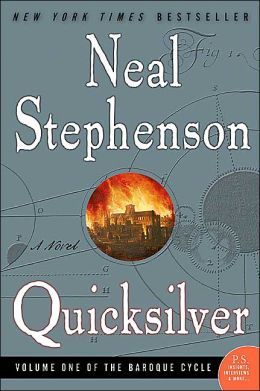
Quicksilver (The Baroque Cycle, #1) - Neal Stephenson
The first novel in the Baroque cycle is an engaging picture of life in 1600s and 1700s England and America, where former Puritan Daniel Waterhouse is mixing it up with the greatest minds of his day, including Isaac Newton and the young Benjamin Franklin, among others. I don't have much to say about the plot (such as it is), but it is full of interesting philosophical discussions, such as this:
Stephenson's Novels
“And yet viewing several depictions of even an imaginary city, is enlightening in a way," Leibniz said. "Each painter can view the city from only one standpoint at a time, so he will move about the place, and paint it from a hilltop on one side, then a tower on the other, then from a grand intersection in the middle--all in the same canvas. When we look at the canvas, then, we glimpse in a small way how God understands the universe--for he sees it from every point of view at once. By populating the world with so many different minds, each with its own point of view, God gives us a suggestion of what it means to be omniscient.”An interesting book. I've set down The Confusion, which has a different cast of characters and didn't grab me as much, but I may return to it.
Stephenson's Novels
- The Big U (1984)
- Zodiac (1988)
- Snow Crash (1992)
- Interface (1994)
- The Diamond Age: or A Young Lady's Illustrated Primer (1995)
- The Cobweb (1996)
- Cryptonomicon (1999)
- The Baroque Cycle
- Quicksilver (2003), volume I
- The Confusion (2004), volume II
- The System of the World (2004), volume III
- Anathem (2008)
- The Mongoliad (2010–2012)
- Reamde + Colin's review (2011)
Labels:
1600s,
1700s,
aristocracy,
Ben Franklin,
bubonic plague,
England,
fiction,
history,
LMB,
nature,
Neal Stephenson,
philosophy,
plague,
religion,
science
Monday, February 17, 2014
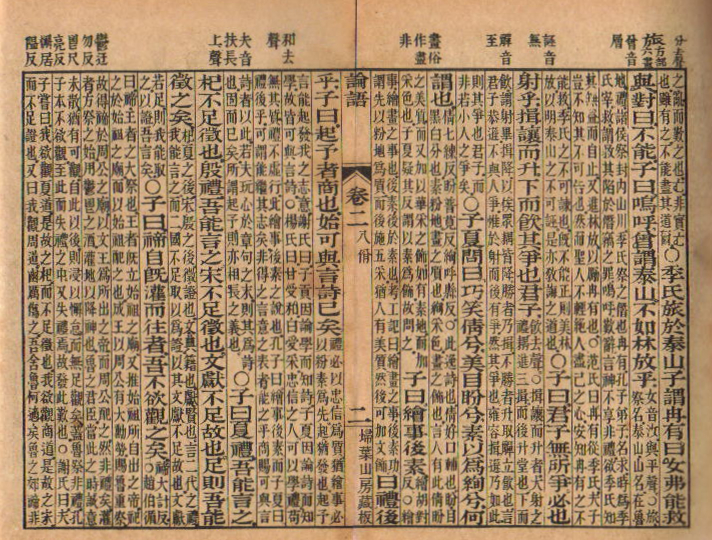
The Analects of Confucius - trans. by Legge
The Master said, "Riches and honours are what men desire. If it cannot be obtained in the proper way, they should not be held. Poverty and meanness are what men dislike. If it cannot be avoided in the proper way, they should not be avoided."Other quotes, while interesting or thought-provoking, were less clear to me. For example,
The Master said, "A cornered vessel without corners---A strange cornered vessel! A strange cornered vessel!"I think this would be a good book to keep around to re-read and consider in small sections over a period of time.
Sunday, January 19, 2014
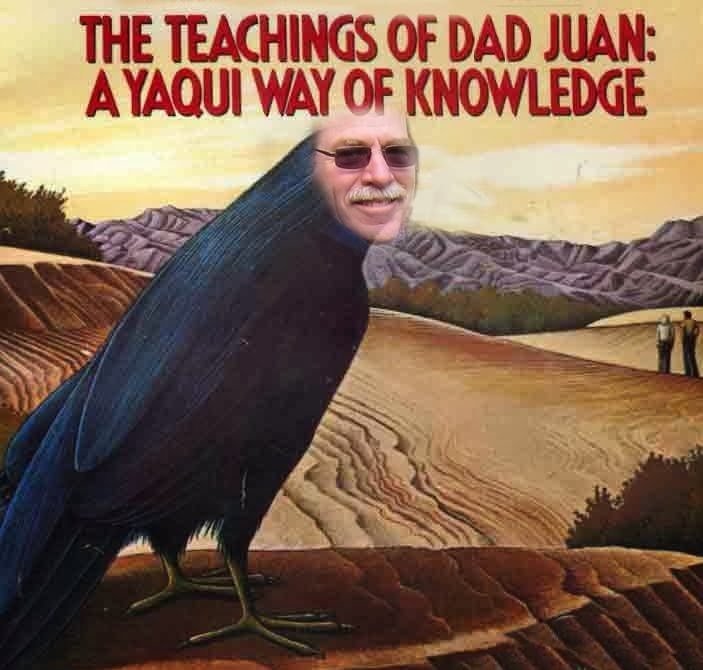
The Teachings of Don Juan - Carlos Castaneda
Tonight I read Carlos Castaneda's "The Teachings of Don Juan" in a single sitting (I skipped part 2, his structural analysis of the teachings, which does not interest me). I became interested in this book in a sort of roundabout way - one part of Levack's Witch-Hunt that keenly aroused my interest was the offhand reference to the hallucinogenic "flying unguents" purportedly used by medieval witches, which may (in some cases) have inspired the visions of flying to the witches' sabbath. These ointments contained plants such as atropa belladona and datura, and in my online research into their effects, I came across the following passage from Castaneda:"There was a question I wanted to ask him. I knew he was going to evade it, so I waited for him to mention the subject. I waited all day. Finally, before I left that evening, I had to ask him, "Did I really fly?," don Juan?"Although I am disappointed that Don Juan the man appears to have been a fiction, I still find this passage very powerful, and am still intrigued by some of the arguments Castaneda attributes to him, such as his rejection of there being only one way to understand our physical relationship with the world.
"That is what you told me. Didn't you?"
"I know, don Juan. I mean, did my body fly? Did I take off like a bird?"
"You always ask me questions I cannot answer. You flew. That is what the second portion of the devil's weed is for. As you take more of it, you will learn how to fly perfectly. It is not a simple matter. A man flies with the help of the second portion of the devil's weed. That is all I can tell you. What you want to know makes no sense. Birds fly like birds and a man who has taken the devil's weed flies as such [el enyerbado vuela asi]."
"As birds do? [Asi como los pajaros?]."
"No, he flies as a man who has taken the weed [No, asi como los enyerbados]."
"Then I didn't really fly, don Juan. I flew in my imagination, in my mind alone. Where was my body?"
"In the bushes," he replied cuttingly, but immediately broke into laughter again. "The trouble with you is that you understand things in only one way. You don't think a man flies; and yet a brujo can move a thousand miles in one second to see what is going on. He can deliver a blow to his enemies long distances away. So, does he or doesn't he fly?"
Regardless of whether you want to take it or leave it as spiritually valid, certainly no one could deny that Castaneda is a powerful storyteller, and the concluding episode was so wild and gripping I forgot I was even reading a book until it was over. A powerful "state of nonordinary reality" induced by reading!
The wise Dad Juan
Sunday, July 7, 2013
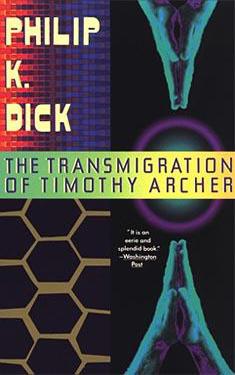
The Transmigration of Timothy Archer - Philip K. Dick
Just finished reading Philip K. Dick's The Transmigration of Timothy Archer (1982), published posthumously. (For those who may not know, transmigration is "the religious or philosophical concept that the soul or spirit, after biological death, begins a new life in a new body that may be human, animal or spiritual depending on the moral quality of the previous life's actions.")
The novel is set in the 1960s and 1970s, and follows the descent into drug addiction, radical religion, and madness of a deeply entwined but unhappy circle of five friends - intelligent but lonely Angel Archer, "professional student" at Cal Berkeley and poetic grass fiend, her disaffected husband, Jeff, whose maniacally intensive study of Wallenstein and Hitler becomes a pointless bid for his father's attention, Jeff's father, the dreamy but brilliant Bishop Timothy Archer, who unwittingly destroys himself and his friends, the Bishop's secret lover, the spiteful barbiturate addict Kirsten, and Kirsten's angelic son, the schizophrenic Bill.
The action begins on the day of John Lennon's death, with Angel's attempts to make sense of the "retributive fate" which has enveloped her life and destroyed those closest to her. For all this darkness, the book is a fairly light read, with some good humorous bits. For Philip K. Dick enthusiasts, it is also an interesting window into his thoughts in later years, and perhaps his most mature piece of writing. Although the repetitive nature of some of the lines was at times tedious for me, I believe it was a deliberate stylistic choice to evoke the obsessive nature of Angel's thoughts, and was effective for that purpose.
Bishop Archer's darkly comic misadventures are in fact based on the doings of the unfortunate Bishop James Pike - definitely worth reading a bit about that man, although save it for after you've read the novel - spoiler alert!
Monday, March 11, 2013
Walden
I know what you're thinking: you're remembering back to high school when you were forced to read this book cover to cover, and after you finished, you instantly shredded and burned your copy. While I can understand where these poor high school students are coming from, I think you might want to re-visit this old classic, especially in light of today's hectic lifestyle.
Since it is a collection of essays, Walden has no narrative, which makes the lengthier passages about as interesting as watching grass grow.This, however, is part of the book's charm. The very point of Walden is to force the reader to slow down, to read about a lazier and simpler lifestyle. If you're reading the book to just get through it, or to seem like an intellectual in front of your friends, you will have a miserable time.
If one reads the book simply for its own sake, however, the true beauty of it comes out. The book is an ode to the poetry and the philosophy in every day life that we constantly miss. Thoreau hopes, desperately hopes, that maybe somebody will pick up the book and realize what they've been missing all this time. They might hear the call of the loon out behind their house, and go out to watch the morning sun rise.
In short, if you want a thriller, or a heartrending tale of despair, or even just a book that you can read to the kids at bed time, this is most definitely not the one you want. But if you ever feel the need to just sit down and clear your mind, there will never be a book more suited to such a purpose than this one.
Since it is a collection of essays, Walden has no narrative, which makes the lengthier passages about as interesting as watching grass grow.This, however, is part of the book's charm. The very point of Walden is to force the reader to slow down, to read about a lazier and simpler lifestyle. If you're reading the book to just get through it, or to seem like an intellectual in front of your friends, you will have a miserable time.
If one reads the book simply for its own sake, however, the true beauty of it comes out. The book is an ode to the poetry and the philosophy in every day life that we constantly miss. Thoreau hopes, desperately hopes, that maybe somebody will pick up the book and realize what they've been missing all this time. They might hear the call of the loon out behind their house, and go out to watch the morning sun rise.
In short, if you want a thriller, or a heartrending tale of despair, or even just a book that you can read to the kids at bed time, this is most definitely not the one you want. But if you ever feel the need to just sit down and clear your mind, there will never be a book more suited to such a purpose than this one.
Monday, February 20, 2012
Stephen Hawking's A Brief History of Time
Since I have recently been pursuing the fundamental philosophical question "why is there something instead of nothing" from one end of the philosophical tradition, Daoist metaphysics in particular, I decided to switch gears for a bit and see what professor Hawking had to say about the issue.
A Brief History of Time is an eminently accessible guided tour, not through time itself, but through the Western tradition's understanding of the nature of the universe. Hawking walks the reader through the major paradigm shifts in intellectual history, beginning with the Copernican revolution, and explains in each case why the previous theory had to be abandoned and why the new one was chosen. The first section of the book should be familiar to most readers from high school. The second half was all things I had heard of before, and understood to some extent, but quantum mechanics et al. are always worth thinking about again.
Hawking presents the history of cosmology as the gradual reconciliation and elaboration of partial theories, with the current problem in physics understood as the production of a theory that will unify quantum mechanics and general relativity; in other words, reconcile our theories about what happens at very small scales and very large ones, respectively. Reading this book makes me nostalgic for the alternate life in which I pursued mathematics and understood in something more than a qualitative way what was at stake in all of this, but Hawking generously includes the rest of us in the conversation with his clear presentation.
The best part of the book, by far, is Hawking's stories about the bets he has made with various physicists on points of theoretical contention.
"I... believe there are grounds for cautious optimism that we may now be near the end of the search for the ultimate laws of nature."
Labels:
Colin,
Copernican revolution,
cosmology,
Daoism,
history,
nonfiction,
philosophy,
Stephen Hawking,
theory
Friday, February 17, 2012
Thomas Cleary - The Essential Confucius
This is the best book I have ever read.
Cleary's translation is extremely readable - his ordering is somewhat unorthodox but I don't understand what the details of that are.
As for the text itself, nothing has ever struck me so deeply. I have read the Analects before, but I did not fully appreciate it. I think everyone should study this book carefully and live their life by it. I am not going to say anything else about it because it is very short and the master speaks for himself.
Monday, June 27, 2011
Partially Finished with Infinite Jest - Preliminary Thoughts
On page 161 of the 1079-page epic Infinite Jest and figured I'd better do a preliminary post since it's taking me a while to work my through this book and I am reading other books at the same time.I sort of like this book so far. I know that's blasphemy (especially in Colin's mind) since the consensus is that this is a masterpiece on par with Joyce's Ulysses, but so far it isn't really doing it for me. There are definitely ideas of pure genius and some parts that are uproariously funny, Hal is a compelling character, and the theme of entertainment/media is very interesting.
However, it took me til ~150 to become slightly eager to know what happens in the rest of the book. My beef: 1) the mixed up chronology is irritating since I don't know when anything happened and am having difficulty piecing together any coherent storyline. Colin says that it comes together at a certain point, but I don't see why I should have to wait this long for it to make sense. 2) I dislike that the perspective switches so frequently - most of the segments are interesting individually but the sheer number of them feels a little bit gimicky and is another distraction for me.
Hopefully I will like it better as I go along since everyone else finds it brilliant and inspired.
***Updates***
- 6/29/11: on page 185 I have hope!!! There is a reference to "anticonfluential cinema," which is described in footnote 61 as, "an après garde digital movement... characterized by a stubborn and possibly intentionally irritating refusal of different narrative lines to merge into any kind of meaningful confluence" - does this sound familiar???
I feel vindicated and more hopeful that I will ultimately enjoy this novel - I doubt it is coincidence that the description of anticonfluential cinema so closely parallels my experience of the book thus far (especially since the concept is significantly attributed to J.O. Incandenza, a central figure in the novel).
I hope that now that this underlying structure has been revealed, it will be rejected. In other words, the different narrative lines of I.J. damn well better merge into some kind of meaningful confluence.
***Links***
- http://bmackie.blogspot.com/2009/05/david-foster-wallace-and-hypertext.html
Labels:
comedy,
crime,
David Foster Wallace,
drug culture,
epic,
junkies,
LMB,
media,
philosophy,
tennis
Monday, June 13, 2011
Vagabonding
All I gotta say is... WOW.
The book, while it is subtitled "An uncommon guide to the art of long-term world travel", is more of a philosophical text than anything, one that is certain to get one excited about traveling.
If you've ever wanted to travel (I know that seems like a broad category)... this book is definitely for you.
The book, while it is subtitled "An uncommon guide to the art of long-term world travel", is more of a philosophical text than anything, one that is certain to get one excited about traveling.
If you've ever wanted to travel (I know that seems like a broad category)... this book is definitely for you.
Subscribe to:
Comments (Atom)