Showing posts with label social commentary. Show all posts

Saturday, July 16, 2022

World War Z - Max Brooks

World War Z was excellent. One could be forgiven for thinking it would be pulpy drek (though I personally love zombie stories) -- however, nothing could be farther from the truth! Brooks treats the zombie virus rationally, using it as a thought experiment to explore the ramifications of rampant contagious disease and violence on all levels of society, world-wide, over a span of decades. Truly impressive and far-seeing. The novel is framed as a collection of survivor interviews, and Brooks' ability to compellingly embody many diverse characters and perspectives makes for very enjoyable reading. Some of the stories are very ugly and heartbreaking, but overall I found it uplifting, about the resilience of the human spirit. Would definitely recommend. 


As an aside-- the (very mediocre) disaster flick World War Z bears no resemblance to the book, they basically just copped the title. While the book is genius, the movie's sole virtue is that it features hottie Brad Pitt. Still, I enjoyed both. 

Saturday, February 17, 2018

Vile Bodies - Evelyn Waugh

Vile Bodies is a delightfully written satire about the desperately frivolous goings-on of the youth in 1920s England. I have not read a gossipy novel I enjoyed so much since I read Thackeray’s Vanity Fair, or before that, the Scarlett Pimpernel. A loosely-knit band of friends veers from drunken party to drunken brunch, careening wildly toward death, disgrace, or marriage, fueled largely by money conned or borrowed from friends or relatives. A book about nothing, that still manages to excite interest and sympathy for its dissolute “heroes.”

Monday, September 29, 2014

Future Shock - Alvin Toffler

Very much enjoyed Toffler's Future Shock, especially the second half.

The first part of the book explains at somewhat tedious length the titular psychological condition (the complete breakdown of adaptive functioning Toffler asserts is caused by overwhelming levels of change and novelty), which Toffler argues will become epidemic as society continues to change at an increasing pace. Although the quaintly-phrased doom and gloom is a bit tiresome, I agree with his overall theory, that there may be optimal levels of transience, novelty, and choice in society (which we are heedlessly zooming past), beyond which the average person finds it difficult to cope. Although I won't attempt to prove these connections here, I also believe that many of the psychological ills of our time (such as widespread Generalized Anxiety Disorder) are fairly linked to these same tendencies in society. (Also fascinating that this book was written in 1970, before the explosion of the internet, which has radically transformed our society in ways undreamt of even in this work!)

More interesting to me, however, is the second part of the book, which proposes individual and society-wide methods for treating the symptoms of change, as well as more radical proposals to control change itself. Toffler rejects the "regressive" hippies who would shun all technology and change, but he applauds the creation of enclaves of the past, which he sees as a sort of insurance against devestating disasters in the broader community. His strongest weapon against FS, however, is "imagineering" of the future by EVERYONE, and vast systems to integrate these predictions and disseminate findings about the most likely futures, according to the logic "forewarned, forearmed." He speaks in praise of science fiction here, as a "sociology of the future," an especially progressive stance at a time when the genre was held in "contempt" - his word. (I think William Gibson is personally carrying that torch for our whole society!)

What was a bit depressing about this book were the ways in which Toffler's predictions have NOT come true. Extrapolating logically from the increases in technological efficiency and output which had increased the standard of living for many, Toffler assumed that we would quickly use this wealth to end radical poverty inequalities, and with basic needs satisfied for all, could focus our surplus on moving up the needs hierarchy to focus on loftier goals like fulfillment and meaning. (He was not a socialist, by the way, his assumption that this would happen was not ideologically driven, but simple deduction.) Sadly, while this may have made sense at the optimistic time at which he was writing, on the contrary, wealth has become even MORE concentrated in the hands of a greedy few, and we haven't even begun to work on these deeper issues.

Much food for thought here!

Wednesday, April 16, 2014

The Grapes of Wrath - Steinbeck

For whatever reason, I was never required to read this book in high school, so I read it now for the first time as an adult. It's really a masterful work, very emotionally powerful and heartbreaking. The grotesque plight of the disenfranchised Oklahoma tenant farmers is told through the eyes of the Joad family. The story recounts their struggles as they are forced to leave their land and seek work in California, where they experience the cruelty of poverty and the futility of hard work and hope in the face of an oppressive system.  I am not surprised the book was so controversial in its day, the politics are very progressive and pro-labor. The book can be graphically disturbing but it is  an important story that remains very relevant today.

Monday, February 17, 2014

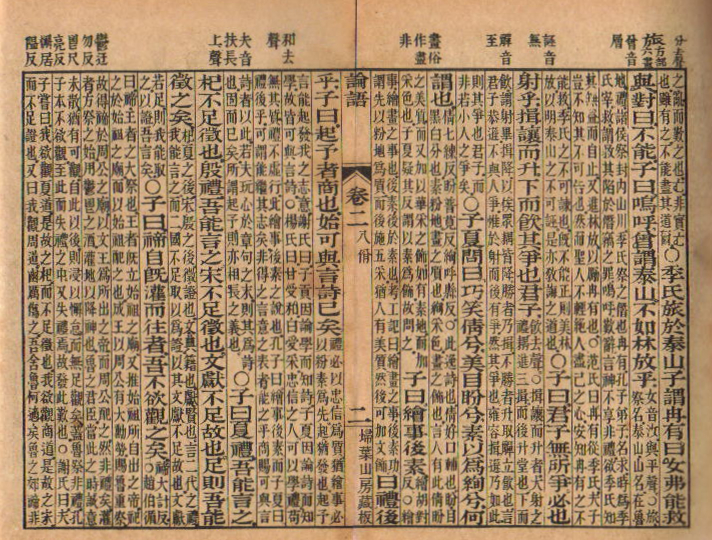
The Analects of Confucius - trans. by Legge


Picked up Legge's translation of The Analects of Confucius at a recent trip to Powell's in Portland (thanks, Colin, for the recommendation!). Nabokov said, "one cannot read a book; one can only reread it," and I think this clearly applies to the Analects. There were some quotes which seem clear enough at first reading:
The Master said, "Riches and honours are what men desire. If it cannot be obtained in the proper way, they should not be held. Poverty and meanness are what men dislike. If it cannot be avoided in the proper way, they should not be avoided."
Other quotes, while interesting or thought-provoking, were less clear to me. For example,
The Master said, "A cornered vessel without corners---A strange cornered vessel! A strange cornered vessel!"
I think this would be a good book to keep around to re-read and consider in small sections over a period of time.

Sunday, February 9, 2014

A Connecticut Yankee in King Arthur's Court

In contrast to The Prince and the Pauper, this gorgeous Folio Society Edition is Twain at his most critical, sarcastic and mordant.  The title suggests a romance or comic adventure - the tack taken by the gauzy 1949 movie starring Bing Crosby - but from the very beginning, though wildly funny in places, this is a fierce critique of human nature and society.  And the illustrations, by David Hughes, are perfectly married to this dark text.

Twain wrote the sweet and simple Prince and the Pauper in 1881, followed by Huck Finn - not so sweet or simple - and then Connecticut Yankee in 1889.  While Prince and the Pauper celebrates human mercy, Connecticut Yankee emphasizes
The truth was, the nation as a body was in the world for one object, and one only: to grovel before king and Church and noble; to slave for them, sweat blood for them, starve that they might be fed, work that they might play, drink misery to the dregs that they might be happy, go naked that they might wear silks and jewels, pay taxes that they might be spared paying them, be familiar all their lives with the degrading language and postures of adulation that they might walk in pride and think themselves the gods of this world.  And for all this, the thanks they got were cuffs and contempt; and so poor-spirited were they that they took even this sort of attention as an honor.
There is much humor - some sly (The chapter titled Morgan le Fey starts, "If knights errant were to be believed, not all castles were desirable places to seek hospitality in.") and some uproarious:
It was a very fine show.  In a gallery a band with cymbals, horns, harps, and other horrors, opened the proceedings with what seemed to be the crude first-draft or original agony of the wail known to later centuries as 'In the Sweet By and By'.  It was new, and ought to have been rehearsed a little more.  For some reason or other the queen had the composer hanged after dinner.
But the foundation of the book is the brutal and callous treatment of poor or powerless people by the lords and Church.  Some of these episodes are heart-rending.  And, without spoilers, the conclusion of the book is that in general, men are powerfully molded by society, making it nearly impossible to reform the oppressor or free the oppressed.

This is a powerful and wonderful book, simply but beautifully written, portraying, with love, sympathy, humor and horror, the full range of human behavior.

Thursday, January 2, 2014

Understanding Power - Noam Chomsky

My book group's most recent selection (at my suggestion) was Chomsky's "Understanding Power." My friend Dan had urged me to read this book many times and I kept putting it off, thinking it would be boring and difficult. Nothing could be farther from the truth! This gripping book, although shocking and disturbing at times, was extremely interesting and readable. It is an edited transcript of Chomsky's various talks, and his style is clear and persuasive. I found this book to be profoundly eye-opening and unsettling regarding American politics and media censorship, and while I felt very disillusioned, it was important for me to have a better understanding of power and oppression in our nation. A must-read for everyone, I think!
Footnotes to the text are available here.

Friday, September 6, 2013

Fathers and Children

Lauren has already reviewed this book by Turgenev , often published under the title Fathers and Sons, providing a nice summary of its depiction of two generations of Russians, the idealists of the 1840's (the Fathers) and the nihilists of the 1860's (the Children).

Turgenev's portrait of the self-proclaimed nihilist Bazarov provoked huge controversy: opponents of the utilitarian nihilists reviled Turgenev, denouncing Bazarov as a villain.  Most nihilists dismissed the portrait as a laughable caricature, though a few actually praised him as a "new man" of the type who would rejuvenate Russia.
 "Your sort, you gentry," Bazarov tells Arkady, when the two friends come to the parting of the ways, "can never get beyond refined submission or refined indignation, and that's a mere trifle.  You won't fight.....but we mean to fight.....we want to smash other people!"
Interestingly, one of the few people in Russia who seemed to accurately understand Turgenev's portrayal was Dostoevsky, who saw Bazarov as a tragic character, doomed to unhappiness by the contradiction between his sterile and brutal intellectual beliefs and his human needs and longings. Dostoevsky's praise and understanding helped forge a strong but brief friendship with Turgenev, which, however, was quickly dashed to pieces by their widely divergent views on religion and whether Russia's future lay in adopting western ideas (Turgenev) or seeking guidance from the true Russian character, which, in Dostoevsky's view, derived from a deep faith in Christ.

I really enjoyed the book, which is lyrically written, with great sensitivity to human love and loneliness. Though Bazarov is infuriating in his brutality, he is captivating in his passions and deep emotions.


Monday, August 5, 2013

Vanity Fair - Thackeray

I told my doc I was reading Vanity Fair, and she asked if a new one had come out. Well... Not since 1848!

Anyway, this gossipy novel follows the beautiful schemer Becky Sharp as she climbs from her lowly beginnings as a poor opera dancer's daughter to the height of English aristocratic wealth and influence. A gorgeous portrait of English and continental life during the Napoleanic war, which sounds utterly blissful (although of course filled with ridiculous intrigue).

Thackeray is a master of the language, and this lighthearted but keen examination of vanity is a delight to read.

Recommended if you liked The Scarlet Pimpernel, reviewed here: http://blogenburyisreading.blogspot.com/2012/01/scarlet-pimpernel-by-baroness-emmuska.html?m=0

Dad's VF review: http://blogenburyisreading.blogspot.com/2009/06/vanity-fair.html


Sunday, March 17, 2013

Heart of Darkness

This classic from Joseph Conrad is actually a really, really short read. So, if you've ever wanted to dip your toe into the novels you should have read in high school but never got around to, this one's a good one to start you off.

The story is rather straightforward, so much so that one might argue very little happens-- the true beauty of the novel, however, is in the atmosphere that Conrad creates throughout the book, bringing to life the struggles of the African people, and the darkness that is within everyone.

I thought this book was fantastic, and definitely worth the read. If you're willing to brave a couple of nightmares, pick this sucker up from your local library.

Tuesday, May 29, 2012

Our Kind of Traitor

Just finished “Our Kind of Traitor” by John le Carre – I thought it was brand new, as I picked it up off the New Books shelf of our Library, but it was actually published in 2010. Well, it was excellent, as usual, but as I have seen in Le Carre’s other recent books, he increasingly indicts major distortions of society caused by massively outsized greed, corruption and international criminality.

In this book, a British academic and his lawyer girlfriend are drawn into helping Dima, a Russian vor or mafia-type, who wishes to defect to Britain to save himself and achieve revenge on a criminal kingpin who has killed Dima’s right-hand man. Dima is “the greatest money launderer in the world” and crusaders within the British Secret Service attempt to use his defection to clean up the financially corrupted British establishment, but they are naturally opposed by those who benefit from the corruption. The novel, intensely readable and absorbing, ends powerfully and unhappily.

le Carre asserts in comments on The Constant Gardener and Our Kind of Traitor that he does not exaggerate the extent of corruption, but if anything, understates it. Interested? Here’s a lengthy and very thoughtful interview, from Democracynow.com in which he discusses these views (http://www.democracynow.org/2010/10/11/exclusive_british_novelist_john_le_carr)

A quick, thought-provoking read - highly recommended.

Tuesday, April 10, 2012

Plays by Lee Blessing

I should have updated more frequently here, but as I have not, I'll give a quick rundown with this. I've been looking at a lot of plays by a very little-known playwright named Lee Blessing, and so I'll list each and give a quick rundown.

A Walk in the Woods-- This is Blessing's most well-known play. In fact, if anyone has heard of him, it would be because of this play. The play is awesome! It's about two negotiators, one from Russia, one from America, who, over a long period, try to develop agreements for arms reductions. All the scenes take place while they walk in the woods after negotiations, which explains the title. The play was great-- very thinly disguised commentary, but great despite that. Recommended for people who like plays or talk about arms reduction.

Down the Road-- This one is not one of Blessing's well-known plays. This is easily the creepiest play I have read in a long time, but I found it extremely interesting. It's about a couple who interviews a serial killer for a book about him. The play concerns how our writing of such books from the murderers perspective glamorizes serial killing and other such crimes, though, for the most part, the play leads one to see how they might not be as different from serial killers as they might think. Scarrrrryyyyy. If you'd like something to make you really think, go for this one.

Fortinbras-- This was my favorite of all of them. The play takes place right after the death scene in Hamlet, and basically discusses what happens once Fortinbras takes over. The play is hilarious for the first part, and then interesting for the second part. The play flows nicely within the two, and so I found it to be ultra awesome, and I now yearn to play Fortinbras in this production some day. If you want to laugh, read this one.

Cobb-- This play is an interesting look at the first baseball player inducted into the hall of fame, Tyler Cobb. This play is the least distinctive of all of them, since it's mostly biographical, but it manages to tell Cobb's story in a way that really engages the reader (or audience, hopefully). Read this one if you want a quick read for fun and to learn a bit about Tyler Cobb.

Theater, admittedly, is meant to be performed, not read. I think all of these, however, lend themselves to reading, so take your pick. If any of them are performed near you, though, go for it and check it out. You will enjoy.

Sunday, February 19, 2012

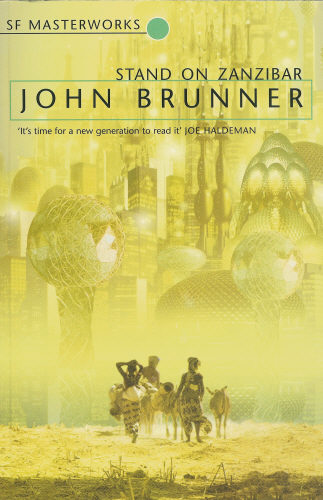
John Brunner - Stand on Zanzibar


Another classic science fiction novel that I never knew existed.  Written in 1968, Stand on Zanzibar is set in a crowded, decolonized early 21st century.  The world is filled with mass-market psychedelics and eugenic legislation, overstimulated and disney-fied in a way that hits pretty close to home.  The world's crowded cities are terrorized by "muckers," or people driven to the point of berzerk killing sprees.  Brunner's vision is on the level of a Philip K. Dick in terms of sheer affectual prescience.

The novel contains several narrative threads, interspersed with commercials and other snippets from the infosphere, as well as vignettes that act as character sketches of various dysfunctional relationships (usually centered around attempts to circumvent eugenics laws).  Other sections are polemics, written in the voice of Chad Mulligan, who can perhaps best be described as stand up comedian channeling Vonnegut.

The two main plot lines involve a propaganda campaign by a Southeast Asian archipelago claiming that they will genetically modify their next generation to breed a perfect species, and a series of negotiations between a large US corporation and a small African ex-colony which is mysteriously free of violence, and whose people have had a reputation for witchcraft stretching back into prehistory.

The novel is scathing and quite funny.  I find most satire to be a bit cringe-inducing, but Brunner pulls off his tone with an aplomb that reminds me most of David Foster Wallace.

Paul Gilding - The Great Disruption


There is a war coming.

In this book, Gilding tries to articulate a way out of the mess we're in - he says, in essence, "if we're going to solve these problems, here's what it will look like."  He argues that the coming crisis will initiate a response from the first world directly analogous to that of the second world war, in which enormous swaths of first world economy were nationalized and repurposed to the war effort.  It is this wartime economy, with an emphasis on efficiency and frugality, that will allow us to orchestrate a crisis management response to the collapse that we are now far too late to head off with more gradual efforts.

While much of the material covered in the book is not new to me, Gilding's experience as first an environmental activist with Greenpeace, and later as a environmental consultant who has worked with people like the CEO of DuPont, provides a perspective that is more of an insider's view.

I think the most important point that I drew from this book was his argument that we cannot fight a war on two fronts.  The first front is the radical and transformative restructuring of our political and economic systems that will allow the creation of a sustainable and steady-state (as opposed to growth-focused) economy.  The second is the direct response to the chaos and violence that will make the conflict of the twentieth century look like a gentlemanly session of fisticuffs.  Since the vested interests of the current establishment will, like any hegemony, fight to protect its power, we need to find a way to in the short term harness the old capitalist system to fight the Carbon War, in a concerted effort that will in turn bring about the systemic transformation that we need so desperately.

While I don't know if I share Gilding's optimism, his analogy to the war-time effort of WWII is thought provoking (he notes that military spending went from 3 percent of GDP at the beginning of the war to 39 percent at the end, in a time when the GDP as a whole increased by 75 percent.)  If we can accomplish something similar, along with a total paradigm shift in the consciousness of the first world which will divert our collective activity away from mindless consumption, there may still be hope.

Saturday, February 4, 2012

The Stars Look Down

This novel, by Scottish physician and author AJ Cronin, is a powerful and emotional account of the plight of coal miners in Wales, interweaved with moving stories of struggles between people with different values.

The story begins cruelly with the miners returning to work after a lengthy and unsuccessful strike that has caused substantial hardship, to the point of desperate hunger. Robert Fenwick led the strike to obtain changes he felt essential for the miners' safety, but is now scorned by the miners and his own wife. Inevitably, the disaster he foresaw does occur: the miners break through a barrier into an underground reservoir, flooding the mine. Over 80 miners are quickly drowned, while Robert, with controlled intelligence and courage, leads his son Hughie and 10 others to safety into an old portion of the mine. They become trapped, however, by tons of collapsed tunnel and must wait for rescue. As days pass, first lit by candlelight and eventually in darkness, the miners die one by one. The account of the deaths by drowning, though short, is vivid and chilling; the drawn out description of the deaths of the trapped miners is harrowing.

Over the next decades, the story reveals the effects of this disaster on Robert's idealistic son Davey, on Arthur, the tortured son of the domineering and rapacious mine owner, and on Joe Gowlan, who flees the mines to become a successful and powerful war-profiteer. SPOILERS: Davey fights for miners' rights by striving to promote nationalization of the mines. Eventually elected to Parliament, Davey becomes a prominent miners' advocate, but the crushing realities of politics as usual and the influence of well-heeled capitalists defeat his efforts. After his father is debilitated by a stroke, Arthur uses the mine's astonishing war profits to initiate massive improvements. Crushingly, his outlays, coupled with economic downturn, lead him to the brink of bankruptcy, while his perceived weakness and the disregard for miners shown by politicians and other mine owners, make him an object of scorn rather than appreciation among the miners. The despicable Gowlan succeeds in business beyond his wildest dreams, makes massive amounts of money during the war, and eventually defeats Davey's attempt to be re-elected to Parliament.

Written in 1935, the book expresses a view of capitalism that resonates with present conditions:
At last, through their constitutional hidebound apathy, people were beginning to question the soundness of a political and economic system which left want, misery and unemployment unrelieved. New and bold ideas went into circulation. Men no longer retreated in terror from the suggestion that capitalism, as a system of life, had failed.
At book's end, both Davey and Arthur are back in the mines, working under Gowlan. Jeez, this sounds depressing! The fundamental inequalities and unfairness of British society depicted here are leavened, however, by the rich interpersonal relationships, which provide many heart-warming and heart-rending incidents. Moreover, Davey convincingly achieves individual fulfillment, even as his professional ambitions are thwarted, and the book ends on an optimistic note. Very highly recommended!

Sunday, August 21, 2011

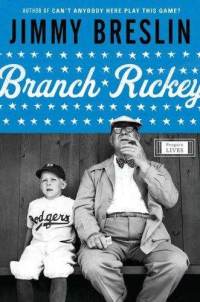
Branch Rickey by Jimmy Breslin

This quick, pleasurable read sketches the very interesting life and character of Branch Rickey, for many years the general manager and part owner of the St. Louis Cardinals and Brooklyn Dodgers and the man who single-handedly integrated major league baseball by recruiting Jackie Robinson and, immediately after, Don Newcombe and Roy Campanella. Breslin is a master of the lively anecdote and a shrewd commentator on American life - highly recommended!

Monday, January 3, 2011

Anna Karenina

Another post on a book I read a year ago, so my thoughts are not as fresh. However, I have thought about the book a lot since then so have more broad-picture type comments.

Anna Karenina is one of the best books I have ever read. Tolstoy's writing is incredibly realistic, complex, deep, moving, and beautiful, and his thinking is prophetic. For me, the best things about this book are:

1. The complexity, coherence and realism of the world that Tolstoy invents. His writing comes as close to representing reality on paper as I can imagine is possible, and he does this in such a way that it feels completely natural. It is also fascinating: he knew such an immense about about so many things! Horse keeping, hunting, domestic life, business affairs, fashion, politics, relationships, gambling, agriculture, adultery, etc, etc. - all topics on which Tolstoy writes in depth and with ease.

2. The complexity, understanding and sympathy with which Tolstoy regards humanity: from the peasant to the nobleman and from the virtuous to the amoral, Tolstoy seems to understand everyone. The grace with which he is able to portray the inner life of various individuals is unparalleled. Anna Karenina is the greatest exception to this sweeping realism: for me she felt (at times) flat and under-explored, which was disappointing. Lyovin, on the contrary, is shockingly real, perhaps aided by the near-autobiographical nature of his character (by many accounts).

I cannot recommend this book highly enough.

Fathers and Sons


I realized I never made this post, even though I read the work last Christmas, so here goes: my thoughts on Turgenev's (1862) Fathers and Sons (Отцы и дети is actually Fathers and Children, although it's true that I don't recall any daughters in the novel).

This book is truly genius. I think of it often. The two generations under discussion are the Fathers (1840s) and Sons (1860s). The book describes (primarily male) family and friend relationships and the way that these interactions evolved during a time of major social change: the emancipation of the serfs occurred in 1861 and freed millions of people from serfdom, causing great upheaval in landed/aristocratic families and in society. The Fathers and Sons represent conflicting ideologies which are very interesting to consider, because their opposition foreshadows the 1917 revolution.

One of the two primary Sons in the book is Arkady Nikolaevich Kirsanov. He has recently graduated from St. Petersburg University where he became friends with a man named Bazarov. The Sons' values are boldly and at times offensively embodied by the larger-than-life Bazarov, a loud-mouthed, frog-dissecting, arrogant nihilist. These values include: egalitarianism, nihilism, and rejection of sentimentality and of bourgeois values.

The book begins with Arkady taking his friend Bazarov home to meet his father, the sensitive land-owner Nikolai Petrovich Kirsanov. Although Nikolai is one of the Fathers, he is liberal for his generation, and as an educated and thoughtful man is trying to make sense of and in some ways assimilate the liberal values of the youth while holding onto his appreciation of literature, the arts and the beauty of nature.

The conflicts in this book are fascinatingly timeless and really bear thought. Although I was not bowled over when I first read the book a year ago, it has been on my mind very frequently since and I have come to appreciate it very much.

Friday, December 31, 2010

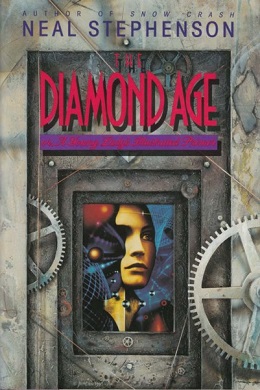
The Diamond Age or, a Young Lady's Illustrated Primer

Recently read Neal Stephenson's The Diamond Age, a novel set in a futuristic society (maybe ~100 years from now) in China. Whether this book presents a dystopian or utopian vision is unclear, maybe it shows both, although the dystopian aspects (callous brutality, pervasive misogyny) are more salient.

Background (no spoilers):

In this society, nanotechnology has become the dominant means of production. (Many buildings are built out of man-made diamond because it is hard and durable, hence the title). Stephenson's novel is Marxist in that he posits a world in which the social structure arises from the means of production. Matter Compilers, or MCs, create food, clothes, etc. using molecular blueprints downloaded from a central government server. This top-down means of production makes poor people dependent on the government for their existence.

Most people are divided into phyles (aka claves) which are essentially tribes which live together in different parts of the city. One prominent phyle is that of the "Vickys" - neo-Victorians who have consciously adopted Victorian dress, mannerisms and social codes, believing that this is preferable to the amoral degeneracy of prior centuries (i.e. our time). The poor are the exception to this structure; they have no phyles, and lead lives that are nasty, brutish and short.

Nanotechnology has also become a means of ugly warfare and supports a bizarre justice system which combines Confucian principles with nanotech-based methods of execution. Rogue nanotech experts develop their own micromachines in defiance of the government's prohibition, and use them to spy, track, and kill.

My take on it:

I really, really enjoyed the first half of this book. Stephenson's vision is brilliant: complex, detailed, strikingly creative and novel, and powerful. It is also very pleasurable to read. However, I found the second half of the book chaotic and the ending unrealistic and anticlimactic. I was also troubled by the book's at times graphic misogyny, which does not seem to serve any purpose beyond reinforcing the brutality of the world. However, I highly recommend it because it is truly novel and gripping and introduces many fascinating ideas.

Stephenson's Novels

Sunday, November 29, 2009

The Age of Innocence


This is the second Edith Wharton novel I've read, in Folio editions. Lovely books, with wonderful illustrations, but Wharton's critiques of Old New York Society are severe, with likable, if flawed, people being directed or even crushed by forces beyond their control. Age of Innocence, beautifully and powerfully written, does end on a more balanced note than House of Mirth, which was truly tragic. Recommended.