Showing posts with label farmers. Show all posts

Monday, October 19, 2020

Love and War in the Apennines

Love and War is Eric Newby's account of his experiences after being captured in Italy during World War II.  He was initially confined, along with other POWs, to an orfanotrofio (orphanage) in Fontanellato in the Emiglia-Romagna region.  The Armistice (really a surrender) of Italy to the Allies was declared two weeks before the Allies actually arrived in force, allowing the Germans to immediately send forces into Italy to prepare for the Allied invasion.  Accordingly, when Newby and the other POWs were released, they fled into the countryside to avoid being recaptured by the incoming German forces.  

Newby's story, then, describes his experiences of being harbored by the Italian farmers and mountain people who, at great risk to themselves, assisted him, out of their admirable humanity and because they hated the Fascists.  Newby is humbled by their courage and generosity and views his experiences with sympathy and humor. 

Here are a couple examples of the humor:

Drink and supplementary food were bought on the black market, which was even more extensive and better organized than it was in Britain, and a special float of Red Cross cigarettes was kept for this purpose, and for the general corruption of the Italian camp staff, by responsible members of the British administration, ex-bank managers mostly, to whom this sort of thing was second nature.

She used to tell me the latest news about my friends………how one officer whose identity I never discovered had been hidden in the castello of a local principessa who had been so impressed by his girlish face that she had the brilliant idea of dressing him as a young woman of fashion and putting him on a train to Switzerland.  This she had done but, unfortunately, he looked so desirable on the train that some soldiers had “interfered” with him, as the News of the World used to put it, and discovered the truth, although one of them got punched hard on the nose in the process of doing so.

And, in an example of the humanity and generosity of the Italian country people, one evening, a few days after the Germans had made a surprise raid to search for hidden enemy soldiers or Italian deserters, Newby was invited to a dinner with some important people in the town.  This was dangerous and he had to take special care to arrive unseen. 

I was motioned to take a seat and a glass of wine was poured for me. There was no small talk. The Chairman of the Board, for that was obviously what he was, said carefully and very slowly so that I could understand, "We have been talking about you among ourselves for some days. Many of the people in this village and in the farms round about have sons and relatives who are being hunted by the Germans.  Three of them were taken the other day. Some of them have sons in Russia of whom, so far, there is no news and who may never return. They feel that you are in a similar condition to that of their sons who, they hope, are being given help wherever they are , and they think it is their duty to help you through the coming winter, which otherwise you will not survive. I speak for them because my father was born here, and they have asked me to do so. And as it has now become too dangerous to shelter you in their houses, they have decided to build you a house which no one except the people assembled in this room, our families and one other person, and he is a kinsman, will ever hear about. The work will begin at dawn tomorrow".

The descriptions of where the home was to be located and how it was built are extraordinary.  A truly wonderful book.

Friday, August 8, 2014

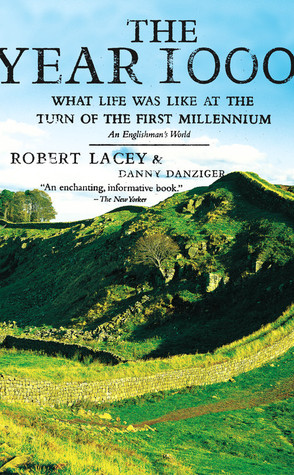
The Year 1000

This extremely charming book about life in the year 1000 is organized around the 12 months of the year, and the activities that were typical of that month. It is densely packed with fascinating information, and is extremely readable. Many fascinating facts in this book and I highly recommend it to everyone!

The first page of every chapter bears that month's illustration from the Julius Work Calendar, such as these:

Sunday, January 26, 2014

An Edible History of Humanity - Tom Standage

An Edible History of Humanity was sort of entertaining, as it contains lots of colorful anecdotes, but much of it felt like a less substantive (and very derivative) version of Pollan's Omnivore's Dilemna (cf the discussion of corn). Moreover, I came away feeling like behind his pseudo-intellectualism, Standage is either really ignorant, or sort of a schmuck. His political beliefs, when they show through, are disturbing.

For example, Standage describes several instances of famines in which the native community starved, while exporting their food for consumption by wealthy foreigners.* However, evidently without realizing the irony in his position, Standage remains shockingly, unabashedly colonialist - he explains the danger of the current popularity of "local food" by stating that, "an exclusive focus on local foods would harm the prospects of farmers in developing countries who grow high-value crops for export to foreign markets. To argue that they should concentrate on growing staple foods for themselves, rather than more valuable crops for wealthy farmers, is tantamount to denying them the opportunity for economic development." I was dumbfounded when I read this... Below I have excerpted only 2 of several passages where Standage plainly describes the misery that results when poor farmers grow crops for wealthy foreigners, but this does not seem to have shaken his ideology.

He also extensively lauds the virtues of nitrogen farming while devoting exactly 1 paragraph to its dangers, trivializes the organic movement, and is a bit over-the-top in his rah-rah Capitalist, anti-Communist jingoism ("Is it a coincidence that the worst famine in history occurred in a Communist state?"). He's the business editor at the Economist, so maybe that explains it?

Anyway, I wish he would take some time out from copying Pollan's rhetoric to read a little Chomsky.

Sigh!

* On p.135, he states that "by the early 1840s, imports from Ireland were supplying one sixth of England's food. This food was produced by men who worked on the best, most easily cultivated land and were typically given small patches of inferior land on which they grew potatoes to support themselves and their families. The English could only keep eating bread, in short, because the Irish were eating potatoes." He later describes, on p.188, how under Mao in China, "the main cause of the famine was not inadequate food production so much as the farmers' lack of entitlement to it. The food they produced went to feed people in the cities, Party officials, and foreigners."

Thursday, December 26, 2013

House of Earth

Woody Guthrie's only full-length novel, written in 1947, languished in a closet until ferreted out by author Douglas Brinkley and actor Johnny Depp, who edited it and brought it to publication.  The interesting backstory is available in a NY Times story and a very nice piece from NPR.

The novel tells a bit of the story of the dirt-poor,  farming couple Tike and Ella May Hamlin.  Tike and Ella May are struggling to make a home for themselves, struggling against the harsh midwest dustbowl conditions and the even harsher exploitation of bankers, politicians and landowners.

The book is one of the most interesting, least interesting books I have ever read.  It falls into the category of least interesting because there is very little plot - essentially nothing happens for 150 pages, until the story of Ella May's childbirth is told - which ends the book.  The cornerstone of the book is the dream of building a house of earth - one made from the very earth they live on, out of adobe bricks, as described in a government pamphlet that never leaves Tike's body.  The thick, solid walls of the house of earth would provide protection against the elements  - and also insulation from the exploiters, as it could be built at little cost, through their own labor.  At the conclusion of the book, the house of earth remains a dream, though perhaps one that could be realized in the future.

Of least interesting books, though, House of Earth is one of the most interesting!  The voice of Woody Guthrie is very distinctive - descriptive words and events are strung together in near rhyming, streams of consciousness - and these drones of words sometimes convey powerful emotions or evocative portraits of the land and life of Tike and Ella May.  It is also surprising that the 1947 book is very frank, sexually.  Not lurid, but definitely earthy and very human.  Interestingly, one of the thousands of songs written by Woody Guthrie is entitled House of Earth - and this song asserts that prostitutes play a valuable role:

Come here to my house of good rich earth if you
Would like me teach your wife a thing or two.