Thursday, September 19, 2019

A Legacy of Spies

Written in 2017, this is an interesting sequel to The Spy Who Came in from the Cold, Le Carré's breakout novel published in 1963, at the height of the Cold War.  The Spy Who Came in from the Cold was a masterpiece,  a dark portrayal of the cynical ends-justify-the-means view of the espionage services on both sides of the Cold War.  A Legacy of Spies revisits the events of The Spy Who Came in from the Cold from the perspective of 50 years afterwards: the children of Alec Leamus and Liz Gold (the protagonists of Spy), now grown and deeply embittered, attempt to sue and/or extort the British Secret Service (and especially the very likable Peter Guillam, right-hand junior to George Smiley) for the wrongs done to their parents. 
This backward look is an interesting idea (see Le Carré's piece in The Guardian on how he came to write Spy), and it does effectively highlight some cultural changes in attitudes toward secret services, but the issues at stake are not as powerful as those in almost all of Le Carré's other books and, accordingly,  I did not find it as satisfying. 

Monday, September 16, 2019

Just Kids


I really enjoyed Just Kids by Patti Smith (thanks to Jillian!), which is full of vivid anecdotes, gritty wisdom and the story of her very close relationship/lifelong friendship with Robert Mapplethorpe. I’d call it a rags-to-richness story…richness, less in the sense of wealth than in the variety of her experiences, her achievements and the astonishing number of accomplished, interesting people she met or became friends with.  In all of this, she remained an unusually simple and fresh person.  Here’s a small but surprising example of her openness (although taken from M Train, rather than Just Kids):
September was ending and already cold. I was heading up Sixth Avenue and stopped to buy a new watch cap from a street vendor.  As I pulled it on an old man approached me.  His blue eyes burned and his hair was white as snow.  I noticed that his wool gloves were unraveling and his left hand was bandaged.
 --Give me the money you have in your pocket, he said.
  Either I am being tested, I thought, or I have wandered into the opening of a modern fairy tale.  I had a twenty and three singles, which I placed in his hand.
 --Good, he said after a moment, and then returned the twenty.
  I thanked him and continued on, more buoyant than before.
Patti’s  openness unlocked paths that remain invisible to more conventional souls (me).  Like, she goes to a Holy Modal Rounders concert and becomes interested in the drummer, Slim Shadow:: “..and as he slammed the drums, I thought, This guy truly embodies the heart and soul of rock and roll. He had beauty, energy, and animal magnetism.”  She decides to write an article about him for the rock magazine Crawdaddy, and, over the autumn months, they start seeing each other, as friends.  As winter comes, the impoverished Patti becomes anemic and her doctor advises her:
…to have red meat and drink porter, advice given to Baudelaire when he trudged through a winter in Brussels sick and alone.  I was a bit more resourceful than poor Baudelaire.  I donned an old plaid coat with deep pockets and lifted two small steaks from Gristede’s, planning to fry them in my grandmother’s cast-iron pan over my hot plate.  I was surprised to run into Slim on the street and we took our first non-nocturnal walk.  Worrying the meat would go bad, I finally had to admit to him I had two raw steaks in my pocket.  He looked at me, trying to detect if I was telling the truth, then slid his hand in my pocket and pulled a steak out in the middle of Seventh Avenue.  He shook his head in mock astonishment, saying “Okay, sugar, let’s eat.”
  We went upstairs and I fired up the hot plate.  We ate the steaks out of the pan.
Slim becomes concerned about Patti’s health and takes her for a lavish lobster dinner at Max’s Kansas City.  Patti begins to worry that this “handsome hillbilly might not have the money to pay the check.”  But a stunned friend of Patti’s sees her with Slim and, motioning her to meet in the ladies’ room, saying “Honey, you don’t know who he is?”  She soon informs her that “Slim” is Sam Shepard: “he’s the biggest playwright off-Broadway. He had a play at Lincoln Center.  He won five Obies!”

The heart of the book, though, is the story of the remarkable friendship/partnership between Patti and Robert Mapplethorpe, a friendship that seemed fated from the beginning.  For many years, they lived together, collaborated on art projects, and were true friends until Mapplethorpe’s death from AIDS.  Early in the book, Patti says
We headed home holding hands.  For a moment I dropped back to watch him walk.  His sailor’s gait always touched me.  I knew one day I would stop and he would keep on going, but until then nothing could tear us apart.
Just Kids is Smith’s tribute to Mapplethorpe and their friendship and it’s funny, fascinating, and deeply touching.

NB:  9-19-2019 NY Times just ran a piece on Patti Smith

Saturday, September 7, 2019

Update on A Delicate Truth by John Le Carré

Just re-read a 2013 Le Carré, which I had read and liked when it first came out, but had not been particularly struck by.  But this time, it hit me harder.  One of the prefatory quotes, from Oscar Wilde, was "If one tells the truth, one is sure, sooner or later, to be found out".  And without specific spoilers, the book deals with the aftermath of an operation gone very wrong and briskly covered up.  A key player, in both the operation and the cover up, is Jay Crispin, a trader in mercenaries. Here's an assessment of Crispin by our protagonist, Toby:
And for sure, wrestling with his disgust and anger, and determined as usual to reduce them to a manageable level, he gave due thought to Hannah Arendt's concept of the banality of evil, and launched into a debate with himself about where Crispin fitted into her scheme of things. Was Crispin, in his own perception, merely one of society's faithful servants, obeying market pressures?  Maybe that was how he saw himself, but Toby didn't.  As far as Toby was concerned, Jay Crispin was your normal, rootless, amoral, plausible, half-educated, nicely spoken frozen adolescent in a bespoke suit, with an unappeaseable craving for money, power and respect, regardless of where he got them from. So far, so good. He had met embryonic Crispins in every walk of life and every country where he had served: just never until now one who had made his mark as a trader in small wars.
In a half-hearted effort to find excuses for Crispin, Toby even wondered whether, deep down, the man was just plain stupid. How else to explain the cock-up that was Operation Wildlife? And from there, he wandered off into an argument with Friedrich Schiller's grandiose statement that human stupidity was what the gods fought in vain.  Not so, in Toby's opinion, and no excuse for anybody, whether god or man. What the gods and all reasonable humans fought in vain wasn't stupidity at all. It was sheer, wanton, bloody indifference to anybody's interests but their own.

Thursday, August 22, 2019

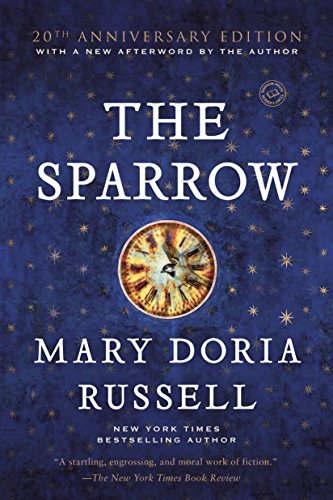
The Sparrow - Mary Doria Russell

I read The Sparrow on a recommendation from Mark's sister, Kelly, who said it is her favorite book. WOW! It is a masterpiece. Totally brutal without being vulgar, and wholly fresh and unexpected.

The story is told from both ends - an idealistic Jesuit monk bonding with his close-knit group of friends, and this same monk, broken almost beyond recognition, after his return from a first-contact mission gone horribly awry.

I don't want to say too much lest I spoil anything, but this is definitely a first-rate book, which I highly recommend! It is rough but very powerful and poignant.

Jesse's review here
Dad's review here

Sunday, August 18, 2019

The Neapolitan Novels


Like millions of others, I found Elena Ferrante’s Neapolitan novels (My Brilliant Friend, The Story of a New Name, Those Who Leave and and Those Who Stay, The Story of the Lost Child) to be fully absorbing and addicting – I don’t say riveting, as many times I alternated between can’t put it down and can’t keep reading. The four books comprise a single, long story of the lifelong, deep and conflicted relationship between two girls, Elena (or Lenù), the narrator, and Rafaella (Lila).  The girls grow up in a poor and violent neighborhood of Naples, from the 1950’s to 2014  – the pervasive violence is not always due to the activities of the camorra, the “secret” crime syndicate that was widespread in Campania, but is embedded in the families and neighborhoods, and especially in the relationships between men and women. 
I was angry.  I said, “You want to use me to con them?”

She understood that she had offended me.  She squeezed my hand hard. “I didn’t intend to say something unkind.  I meant only that you are good at making yourself liked.  The difference between you and me, always, has been that people are afraid of me and not of you.”

“Maybe because you’re mean,” I said, even angrier.

“Maybe,” she said, and I saw that I had hurt her as she had hurt me.  Then, repenting, I added immediately, to make up: “Antonio would get himself killed for you: he said to thank you for giving his sister a job.”

“It’s Stefano who gave the job to Ada,” she replied. “I’m mean.”
The relationship between Lenù and Lila is synergistic – on her own, Lenù is book-smart, but a striver, who says she is only fully alive and most creative when working with, or stimulated by Lila.  In contrast, Lila is strong, exceptionally creative and fiercely independent, but seems to seek and need the validation of her accomplished friend.  And their lives and friendship are framed in the books within the larger currents of Italian political and social life, which are fully and grippingly explored.  Still, there are key events in the books whose meaning and significance I cannot quite grasp but which remain in my mind long after closing the books.  Fascinating books!
-->

Saturday, July 27, 2019

One Hundred Poems from the Japanese


Kenneth Rexroth was a highly-regarded poet and influential leader of the San Francisco School of poets in the 1950’s (but he pleaded innocent to the suggestion that he was a Beat Poet!)  In One Hundred Poems from the Japanese, he offers a history of Japanese poetry from the significant period of the 700s to the late 1100s, through translations of the works of major figures.  All of the poems are short, characteristic of Japanese poetry; haikus were a later form that Rexroth did not value as highly, and he offers only a few famous examples in an appendix). 

Many of the poems, read alone, are strikingly lovely and/or thoughtful:
When I left my girl
In her grave on Mount Hikite
And walked down the mountain path,
I felt as though I were dead.
The meaning and significance of the poems is immensely enhanced by Rexroth’s introduction and by notes on many of the poems, discreetly located at the end of the book.  I had been unaware of some important themes and devices that, when explained by Rexroth, opened entirely new perspectives on what had seemed to me to be beautiful but simple moments in nature:
Though the purity
Of the moonlight has silenced
Both nightingale and
Cricket, the cuckoo alone
Sings all the white night
In a note, Rexroth briefly explains the significance of the different birds in Japanese literature; for example, the cuckoo “is also supposed to be a spirit from Hell, and, again, symbolizes the pleasures of the flesh, courtesans and prostitutes, sacred and profane”.  He suggests that this poem could mean “The salvation of Buddha has enraptured both the householder and the monk or nun, but the prostitute worships in her own way, all through the night.”

A very rewarding book.

Thursday, July 11, 2019

Crazy Loco | Stories by David Rice

This is a funny, sweet, wise, loopy book of short stories about kids growing up in Mexican-American families in South Texas.  Laughed and cried.  Wonderful.