Showing posts with label historical fiction. Show all posts

Sunday, February 28, 2021

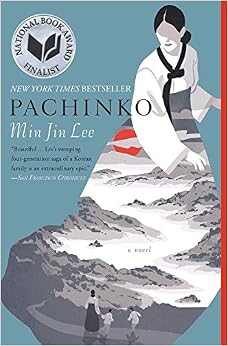
Pachinko - Min Jin Lee

Our March bookclub book was Pachinko, and WOW, it was fantastic!! The best book I've read in a long time. It tells the story of one Korean family across 4 generations, from their roots in Korea in 1883, to their lives in Japan up through 1989. 

Before reading this novel, I was ignorant of Japan's occupation of Korea, and the way Japan oppressed Korean expats after the war. (I had been aware of the shameful history of conscripted "comfort women," but not the broader context of colonization,  oppression, and forced assimilation). This ugly history is not exactly the center of this story, but it is its pervasive backdrop, and influences all of the major events in the family's lives.

The story is beautiful and heartfelt, and although parts are truly heartbreaking, it was a pleasure to read, because of the fascinating characters and their resiliency and even success, despite the many hard years of their lives. The author is clearly a brilliant observer of human nature, as her character studies read so true. The character Sunja is perhaps the central figure, as the story follows her life from young girl to septuagenarian grandmother, and her clear-eyed view of the world is deeply compelling. I would strongly recommend this book to all!

Sunday, May 28, 2017

The Enchantress of Florence

This is a lush book, with bravura writing, that weaves a magical and captivating tale together with historical events and figures.  A charismatic and beautiful young man arrives in Mughal India from Florence with an outlandish tale of presumed relationship to Akbar, the all powerful ruler. Is his implausible story true, entitling him to become part of the ruling family, or is he a likable and immensely gifted con man, who should perhaps be put to death?
When the sword of the tongue is drawn, the emperor thought, it inflicts deeper cuts than the sharpest sword.
The power of artistic creation is a central to the book, in small ways:
the court's musical genius Tansen had gone so far as to create a raag in the two courtesan's honor, the raag deepak, so called because when he played it for the first time in the House of Skanda the sorcery of the melody made unlit lamps burst into flame.
And in major themes: The emperor, through the power of his imagination alone, creates one living, perfect wife, visible to him and a few others, who is eventually replaced by Qara KÖz, Lady Black Eyes, who had died more than a century previously.  

The book is a pleasure to read, in its historical range, bursts of humor, mordant views of  man, and celebration of artists.


Monday, February 20, 2017

Kindred - Octavia Butler

Kindred is unlike anything I have read before. Set in the 1970s, it is the tale of a modern Black woman living in California who suddenly begins to experience involuntary time travel episodes to antebellum Maryland. Each time Dana is transported to the past, she arrives at a moment of extreme peril for a young plantation owner's son named Rufus Weylin. Repeatedly saving Rufus' life leads them to develop an unlikely bond, but as Rufus gets older and takes over running the plantation (and its many slaves), and as Dana gets sucked into the past for longer and longer stays, she learns first-hand the ugly realities of slavery and the complexity of the relationships it breeds. A truly remarkable and original tale, offering a very compelling first-person account of a cruel and strange time in American history. Powerful and a must-read, in my opinion.

Saturday, January 7, 2017

The Invention of Wings

Very compelling historical fiction.  Sue Monk Kidd was startled to discover, at a theatrical performance celebrating the unsung contributions of women, that two sisters, Susan and Antonio Grimke, were towering figures in the history of both the anti-slavery and feminist movements and had grown up in Kidd's hometown of Charleston -  yet she had never heard of them.  Monk's research produced this powerful and lyrical story that brings to life the sisters - especially focusing on Susan, who believed she was being encouraged by her father, a very respected jurist, to pursue the law as a career and become the first female attorney and judge in Charleston - her spirit was nearly broken by the shattering of this dream when her father and respected brother told her in no uncertain terms that this was an ludicrously impossible and inappropriate dream.  Then, on her 11th birthday, following a tradition in the family, her mother "gave" her a slave, Hetty, called "Handful," as a birthday "present" - horrifying Susan, who wishes to set the girl free.  The Invention of Wings follows the separate lives of Susan and Handful and also their relationship, which is close but blighted by the injustice and horror of slavery.  This is both a very absorbing human story and an informative and powerful account of the impact of slavery. Thanks to CH for suggesting this book!  Highly-recommended.

Sunday, August 9, 2015

Wolf Hall

The fascinating and captivating first book of the Cromwell Trilogy, by Hilary Mantel.  Cromwell rises from low birth to influence, first as right-hand man of the powerful Cardinal Wolsey, then as advisor to Henry VIII.  Wolf Hall deals with Cromwell's successful efforts to help Henry arrange his marriages in attempts to assure an heir, and in his quest to gain control over the Church.  The latter struggle highlights Cromwell's rivalry and differences with Thomas More.

The character of Cromwell is intriguing:
Thomas Cromwell is now a little over forty years old....It is said he knows by heart the entire New Testament in Latin, and so as a servant of the cardinal is apt - ready with a text if abbots flounder.  He speech is low and rapid, his manner assured; he is at home in a courtroom or waterfront, bishop's palace or inn yard.  He can draft a contract, train a falcon, draw a map, stop a street fight, furnish a home and fix a jury.  He will quote you a nice point in the old authors, from Plato to Plautus and back again.  He knows new poetry and can say it in Italian.  He works all hours, first up and last to bed.  He makes money and he spends it.  He will take a bet on anything.
There are keen observations, as in this description of Anne Boleyn:
Her eyes passed over him on their way to someone who interested her more.  They are black eyes, slightly protuberant, shiny like the beads of an abacus: they are shiny and always in motion, as she makes calculations of her own advantage.
And the book is frequently laugh out loud funny. Here's Wolsey's description of Cromwell:
And he will have to take you as you are, which is rather like one of those square-shaped fighting dogs that low men tow around on ropes. Not that you are without a fitful charm, Tom.
Of interest to us, here's a comment on our (possible) ancestor:
The Londoners say - and he reckons the Londoners know - that it was on Howard's watch that the princes were last seen; though Thomas More thinks it was Constable Brakenbury who handed the keys to the killers.  Brakenbury died at Bosworth; he can't come out of his grave and complain.
In short, highly recommended!  Thanks to Karen Elizabeth for giving me this can't-put-it-down read!


I couldn't put Wolf Hall down, really, so when I reached the end, I immediately replaced it with the second in the intended trilogy, Bring Up the Bodies - the equally absorbing continuation of the story of Thomas Cromwell. Again, fascinating portrayals of power, ambition, lust and intrigue. Hilarious in brief spots, everywhere thoughtful, and sharp insights into human interactions.  Now I'm going to Google to see when the final volume is due!