Sunday, November 29, 2009

The Age of Innocence


This is the second Edith Wharton novel I've read, in Folio editions. Lovely books, with wonderful illustrations, but Wharton's critiques of Old New York Society are severe, with likable, if flawed, people being directed or even crushed by forces beyond their control. Age of Innocence, beautifully and powerfully written, does end on a more balanced note than House of Mirth, which was truly tragic. Recommended.

Tuesday, November 17, 2009

Measure for Measure

In my Shakespeare class we recently read the "problem comedy" Measure for Measure. The action of Measure for Measure commences with the Duke’s reflection that due to lax law enforcement in the city of Vienna, “liberty plucks justice by the nose/…and quite athwart/ Goes all decorum” (I. iii. 29-31). Believing himself to blame, the Duke decides that he cannot be the one to discipline the citizens, and thus decides to temporarily leave Vienna and appoint the austere Lord Angelo as deputy in his place, to restore order to the city through strict punishment. In fact, the Duke only pretends to leave the city, but remains behind disguised as a Friar. Angelo’s first act is to sentence a young man, Claudio, to death for fornication. When Claudio’s sister, a young postulant nun named Isabella, comes to Angelo to plead for his release, Angelo becomes passionately enraptured by her. I won’t give away more, but suffice to say, this play is full of surprises, including a “bed trick” and a “head trick.” The play is dark and disturbing but excellent, and I had the pleasure of watching it performed by the Reed theatre. I highly recommend it.

Sunday, October 25, 2009

A Year in Provence

Light, wry, humorous and filled with an appreciation of humanity. A sweet read. Highly recommended

Thursday, October 15, 2009

The Master of Ballantrae


Just finished this great Robert Louis Stevenson book. The blurb: "Set at the time of the Jacobite uprising, The Master of Ballantrae tells of a family divided". Boy, are they ever! "The intensity of the feud between the Durrisdeers, and the portrait of James - an incubus 'touched with the lurid flickerings from the Pit' - draws upon the deepest, darkest corners of Stevenson's imagination". I loved it. Interestingly, James repeatedly changes from charmer to tormentor - rather like the dramatic but convincing changes in the character of Long John Silver. And this comparison made me realize how strong a theme this is in Stevenson - the entire subject of Dr. Jekyll and Mr. Hyde - and a particularly fascinating theme for me personally. Gripping tale - great read!

Saturday, September 26, 2009

Demons (formerly translated as The Possessed)

Finished reading Dostoevsky's "Demons" (1872) for my Russian lit class. I am huge fan of Dostoevsky, and although this is not my favorite of his works, it was still highly enjoyable. Set in a provincial Russian town in the late 19th century, "Demons" chronicles the banal intrigues of a band of revolutionary conspirators and the madness they incite in the townspeople. The novel is based in part on the real-life political murder of Ivan Ivanovich Ivanov and seeks to deride the various ideologies prominent at the time. Written about 50 years before the October Revolution, Dostoevsky's characterization of the revolutionaries is shockingly prophetic in some places.

Definitely recommend, particularly if you liked:
--"The Master and Margarita" (1940), by Mikhail Bulgakov, which is heavily influenced by this work
--"Petersburg" (1913, 1922), by Andrei Bely, also heavily influenced by Demons

The Life of Archpriest Avvakum by Himself


Autobiography of Avvakum (1621-1682), "a Russian protopope of Kazan Cathedral on Red Square who led the opposition to Patriarch Nikon's reforms of the Russian Orthodox Church. His autobiography and letters to the tsar, Boyarynya Morozova and other Old Believers are considered masterpieces of 17th-century Russian literature." (excerpted from the Wikipedia article).

(The painting is The Burning of Avvakum (1897), by Grigoriy Myasoyedov.)

This autobiography is short and truly delightful to read. It is unique among old Russian literature for the "vigorous, clear, and laconic style." Avvakum's opposition to the reforms of Nikon is incredibly strong, and at one point he refers to Nikon as the "anti-Christ." This probably doesn't sound that appealing to most people, but I really highly recommend it to all!!

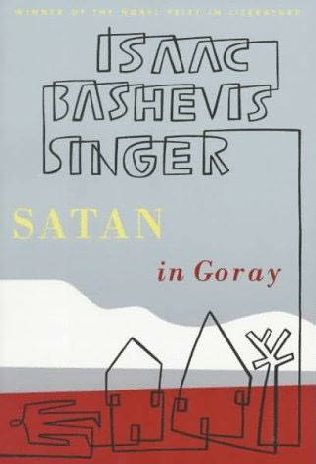
Satan in Goray

Just finished reading Isaac Bashevis Singer's "Satan in Goray" for my Russian lit class, Literature of Destruction. The novel was written in Yiddish in 1955.

This apocalyptic novel takes place in 1648 in Goray, Poland. Goray is a small Jewish town "at the end of the world" (a deliberately ambiguous phrase, it can mean either temporally or spatially or both). Many of the Orthodox residents become convinced that the end of the world is at hand after hearing news of Sabbatai Zevi, a rabbi who has proclaimed himself the Messiah. Zeal for the end of days leads Goray into depravity and madness.

This book is fantastic, I highly recommend it! I particularly recommend it if you liked:

-- "Everything is Illuminated," (2002) by Jonathon Safran Foer, which clearly took a lot from this work.
-- "One Hundred Years of Solitude," (1967) by Gabriel García Márquez. (Jesse, don't be deterred.)